
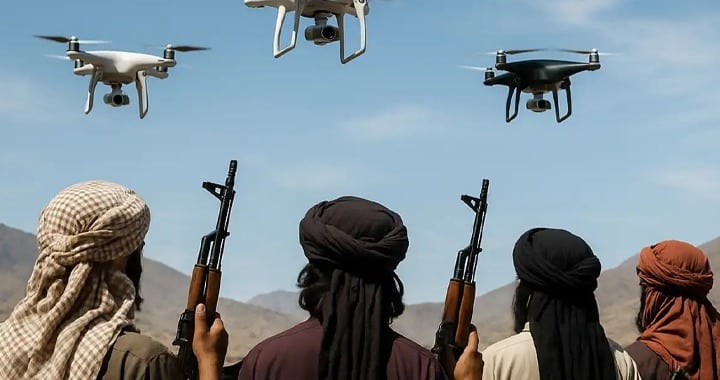
A significant shift in the security landscape is emerging across Khyber Pakhtunkhwa (KP), where terrorist groups are increasingly adopting commercially available quadcopter drones to conduct attacks, signaling the rise of a new phase of drone-led asymmetric warfare in Pakistan’s northwestern region.
According to official provincial police data, terrorists have carried out at least 246 drone-related attacks across KP so far this year, reflecting a sharp escalation compared to previous years and raising serious concerns among security officials and regional analysts.
The Bannu region recorded the highest number of incidents, with 215 reported attacks, making it the primary hotspot of the evolving drone threat. The Dera Ismail Khan region reported 15 attacks, followed by Malakand with seven incidents and Peshawar with four. Mardan and Kohat each recorded two attacks, while Hazara reported one incident.
Separate assessments indicate that at least 50 alleged quadcopter strikes targeted civilians, intensifying fears over the expanding use of aerial attacks beyond direct confrontations with security forces.
Inspector General of Police Khyber Pakhtunkhwa, Zulfiqar Hameed, acknowledged the growing threat, stating that rapid technological developments worldwide have significantly altered Pakistan’s internal security environment.
“Last year, drone attacks were limited to a few dozen, but this year the number has risen into the hundreds,” he said, describing the trend as an alarming evolution in terrorist tactics.
Security analysts note that terrorist groups are increasingly abandoning conventional battlefield strategies in favor of remote-controlled aerial operations that reduce direct exposure while maximizing psychological and operational impact.
Senior journalist and regional security observer Rifatullah Orakzai stated that drone warfare in Pakistan traces back to the first reported U.S. drone strike in 2004, which fundamentally altered the operational behavior of terrorist groups in the region.
“Terrorists would often scan the skies before emerging from their hideouts due to fears of surveillance or aerial strikes,” he said. According to Orakzai, sustained aerial operations by state actors eventually compelled terrorist groups to acquire and adapt similar technologies for their own use.
Experts warn that the accessibility of commercial quadcopters has accelerated this transition. Rahim Nasari, a PhD scholar specializing in regional security, stated that terrorists are now increasingly relying on modified drones capable of bypassing traditional checkpoints and conducting targeted strikes from a distance.
“These tactics provide asymmetric advantages by reducing operational risks for terrorists while increasing pressure on security forces,” Nasari said.
Analysts further note that commercially available drones ranging between $200 and $1,000 remain widely accessible in local markets despite regulatory restrictions, with many devices originating from international manufacturers.
Security observers also point to developments following the U.S. withdrawal from Afghanistan in 2021, which reportedly enabled black-market access to advanced equipment and facilitated the transfer of operational knowledge across regional terrorist networks.
According to regional assessments, some terrorist factions have begun recruiting technicians and specialists capable of modifying drones to carry explosives, mortar shells, grenades, and improvised projectiles.
Concerns intensified further after the banned Tehreek-e-Taliban Pakistan (TTP) announced the establishment of a specialized operational wing referred to as the “Air Force” in December 2025, fueling fears regarding the institutionalization of drone warfare tactics among extremist organizations.
Security experts warn that terrorist groups also derive propaganda value from drone operations by publicly claiming successful attacks while denying responsibility for incidents involving civilian casualties, often attempting to undermine public confidence in state institutions.
In response to the growing threat, Khyber Pakhtunkhwa Police confirmed that anti-drone units have now been deployed across most districts following specialized training and technological upgrades.
Inspector General Zulfiqar Hameed stated that authorities have successfully neutralized a large number of attempted drone attacks through advanced counter-drone systems and surveillance mechanisms.
“Most attacks were intercepted or disrupted using anti-drone technology, reflecting improved operational preparedness,” he said.
Authorities also confirmed that several alleged drone training facilities have been dismantled and multiple suspects involved in technical support and training activities have been arrested. Investigations are ongoing to determine procurement channels, financing mechanisms, and cross-border linkages associated with the emerging drone networks.
Security analysts caution that the growing use of quadcopter drones represents one of the most significant tactical evolutions in terrorism across the region in recent years. They warn that if left unchecked, drone-enabled operations could redefine the future battlefield by enabling low-cost, high-impact attacks against both security forces and civilian targets.
Observers stress that the challenge now extends beyond conventional counterterrorism operations and increasingly requires integrated technological, intelligence, and regulatory responses to prevent further escalation of drone-based threats in the region.



