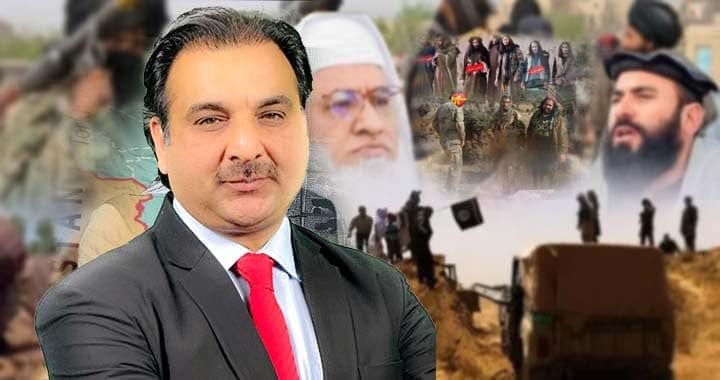
(Irfan Khan)
The battlefield in Pakistan’s northwestern belt is no longer defined by a simple confrontation between the state and militant organisations. It has evolved into a far more dangerous and complex conflict one shaped by fractured alliances, competition for influence, battles over funding, digital propaganda, and psychological warfare. What is unfolding today in Kurram, Bannu, Bajaur, and North Waziristan is not merely a security crisis; it is a multidimensional war where guns, narratives, money, and technology operate together.
Recent statements attributed to the spokesperson of Jamaat-ul-Ahrar, Asad Mansoor, have once again exposed the deep fissures inside the Tehreek-e-Taliban Pakistan (TTP) umbrella. According to the claims, the Noor Wali Mehsud-led faction of the TTP allegedly killed 18 members linked to Jamaat-ul-Ahrar in the Kurram region and abducted 10 others. Whether every detail can be independently verified or not, the implications of such allegations are profound. They reveal an increasingly fractured militant landscape where rival groups are no longer united by ideology alone but divided by power struggles, financial disputes, and internal mistrust.
For years, militant organisations projected an image of cohesion against the Pakistani state. But beneath that surface, intense rivalries have been brewing. These divisions are now becoming visible in alarming ways. The core issue, according to multiple discussions within security circles, revolves around funding and influence. Militancy today is not sustained solely by ideology; it survives through financial pipelines, logistical support, and external sponsorship.
The accusations exchanged among these groups suggest that disputes over the distribution of resources have become a central fault line. Some factions believe they are carrying out more attacks, sacrificing more operatives, and generating greater operational impact, yet receiving a smaller share of support and resources. In militant ecosystems, such grievances quickly turn deadly. Loyalty becomes transactional, and alliances become temporary arrangements rather than ideological commitments.
This internal fragmentation is not entirely new. The killing of Khalid Khurasani in 2022 had already triggered accusations against elements within the TTP leadership. At the time, suspicions and conspiracy theories spread rapidly among militant circles, further deepening mistrust. Today, those unresolved tensions appear to be resurfacing with greater intensity.
Yet the more alarming dimension lies in the external environment surrounding these organisations. In Pakistan’s security discourse, there has long been concern about foreign intelligence involvement in destabilising the region. Allegations repeatedly surface regarding hostile intelligence networks exploiting militancy to weaken Pakistan’s internal stability. Whether these claims involve regional rivalries, proxy warfare, or broader geopolitical competition, one reality is undeniable: instability in Pakistan’s tribal belt serves the strategic interests of multiple actors in a highly volatile region.
Pakistan occupies a critical geopolitical position. It sits at the intersection of South Asia, Central Asia, and the Middle East while simultaneously maintaining strategic partnerships with powers such as China. In such an environment, security instability is never viewed in isolation. Militancy becomes intertwined with regional competition, economic corridors, and international strategic calculations.
The consequences of this conflict are most visible in places like Bannu and Bajaur, where security operations continue under immense pressure. Reports from these regions indicate that militants are increasingly targeting police forces rather than limiting attacks to military installations. This shift reflects a deliberate strategy.
The police represent the state’s most visible civilian security structure. Unlike the military, which often operates in concentrated deployments, police personnel remain embedded within communities. Attacking them achieves multiple objectives for militants: it weakens morale, spreads fear among local populations, disrupts governance, and creates the perception that the state is unable to protect even its own frontline institutions.
The challenge, however, is structural as much as operational.
Pakistan’s police forces, particularly in conflict-prone regions, were historically designed to manage conventional law-and-order issues theft, disputes, local crimes, and community policing. They were not originally structured to confront heavily armed insurgent networks equipped with modern weapons, sophisticated communications systems, and guerrilla warfare tactics.
Today, policemen in Khyber Pakhtunkhwa are often expected to perform tasks that resemble counterinsurgency warfare. They face suicide bombers, ambushes, improvised explosive devices, sniper attacks, and coordinated assaults. Yet questions remain about whether they possess the necessary training, technology, intelligence support, and protective infrastructure required for such an environment.
This is where the state faces a serious policy dilemma.
If the police are expected to stand as the first line of defence against militancy, then they must be transformed accordingly. Recruitment alone is insufficient. Counterterrorism policing requires specialised training, surveillance capabilities, digital monitoring systems, modern weaponry, psychological resilience programs, and rapid-response mechanisms.
Militant groups are no longer fighting twentieth-century wars. They are adapting quickly to modern conflict environments. They use encrypted communications, drones, quadcopters, digital editing tools, and social media ecosystems to shape narratives and manipulate perceptions. In contrast, many local policing systems remain trapped within outdated institutional structures.
The information battlefield has become just as important as the physical battlefield.
One of the most dangerous weapons used by militant organisations today is propaganda. History shows that propaganda has always accompanied warfare. During World War II, propaganda machines shaped public emotions, mobilised populations, and influenced perceptions globally. But in the digital age, propaganda has become faster, cheaper, and infinitely more powerful.
Militant propaganda no longer depends on pamphlets or underground radio stations. It now spreads through Facebook pages, encrypted messaging platforms, AI-assisted video editing, manipulated imagery, and coordinated social media campaigns. A single fabricated video can travel across thousands of phones within minutes, creating panic before authorities even respond.
Recent examples from North Waziristan and Bajaur illustrate this tactic clearly. False or exaggerated reports about mass resignations within police forces, territorial takeovers, or operational victories are circulated deliberately to create fear and confusion. The objective is psychological warfare. When militants fail to achieve strategic military victories, they attempt to create the illusion of dominance through information manipulation. Propaganda becomes a substitute for battlefield success.
This strategy serves several purposes simultaneously.
First, it undermines public confidence in state institutions. If citizens begin believing that militants are stronger than the state, fear itself becomes a weapon. Second, propaganda attempts to demoralise security personnel. Constant exposure to exaggerated narratives of militant power can psychologically affect frontline officers and their families. Third, it helps militants recruit sympathisers and supporters by portraying themselves as victorious, resilient, and unstoppable. Fourth, propaganda distracts attention from internal divisions. While factions fight each other over influence and funding, carefully crafted media narratives attempt to project unity and strength. The digital sophistication of modern militant propaganda raises another critical question: who is producing this content?
Many militants operating in remote mountainous regions possess neither advanced technical expertise nor access to sophisticated editing infrastructure. Yet the propaganda videos appearing online often display professional editing, coordinated messaging, and advanced digital manipulation techniques. This suggests the involvement of technically trained networks operating beyond traditional militant hideouts. Whether such support emerges from sympathisers, transnational extremist ecosystems, cyber operatives, or external actors, the digital infrastructure behind these campaigns cannot be ignored.
The challenge for Pakistan’s security apparatus is therefore not limited to physical counterterrorism operations. It also requires a comprehensive digital counterinsurgency strategy. Counterterrorism in the modern era demands cyber monitoring, online narrative disruption, rapid fact-checking mechanisms, AI-assisted intelligence analysis, and strategic communication capabilities. Security institutions must respond to propaganda not merely by denying it but by outpacing it with credible information, transparency, and effective public engagement.
At the same time, the state must recognise that military operations alone cannot permanently eliminate militancy. Operations may dismantle networks temporarily, but the long-term solution requires governance, economic opportunity, education, and institutional trust. Regions affected by decades of conflict often become vulnerable to militant influence because of persistent instability, unemployment, weak infrastructure, and limited state presence. Militants exploit these gaps skillfully. They present themselves as alternatives in spaces where governance appears absent or ineffective.
Therefore, strengthening civilian institutions is just as important as conducting security operations. Pakistan also faces another crucial challenge: avoiding complacency in the information age. In today’s world, wars are no longer fought solely on mountains or streets. They are fought on screens, timelines, and algorithms. Public perception can shape national security outcomes as much as military engagements.
The state, media, civil society, and technology experts must work together to build resilience against disinformation campaigns. Citizens must also develop digital literacy to distinguish between verified information and manipulated narratives.
At a broader level, the fragmentation inside militant organisations may offer both risks and opportunities. On one hand, internal rivalries can weaken militant cohesion and create operational vulnerabilities. Fragmented groups often become consumed by infighting, distrust, and leadership struggles. On the other hand, fragmentation can also make militancy more unpredictable and dangerous. Smaller factions seeking relevance may resort to more extreme violence, high-profile attacks, or aggressive propaganda campaigns to prove their strength.
This is why Pakistan’s security response must remain adaptive rather than reactive. The events unfolding in Kurram, Bannu, Bajaur, and North Waziristan are warnings that the nature of conflict is changing rapidly. Militancy today operates through a hybrid model that combines insurgency, organised crime, digital warfare, psychological operations, and geopolitical exploitation.
Ignoring any one of these dimensions would be a strategic mistake. The battle is no longer just about territory. It is about narratives, institutions, perception, and endurance. Pakistan’s greatest strength in this difficult moment lies not merely in military capability but in institutional resilience and national unity. Security forces continue to make sacrifices daily, often under extraordinarily difficult conditions. But long-term stability will depend on whether the state can modernise its policing systems, strengthen governance, counter digital propaganda effectively, and restore public confidence in vulnerable regions.
The road ahead is difficult, but clarity is essential: militancy thrives where fear dominates, institutions weaken, and narratives go uncontested.
To defeat modern extremism, Pakistan must win both the physical war and the information war simultaneously.