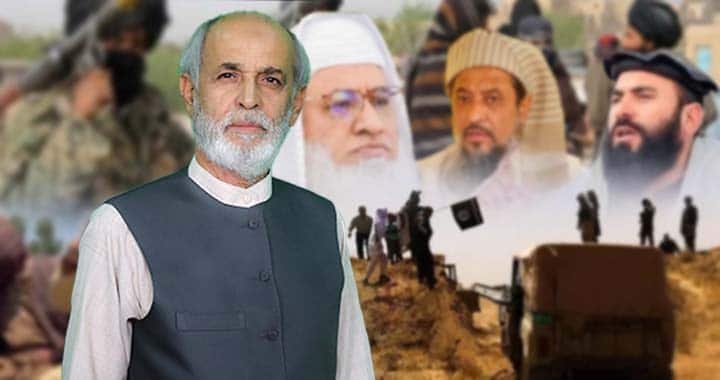
(Shamim Shahid)
The assassination of religious scholar Sheikh Idris is not merely another tragic incident in the long and bloodstained history of Khyber Pakhtunkhwa. It is a message. A warning. A reminder that whenever even a faint possibility of peace emerges between Pakistan and Afghanistan, forces hidden in the shadows move swiftly to sabotage it.
For months, quiet efforts had been underway to reduce tensions between Islamabad and Kabul. Informal contacts among religious scholars, tribal elders, political intermediaries, and influential figures from both sides of the border had intensified. Meetings were reportedly held in China. Religious personalities with influence inside Afghanistan and Pakistan were trying to create a bridge where diplomacy had failed.
From the Afghan side, figures such as Mullah Agha Jan Muhtasim were active. From Pakistan, personalities including Maulana Fazlur Rahman’s associates and scholars like Sheikh Idris were engaged in behind-the-scenes dialogue. These were not random individuals. They were people with social legitimacy, tribal understanding, and religious influence. Unlike bureaucrats sitting in distant offices or diplomats disconnected from the ground realities, these men understood the language of the region, the pain of the people, and the psychology of the fighters.
Then suddenly, the momentum collapsed.
Mullah Agha Jan Muhtasim was reportedly arrested in Afghanistan. In Pakistan, Sheikh Idris was assassinated in a brutal attack later claimed by Daesh. The timing is too significant to ignore. Whenever channels for reconciliation begin to open, violence returns with renewed force.
This pattern is not new.
For nearly five decades, this region has witnessed a continuous cycle of bloodshed. Since the Soviet invasion of Afghanistan, our soil has become a battlefield for competing powers, ideologies, and intelligence interests. Thousands have died — Afghans and Pakistanis alike — yet the war never truly ends. It only changes names, actors, and methods.
In the early years, tribal elders were systematically targeted. Men who possessed authority within their communities, who could unite tribes and prevent chaos, were eliminated one by one. Their deaths weakened the traditional social structure of the tribal belt. Later, political leaders became targets. Leaders of nationalist parties, religious parties, and democratic movements all came under attack. The Awami National Party suffered heavily. The Pakistan Peoples Party lost many workers and leaders. Religious scholars from different schools of thought were assassinated.
This violence has never been random.
The objective has always been the same: to ensure that peace, political stability, and economic normalcy never take root in this region.
When there is peace between Pakistan and Afghanistan, trade grows. Border communities prosper. Extremist groups lose relevance. Foreign interference becomes difficult. Local populations begin to demand education, healthcare, jobs, and development instead of conflict. That is precisely why forces benefiting from instability cannot allow peace to survive.
Today, Khyber Pakhtunkhwa once again stands at a dangerous crossroads.
The rise in militant attacks, targeted killings, bombings, and insecurity shows that terrorism is reorganising itself. Daesh claiming responsibility for Sheikh Idris’ killing is deeply alarming because it signals that the group is attempting to reassert its presence in the region. Alongside Daesh, Tehreek-e-Taliban Pakistan (TTP) remains active, while various facilitators, sleeper networks, and extremist elements continue to operate in different forms.
The question is not whether these groups exist. The question is why they continue to find space to survive.
Part of the problem lies in governance failures and weak security coordination. Sheikh Idris had reportedly been provided security, but clearly it was insufficient. Across Khyber Pakhtunkhwa, there exists a widening distance between the state and the people. Security cannot improve merely through checkpoints, operations, or official statements. Peace cannot be imposed from above. It requires trust between citizens and institutions.
The people of Khyber Pakhtunkhwa have suffered enough to recognise the difference between genuine peace efforts and temporary tactical arrangements. They know that without political ownership and public participation, security operations alone cannot eliminate extremism.
This is why political leadership matters.
Maulana Fazlur Rahman’s position on Afghanistan has often been misunderstood, but one cannot deny that he and leaders from religious parties possess influence within Afghan society. Whether one agrees with their politics or not, they have relationships and communication channels that governments often lack. During different phases of the Afghan conflict, these religious networks maintained contact with Afghan factions and tribal circles.
Pakistan has repeatedly experimented with disconnected diplomatic initiatives involving individuals with little or no social influence inside Afghanistan. Such exercises produce headlines but rarely results. Real dialogue requires people who are trusted by communities on both sides of the border.
If genuine reconciliation is to emerge, then Pakistan must engage those who possess real influence tribal elders, religious scholars, political leaders, and civil society figures who understand the complexities of the region. Peace in this region cannot be manufactured in luxury hotels or foreign conference halls alone. It must be built through local ownership.
At the same time, one must honestly acknowledge a painful reality: there are powerful interests that do not want Pakistan and Afghanistan to normalise relations.
The region remains trapped within a larger geopolitical struggle.
Since the end of the Cold War and especially after the American intervention in Afghanistan, this region has remained strategically important for global powers. The competition involving the United States, China, Russia, and Iran continues to shape regional dynamics. Afghanistan’s geography alone ensures that external powers will continue pursuing influence here.
Many people ask whether America truly wants stability between Pakistan and Afghanistan. The answer is not simple.
The United States publicly speaks about counterterrorism and regional peace, yet contradictions remain visible. Questions persist regarding how various militant structures continue to survive financially and politically despite years of international military presence and intelligence operations. The existence of Taliban political offices abroad, continued international engagement with different factions, and the shifting regional alliances all raise legitimate questions about long-term strategic objectives.
Global powers rarely reveal their complete intentions openly. Their policies evolve according to interests, not emotions or moral arguments.
This is why Pakistan and Afghanistan must eventually understand a simple truth: no external power will prioritise regional peace more sincerely than the people who actually live here.
Unfortunately, mistrust between Islamabad and Kabul continues to deepen. Every terrorist incident quickly becomes a source of accusations. Pakistan blames Afghan-based militants. Afghan authorities reject the allegations. Meanwhile, ordinary people continue to die.
The problem is that investigations rarely satisfy public expectations. Whenever attackers are killed immediately in encounters or operations, doubts emerge. People ask where the evidence is, who financed the attackers, who facilitated them, and which networks were involved. Transparency is essential because without public trust, conspiracy theories flourish.
There is no denying that militants move across borders and maintain historical linkages. During the anti-Soviet jihad and later during the American war in Afghanistan, networks developed that connected fighters, facilitators, financiers, and sympathisers across the region. Some of these relationships still exist. But reducing every act of violence to a simplistic “foreign hand” narrative without credible investigation only weakens public confidence.
The state must present evidence transparently. Terrorism can only be defeated when people trust institutions and believe justice is being pursued honestly.
Equally important is the need for political unity.
Khyber Pakhtunkhwa today requires a broad anti-terror consensus involving all political parties, religious scholars, tribal elders, and civil society. Terrorism cannot be treated as a partisan issue. It threatens everyone regardless of ideology or ethnicity.
After Sheikh Idris’ assassination, there should have been an immediate effort to convene an all-parties conference focused exclusively on security and counterterrorism. Political divisions must not prevent collective action against extremism.
The provincial government also faces a serious challenge. While efforts are being made, security cannot improve unless governance improves simultaneously. Unemployment, lack of opportunities, weak institutions, and political instability create fertile ground for militant recruitment and public frustration.
The people of Khyber Pakhtunkhwa do not want endless war. They want roads, schools, hospitals, trade, and dignity. They want to live without fear of bomb blasts and funerals.
The tragedy is that an entire generation has grown up knowing nothing except conflict.
Children born during the Afghan war are now adults raising children of their own, yet the violence continues. The “great game” that began decades ago still casts a shadow over the region. Different flags may rise and fall, but the ordinary people remain trapped in the same cycle of instability.
Yet despite everything, opportunities for peace still exist.
Backchannel diplomacy between Pakistan and Afghanistan should continue. Religious scholars, tribal elders, and influential social figures must remain engaged. China’s interest in regional stability through economic connectivity could also create incentives for cooperation. Border trade, transit agreements, and regional economic integration can gradually reduce hostility if pursued sincerely.
But none of this will succeed unless both states recognise that security cannot be achieved solely through force.
Military operations may suppress violence temporarily, but lasting peace requires political courage, economic vision, and social reconciliation. Both Pakistan and Afghanistan must stop viewing each other exclusively through the lens of suspicion and strategic depth. Geography has made them neighbours; history and culture have made them interconnected.
Their destinies are tied together whether they like it or not.
If Afghanistan remains unstable, Pakistan will suffer. If Pakistan remains insecure, Afghanistan cannot achieve stability either. Militancy does not recognise borders. Refugee crises do not stop at checkpoints. Economic collapse in one country inevitably affects the other.
That is why the assassination of Sheikh Idris should be treated not only as a security failure but as a warning about the fragile state of regional peace efforts.
Those who benefit from instability understand something very clearly: peace between Pakistan and Afghanistan would transform the entire region.
It would weaken extremist narratives. It would expand trade corridors linking Central and South Asia. It would strengthen local economies. It would reduce the space available to violent non-state actors. Most importantly, it would return hope to millions of ordinary people exhausted by decades of war.
And perhaps that is exactly why peace remains under attack.
The challenge before Pakistan and Afghanistan today is not merely defeating militants. The greater challenge is defeating the politics of perpetual conflict.
If both countries fail to rise above suspicion, mistrust, and external manipulation, then the region may continue drifting toward deeper instability. But if they choose dialogue over confrontation and cooperation over blame, there is still a chance to change the future.
The people on both sides of the Durand Line deserve better than endless funerals, endless accusations, and endless war.
They deserve peace.