
For decades, Afghanistan has been explained through the language of war the Soviet invasion, the civil war, the US intervention, and the Taliban’s return. Each chapter is presented as a turning point. Yet beneath these dramatic shifts lies a far more persistent and less visible reality: Afghanistan’s enduring struggle to reconcile its ethnic diversity with a stable political order.
The instability of Afghanistan did not begin with foreign intervention, nor will it end simply with the withdrawal of external forces. It is rooted in the way the Afghan state was formed, who came to dominate it, and how different communities experienced that dominance.
The foundations of modern Afghanistan are commonly traced to the 18th century under Ahmad Shah Abdali. His consolidation of Pashtun tribes and territorial expansion marked the emergence of Afghanistan as a political entity. It was an extraordinary achievement in a fragmented regional landscape, shaped by tribal loyalty, military strength, and emerging notions of authority. But it also set a historical pattern in which state formation and Pashtun leadership became closely intertwined.
That early structure left a long institutional shadow.
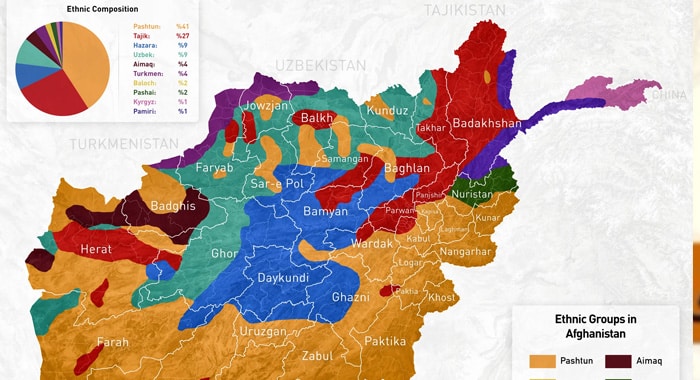
Afghanistan has always been multi-ethnic. Pashtuns form the largest group, followed by Tajiks. Hazaras, Uzbeks, and smaller communities such as Turkmen, Baloch, Aimaq, Pashai, and Nuristanis complete a complex demographic landscape. These identities are not abstract categories; they are geographically rooted and historically sustained. Pashtuns are concentrated in the south and east, Tajiks in the northeast and urban centres, Uzbeks in the north, and Hazaras in the central highlands.
For much of its modern history, Afghanistan functioned not as a fully centralized state, but as a delicate balancing arrangement between the centre in Kabul and regional power structures. Authority was often strongest in major cities, while rural and peripheral areas were governed through negotiation, local influence, and shifting alliances.
Over time, however, a perception became deeply embedded: that political authority in Afghanistan was disproportionately concentrated in Pashtun hands. From monarchy to republic, key positions of power frequently remained within a narrow elite. Even the term “Afghan” historically referred to Pashtuns, creating a linguistic overlap between national identity and one ethnic group. For many Tajiks, Hazaras, and Uzbeks, this overlap reinforced a sense of political and symbolic exclusion.
Yet Afghanistan’s history cannot be reduced to a simple narrative of domination. There were also periods of coexistence, cooperation, and shared resistance against external threats. Leaders from multiple ethnic backgrounds played central roles in national struggles, including the anti-Soviet jihad, which brought together commanders and networks across ethnic lines.
Still, moments of crisis repeatedly exposed the fragility of this balance.
The civil war of the 1990s marked a decisive breakdown. Political and military alliances hardened along communal lines. When the Taliban first rose to power, their leadership base was overwhelmingly Pashtun, rooted primarily in southern Afghanistan. Opposition forces in the north were largely composed of Tajik, Uzbek, and Hazara groups. Ethnic geography and military frontlines became closely aligned, deepening divisions that would shape the country for decades.
After 2001, the internationally supported political order attempted to construct a democratic Afghanistan that reflected its diversity. Elections were introduced, and power-sharing arrangements sought to accommodate different communities. Yet ethnic balance became a permanent feature of governance design. Cabinet appointments, security positions, and provincial authority were frequently distributed with careful attention to communal representation. The system managed tensions, but did not resolve them.
The collapse of the republic in 2021 and the Taliban’s return to power reopened these unresolved questions. Critics argue that insufficient inclusivity risks repeating historical cycles of exclusion and instability. Supporters of the current order emphasize security and centralized control as prerequisites for governance. Beneath both positions lies a deeper question that remains unanswered: can Afghanistan’s political structure genuinely reflect its social diversity?
Ethnic fault lines are further complicated by regional geopolitics. Tajiks share linguistic and cultural ties with Tajikistan. Uzbeks maintain cross-border connections with Uzbekistan. Pashtuns straddle the Durand Line with Pakistan. These transnational linkages have repeatedly influenced political alignments, migration patterns, and security concerns. Instability within Afghanistan rarely remains confined within its borders.
Compounding these challenges is the security dimension. At various points in Afghanistan’s history, fragmented governance and internal divisions have created space for militant networks to operate. While militancy cannot be explained solely through ethnicity, divisions have often weakened the state’s ability to develop a unified response to security threats.
In this context, some analysts have proposed territorial restructuring along ethnic lines as a theoretical solution. The argument suggests that smaller, more homogeneous political units could reduce competition for central power and improve governance at the local level. However, critics caution that such approaches risk triggering new conflicts, displacement, and broader regional instability, potentially replacing one set of fault lines with several new ones.
A more viable path may lie elsewhere not in fragmentation, but in inclusion. Genuine decentralization, equitable political representation, and constitutional protections for minority communities could help reduce the zero-sum nature of Afghan politics. When power is concentrated, every political transition becomes existential. When authority is shared, political competition becomes more manageable.
Afghanistan’s ethnic divisions are neither artificial nor temporary. They are historically embedded and socially real. But they do not have to determine the country’s future trajectory.
The core challenge is not simply to defend Afghanistan’s territorial integrity or redraw its borders, but to build a political system in which all communities see themselves reflected in the state. Stability will not emerge from suppressing identity differences, nor from privileging one group over others. It will emerge from a framework that treats diversity as a structural reality to be governed, not a problem to be eliminated.
Afghanistan has endured empire, occupation, revolution, and civil war. Yet its most enduring struggle has remained internal: the search for a political order that feels genuinely shared.
Until that balance is achieved, the fault lines beneath the Afghan state will persist. The task ahead is not to deny them, but to construct a system strong enough and inclusive enough to hold them together.



