
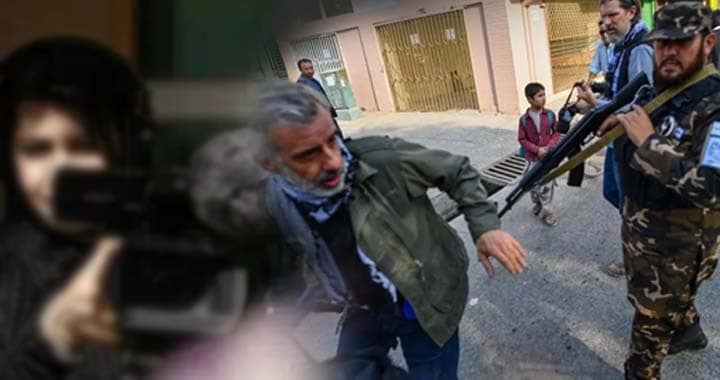
On a day meant to celebrate the power of free expression, a carefully staged gathering in Afghanistan offered a quieter message, one not spoken aloud but impossible to miss.
In Kabul, the Taliban’s Ministry of Interior marked World Press Freedom Day with a meeting of journalists, but the official communication told its own story. The word “freedom” was missing. The event was instead referred to simply as “World Press Day”, a subtle edit that carried heavy meaning in a country where the space for independent voices continues to shrink.
Images released by ministry spokesperson Abdul Matin Qani showed rows of attendees, all males. Not a single woman appeared among the journalists invited to the discussion. In a nation where women once anchored newsrooms, hosted debates, and reported from the field, their absence now feels less like coincidence and more like policy made visible.
Qani, in his remarks, described media as “the awakened brain of society and the echo of civilized nations,” acknowledging the importance of journalism in shaping public awareness. Yet, the same statement stressed that media activity must operate “in the light of Islamic values,” a phrase repeatedly invoked by the Taliban to justify regulatory control across sectors.
The Disappearing Half of the Story
What unfolded at this event reflects a broader transformation of Afghanistan’s media landscape. Over recent years, sweeping restrictions have tightened the boundaries of journalistic work. Independent outlets have faced mounting pressure, with reports indicating that publications increasingly require prior approval before dissemination.
The most striking shift has been the near-total erasure of women from the media sphere. Once visible as reporters, anchors, and editors, women journalists have gradually been pushed out through a mix of formal bans, workplace restrictions, and an environment that makes participation nearly impossible. The absence seen in the Kabul meeting is not an isolated moment but the culmination of a systematic rollback of women’s presence in public life.
Concerns over press freedom are also reflected in global assessments. Reporters Without Borders ranked Afghanistan 175th out of 180 countries in its 2026 Press Freedom Index, placing it among the most restrictive environments for journalism worldwide.
At the same time, accountability mechanisms remain under strain. Richard Bennett has noted that journalists continue to face detention, with at least four media workers reportedly still in custody. Such developments reinforce fears that the boundaries of permissible reporting are being enforced not just through policy, but through coercion.
Subheading: Freedom in Name, Control in Practice
The contrast between rhetoric and reality is hard to ignore. While officials speak of the media as a pillar of society, the conditions under which journalists operate suggest a far narrower vision, one where dissent is muted and participation is selective.
Removing the word “freedom” from an international observance might appear symbolic, but symbols matter. They signal intent, define limits, and shape expectations. When paired with the exclusion of women and the continued detention of journalists, the symbolism begins to resemble a doctrine.
In today’s Afghanistan, the press still exists, but its contours are tightly drawn. And as the chairs at official gatherings fill without women, and the language of freedom quietly disappears from public statements, the story of Afghan media becomes less about what is reported, and more about what is no longer allowed to be seen or heard.



