
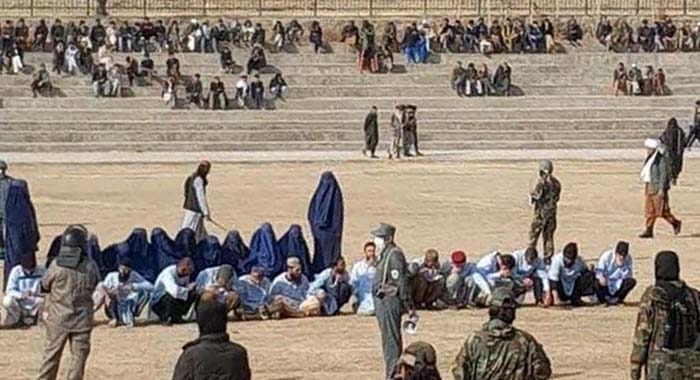
The Taliban regime has intensified its use of public corporal punishment across Afghanistan, with its Supreme Court confirming the flogging of six individuals, including two women, in Samangan and Balkh on charges ranging from alleged extramarital relations to so-called moral offenses.
According to official statements, the punishments were carried out publicly in the presence of local authorities, clerics, security personnel, and residents, reinforcing a pattern of highly visible enforcement measures.
In the past 48 hours alone, at least 20 more individuals were subjected to public flogging in multiple provinces, including Faryab, Daikundi, Herat, and Jawzjan, highlighting the expanding scope of such practices under the current regime.
Human rights observers have raised serious concerns over the scale and nature of these punishments. Reports indicate that over the past year, hundreds of individuals have been subjected to corporal punishment, including floggings, alongside instances of capital sentences and other severe penalties.
The continuation of such measures comes despite sustained criticism from international organizations, which have consistently called for an end to practices considered cruel, inhuman, and degrading.
Analysts note that the Taliban’s reliance on public punishments reflects a broader governance approach centered on coercive enforcement rather than institutional legal standards. The regime maintains that these actions are carried out under its interpretation of Islamic law, a stance that has further deepened its isolation on the global stage.
The developments underscore the widening gap between the Taliban’s internal policies and internationally recognized human rights norms, raising concerns about the long-term implications for Afghan society and regional stability.



