
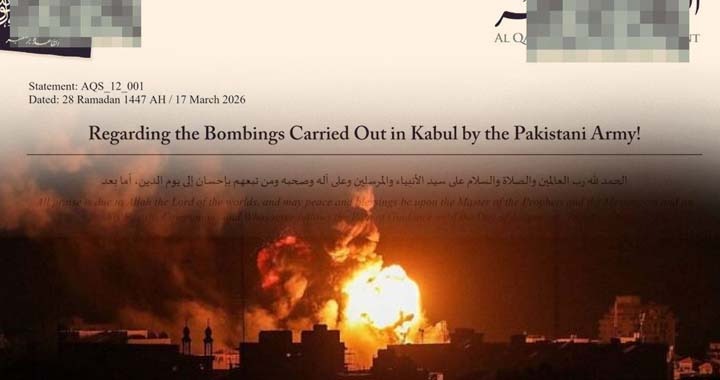
Al-Qaeda has issued a statement condemning recent Pakistani airstrikes in Kabul, marking a rare public reaction from the group following reported attacks on militant infrastructure inside Afghanistan.
According to the statement released by Al-Qaeda’s South Asian branch, Pakistani aircraft carried out strikes on the night of March 16 and 17, 2026, targeting locations in the Afghan capital. The group alleged that the strikes hit a “rehabilitation center” and claimed that hundreds of people were killed or injured.
The claims echo the narrative put forward by the Afghan Taliban authorities, who have also accused Pakistan of causing significant civilian casualties in the strikes. However, these assertions remain unverified, with no independent confirmation of the scale or nature of the reported losses.
Pakistani military officials, on the other hand, maintain that the operation was a precision-targeted effort against militant infrastructure. According to security sources, the strikes were aimed at terrorist safe havens, weapons depots, and logistical facilities linked to groups operating against Pakistan from Afghan territory.
Officials further stated that a significant number of militants, including members of Al-Qaeda and the banned Tehreek-e-Taliban Pakistan (TTP), were killed in the strikes. The targets reportedly included locations associated with weapons storage and operational planning.
The development underscores the continued presence and activity of transnational militant networks in Afghanistan, despite repeated denials by Taliban authorities that Afghan soil is being used by such groups.
Competing Narratives After the Strikes
The contrasting claims highlight the growing information contest surrounding cross-border military actions. While militant groups and Taliban authorities have framed the strikes as attacks on civilian facilities, Pakistani officials insist they were directed at high-value militant targets with efforts to minimize collateral damage.
Analysts note that such divergence in narratives is common in modern conflicts, where immediate claims often outpace independent verification. Calls for access to neutral observers or international media have yet to materialize, leaving key aspects of the incident unclear.
The statement by Al-Qaeda is being seen by some observers as an indication of the impact of the strikes on militant networks, particularly if senior operatives or infrastructure were affected.
Tensions between Islamabad and Kabul have remained elevated in recent weeks, with Pakistan repeatedly accusing militant groups of using Afghan territory to launch cross-border attacks. Taliban authorities have rejected these claims.
As the situation develops, the lack of verifiable information continues to complicate assessments, while competing narratives shape both domestic and international perceptions of the incident.



