
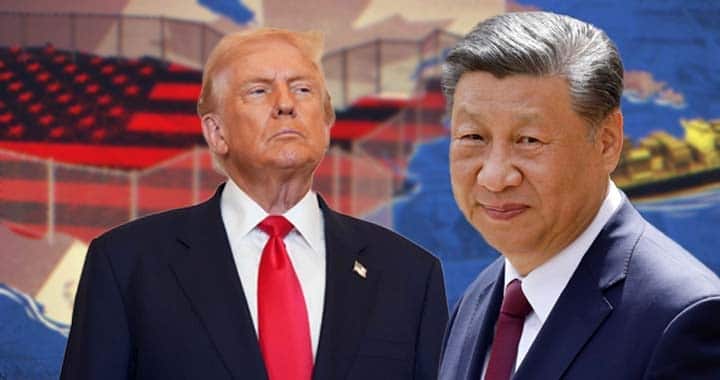
The meeting between Chinese President Xi Jinping and U.S. President Donald Trump in Beijing projects an image of diplomatic warmth, but beneath the carefully staged optics lies a familiar reality: competition between the world’s two largest powers is being managed, not resolved.
Public statements from both leaders emphasized cooperation, mutual respect, and the possibility of working together for global stability. Xi’s framing of parallel national aspirations and Trump’s emphasis on constructive engagement suggest an attempt to stabilize ties after periods of friction. Yet the substance of the engagement points less toward reconciliation and more toward tactical containment of tensions.
At the center of the conversation remains a structural contradiction. Economic interdependence continues to bind Washington and Beijing, even as strategic distrust deepens across military, technological, and geopolitical domains. The language of partnership, therefore, functions more as diplomatic scaffolding than as evidence of alignment.
The most sensitive fault line remains Taiwan. Xi’s warning that “Taiwan independence and peace cannot coexist” reflects Beijing’s unchanged red line, one that continues to define the upper limit of any US–China understanding. While such statements are not new, their repetition in a high-level bilateral setting signals that core disputes remain firmly unresolved despite broader diplomatic engagement.
For Washington, engagement with Beijing continues to be shaped by a balancing act between economic pragmatism and strategic competition. Trump’s emphasis on trade expansion and future cooperation reflects the economic dimension of the relationship, but it does not erase underlying policy divergences on security and regional influence.
Another layer shaping the backdrop is the broader global environment, where multiple crises, including instability in the Middle East and disruptions in global supply chains, are pushing major powers toward selective cooperation. These shared pressures create incentives for dialogue, even when trust remains limited.
What emerges from the Beijing meeting, therefore, is not a strategic breakthrough but a managed pause in escalation. Both sides appear willing to stabilize the relationship at the surface level while preserving their core positions underneath.
In this sense, the encounter reflects a modern pattern in great-power diplomacy: not resolution of contradictions, but containment of them within controlled political space. The result is a relationship defined less by convergence and more by calibrated coexistence, where cooperation and rivalry continue to operate simultaneously.



