
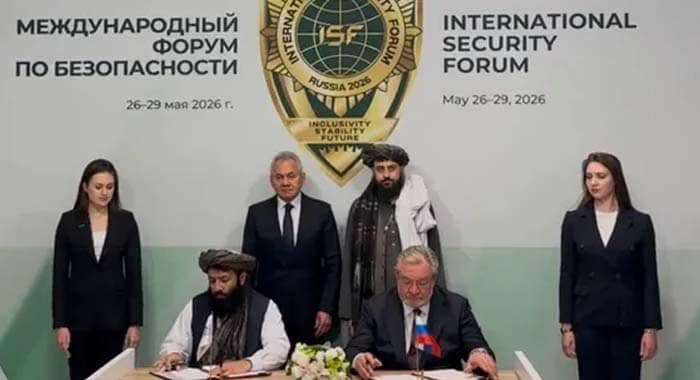
Russia’s expanding military and security engagement with Afghanistan’s Taliban government represents one of the most consequential and paradoxical geopolitical developments in Eurasia since the Taliban’s return to power in August 2021. Recent agreements formalised during Taliban Defence Minister Mullah Mohammad Yaqoob’s visit to Moscow have cemented cooperation across security, military-technical exchanges, and high-level political engagement, signalling that Moscow regards the Taliban as a durable, if deeply problematic, partner.
The pace and depth of this engagement has accelerated despite or perhaps because of Afghanistan’s profound fragility. With a population approaching 42 million, over 63 per cent of whom are under 25, and more than 85 per cent living at or below the poverty line, Afghanistan presents a governance and humanitarian crisis of extraordinary scale. Despite vast untapped mineral wealth including lithium, cobalt, copper, rare earth elements, iron ore, and gold the country remains critically dependent on foreign assistance and the informal economy. These structural conditions, analysts note, provide precisely the fertile ground upon which extremist networks have historically thrived.
What makes Moscow’s engagement especially striking is the candour and alarm with which Russia’s own institutions describe Afghanistan’s security landscape. These are not the assessments of rival powers seeking to undermine Russian interests they are the findings of Russia’s most senior security officials.
According to the Russian Foreign Ministry’s most recent estimates, Afghanistan currently hosts between 20,000 and 23,000 terrorists affiliated with more than twenty extremist organisations. These include approximately 3,000 ISIS-Khorasan (ISIS-K) militants and between 5,000 and 7,000 members of the Tehrik-i-Taliban Pakistan (TTP). Russian officials further assess that more than half of these militants are foreign nationals originating from Central Asia, the Middle East, South Asia, and the Caucasus.
On 14 May 2026, Sergey Shoigu, Secretary of Russia’s Security Council, described Afghanistan as one of the most significant security threats facing the region, warning of a growing influx of Uyghur, Uzbek, Tajik and other foreign fighters — many of them transiting from Syrian conflict zones into Afghan territory. Shortly thereafter, Alexander Bortnikov, Director of the Federal Security Service (FSB), warned that ISIS-K was actively constructing clandestine extremist networks throughout the CIS, actively recruiting from Tajikistan, Uzbekistan, Kyrgyzstan, Kazakhstan and even Russian migrant communities.
Earlier warnings were no less stark. On 23 July 2024, Russian Deputy Foreign Minister Sergey Vershinin stated that terrorist organisations linked to Afghanistan were actively seeking expansion into neighbouring regions and establishing new operational footholds beyond existing conflict zones. The 7th Moscow Format Consultations on Afghanistan produced a formal Russian Foreign Ministry statement calling for the complete eradication of terrorist organisations operating within Afghan territory an implicit acknowledgement that no such eradication has yet occurred.
Crucially, Russia’s alarming assessments are not outliers. They are reinforced by a comprehensive body of independent international monitoring:
The UNSC Analytical Support and Sanctions Monitoring Team in its 35th, 36th, and 37th reports has consistently documented the presence of more than twenty terrorist organisations within Afghanistan. The reports highlight continued Al-Qaeda affiliate activity, strengthening TTP capabilities, the persistent threat from ISIS-K, and the ongoing provision of safe havens under Taliban governance. The 16th Report of the UN Secretary-General on the Threat Posed by ISIL (Da’esh) identified Afghanistan as one of the world’s principal centres of terrorist recruitment and extremist networking, noting that ISIS-K continues to attract foreign fighters from across Central Asia, South Asia, and the Middle East.
The US Special Inspector General for Afghanistan Reconstruction (SIGAR) has arrived at similarly alarming conclusions in its 66th and 68th Quarterly Reports, documenting terrorist safe havens, extremist operational freedom, and proliferation risks associated with military equipment abandoned following the 2021 withdrawal of US and NATO forces. Military equipment valued at approximately $7 billion remained in Afghanistan following the withdrawal. Multiple intelligence assessments have since documented instances of weapons and equipment originally supplied to Afghan security forces appearing in the hands of militant organisations operating across the region.
The Shanghai Cooperation Organisation (SCO), through its Regional Anti-Terrorist Structure (RATS), and the Collective Security Treaty Organisation (CSTO) have both formally identified Afghanistan as a major source of terrorism, extremism, and narcotics trafficking. CSTO warnings have specifically addressed the increasing risks to Central Asian member states resulting from extremist infiltration and cross-border militant activity precisely the risks that Russia’s engagement with the Taliban is ostensibly intended to manage.
For Pakistan, the strategic stakes could scarcely be higher. Russian Foreign Ministry assessments estimate that between 5,000 and 7,000 TTP militants are currently operating from Afghan territory. UN Monitoring Team reports have repeatedly documented TTP recruitment, training, and operational planning activities inside Afghanistan. Pakistani security assessments indicate that more than 600 terrorist attacks and cross-border incidents were launched from Afghan territory during 2025 alone a figure that represents a dire and ongoing security emergency.
The threat extends well beyond Pakistan’s borders. Tajikistan’s 1,357-kilometre border with Afghanistan remains acutely vulnerable to infiltration, and Dushanbe has repeatedly raised concerns at regional forums. Beijing continues to monitor the activities of the East Turkestan Islamic Movement (ETIM) and affiliated extremist groups operating near the strategically sensitive Wakhan Corridor. Central Asian governments increasingly view northern Afghanistan as a potential launchpad for destabilisation across the region a judgement that is formally reflected in SCO and CSTO threat assessments.
Against this backdrop, Russia’s expanding military cooperation with the Taliban appears to many analysts as strategically paradoxical a calculated gamble whose risks are openly acknowledged within the Kremlin’s own security apparatus. Proponents of engagement argue that maintaining direct channels with Kabul provides Moscow with leverage, intelligence access, and opportunities to shape Taliban behaviour. Others suggest Russia seeks to prevent Afghanistan from falling exclusively within the sphere of influence of rival powers, while preserving its strategic footprint across Central and South Asia.
However, these strategic calculations do not dissolve the underlying contradiction. The Russian government continues to warn the international community that Afghanistan represents a major hub of terrorism, extremist recruitment, narcotics trafficking, and foreign fighter activity while simultaneously strengthening formal relations with the regime that governs that environment. The contradiction sharpens further in a military context: deepening defence cooperation with a government presiding over territory that hosts over twenty terrorist organisations raises serious questions of oversight, accountability, and the potential for unintended or intended consequences.
What is clear is that this is not merely a foreign policy experiment. Russia’s Taliban engagement represents a test of whether geopolitical influence can be pursued without compromising counterterrorism principles. If the engagement succeeds in producing genuine and verifiable Taliban action against extremist organisations, Moscow may credibly claim a strategic victory. If it fails or if military cooperation is exploited by the very networks Russia has publicly identified as existential threats Russia risks having materially strengthened a regime while simultaneously confronting the consequences.



