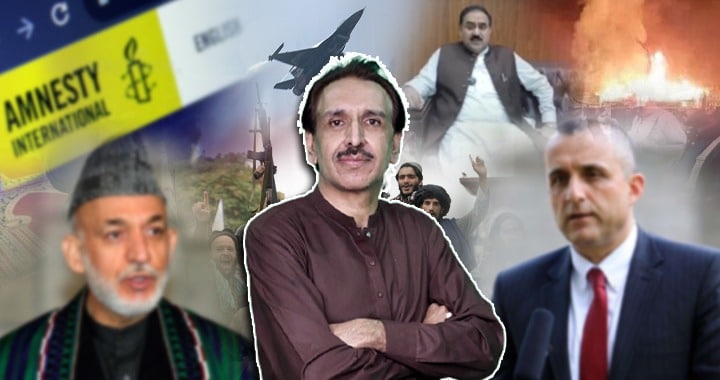
The debate surrounding Amnesty International’s recent report on Pakistan’s airstrikes inside Afghanistan once again demonstrates how difficult it has become to discuss security issues in our region without selective narratives dominating international discourse. Every civilian life is precious. Every allegation involving civilian casualties deserves careful examination. Yet any serious discussion about civilian protection must begin with an equally serious examination of the circumstances that produce military action in the first place. Ignoring one side of the equation while amplifying the other does not strengthen human rights, it weakens credibility.
Those of us who have spent decades reporting on Afghanistan, terrorism, insurgencies and regional security know that no conflict can be understood by examining isolated incidents alone. The story neither begins with an airstrike nor ends with casualty figures. It begins with the security environment that made such operations possible and, unfortunately, necessary.
For more than two decades following the events of September 11, Afghanistan remained the focal point of the world’s largest military and political experiment. Trillions of dollars were spent, thousands of international personnel were deployed, and countless institutions were created under the banner of rebuilding a modern Afghan state. Yet when the dust settled, many of those institutions proved incapable of sustaining themselves. Administrative structures remained weak, corruption became deeply institutionalized, and militant organizations continued to survive despite unprecedented international attention.
This historical context is rarely acknowledged when reports such as Amnesty International’s are released.
Ironically, Amnesty itself has, in the past, documented widespread corruption within Afghanistan’s political system. During the Hamid Karzai era, reports highlighted serious concerns regarding governance, corruption and institutional failures. Afghan state institutions, members of parliament and numerous public bodies were criticized for administrative irregularities and systemic corruption. Those findings were not controversial because they reflected realities that many Afghan citizens themselves openly discussed.
Today, however, the same organization appears willing to narrow its focus almost exclusively to allegations against Pakistan while paying comparatively limited attention to the ecosystem of terrorism that continues to operate from Afghan territory.
This selective emphasis naturally raises questions.
International organizations undoubtedly perform an important role in documenting abuses, encouraging accountability and advocating for civilian protection. Their work becomes valuable only when it is perceived as impartial. Once reports appear to examine one side while overlooking equally important dimensions of a conflict, public confidence inevitably declines.
The issue here is not whether allegations should be investigated. Any credible allegation deserves examination through appropriate legal and institutional mechanisms. The question is why certain issues consistently receive disproportionate attention while others remain largely absent from the conversation.
For years Pakistan has maintained that terrorist organizations operating from Afghan territory have repeatedly targeted its civilians, security personnel and critical infrastructure. These concerns have not been raised only by Pakistan. Various United Nations reports have repeatedly acknowledged the continued presence of multiple terrorist organizations inside Afghanistan, including the banned Tehreek-e-Taliban Pakistan (TTP), which has consistently been identified as one of the most active groups threatening Pakistan’s internal security.
These documented concerns deserve the same degree of international attention as allegations regarding military operations.
Instead, the international conversation often begins after an operation takes place rather than asking why such operations become necessary in the first place.
That is where the discussion becomes incomplete.
Former Afghan officials have themselves acknowledged the existence of militant infrastructure inside Afghanistan. Public statements, interviews and media discussions by former senior Afghan security figures have repeatedly referred to the operational presence of various militant organizations across different provinces. These are not claims originating solely from Pakistani officials or analysts. Many such observations have entered public discourse through Afghan political figures, journalists and former members of Afghanistan’s own security establishment.
When experienced Afghan officials publicly warn about the operational space enjoyed by terrorist organizations, such statements deserve careful consideration rather than selective omission.
Another aspect that deserves greater attention is the deliberate strategy adopted by many terrorist organizations worldwide. These groups rarely establish infrastructure in isolated deserts or abandoned mountains alone. Increasingly, they seek shelter within populated communities or operate in close proximity to civilian areas precisely because they understand the operational constraints faced by state forces.
This creates one of the most painful dilemmas in modern counterterrorism.
Governments have an obligation to protect their own citizens from terrorism while simultaneously minimizing civilian casualties during security operations. Achieving both objectives is extraordinarily difficult when terrorist organizations deliberately exploit civilian environments.
Unfortunately, reports that discuss only the consequences of military operations without adequately examining the tactics employed by terrorist organizations risk presenting an incomplete picture.
The conversation should therefore extend beyond military actions themselves.
It should also ask difficult questions about those who recruit young men across borders, provide logistical support, establish safe houses, finance extremist networks and repeatedly launch attacks against civilians and security personnel.
Human rights cannot be selective.
The rights of civilians living in Afghanistan deserve protection.
Equally, the rights of Pakistani civilians repeatedly targeted by cross-border terrorism deserve recognition.
Families who lose loved ones in mosques, markets, schools, police stations and military installations also deserve international empathy. Their suffering cannot become invisible simply because it occurs on the opposite side of the border.
One of the recurring weaknesses in international reporting has been its tendency to isolate military responses from the broader security environment. Every counterterrorism operation is examined under intense scrutiny, yet the terrorist infrastructure that precedes such operations often receives only passing mention.
This imbalance inevitably shapes public perception.
An ordinary reader unfamiliar with regional realities may conclude that military operations emerge in a vacuum. Those of us who have covered this conflict for decades know otherwise.
Every operation has a context.
Every military response has a preceding chain of terrorist planning, recruitment, infiltration and violence.
If international institutions genuinely seek lasting peace, they must devote equal intellectual energy to understanding the networks that perpetuate violence rather than concentrating almost exclusively on the responses those networks provoke.
That is where any meaningful discussion on civilian protection truly begins, not where it ends.
A similar imbalance is visible much closer to home, particularly in the debate surrounding terrorism in Khyber Pakhtunkhwa. After months of escalating attacks, official statements have finally begun acknowledging the seriousness of the threat. Recognition is certainly welcome, but acknowledgment alone cannot substitute for a coherent and comprehensive counterterrorism policy.
Terrorism in Khyber Pakhtunkhwa is no longer merely a provincial law and order issue. It has evolved into a multidimensional national security challenge with regional and international implications. Cross-border infiltration, recruitment networks, ideological indoctrination, financial support and operational planning rarely respect administrative boundaries. Any attempt to treat attacks in Bannu, Bajaur, Hangu, Kurram, North Waziristan, Dera Ismail Khan or Upper Dir as isolated local incidents fundamentally misunderstands the nature of the threat.
During the past several months, almost every major district bordering Afghanistan has witnessed security incidents of varying intensity. Police personnel, members of peace committees, civilians and security forces have all paid a heavy price. Yet the official response has often appeared reactive rather than strategic.
Counterterrorism demands sustained political ownership.
The security forces continue to carry an enormous operational burden, conducting intelligence-based operations, dismantling terrorist infrastructure and disrupting infiltration routes. Their operational achievements speak for themselves. However, military operations alone cannot eliminate terrorism unless accompanied by unified political direction, institutional coordination and administrative preparedness.
That is where provincial governance assumes critical importance.
One of the strongest institutional mechanisms available for coordinated decision-making remains the Apex Committee, where elected leadership, the military, intelligence institutions, civil administration and relevant departments collectively assess evolving security challenges and formulate integrated responses.
In periods of heightened terrorist activity, such coordination becomes indispensable rather than optional.
Counterterrorism cannot succeed when security institutions move in one direction while political leadership appears distracted by competing priorities. National security requires consistency, clarity and above all, unity of purpose.
The same principle becomes even more evident when one compares developments in Balochistan.
No serious observer would claim that Balochistan’s security challenges are smaller. On the contrary, hostile external actors, separatist violence, proxy warfare and cross-border facilitation have combined to produce one of the most complex security environments in the region. Civilian transport has been attacked, public infrastructure targeted and both security personnel and innocent citizens have repeatedly become victims of terrorism.
Yet despite these challenges, one important distinction remains visible.
There appears to be considerably greater institutional coordination among the provincial administration, the federal government and the security establishment. Differences undoubtedly exist, but the overall strategic direction has generally remained aligned.
Such cohesion matters.
Terrorist organizations closely monitor political divisions. Whenever they perceive confusion, institutional fragmentation or inconsistent messaging, they attempt to exploit those weaknesses. Conversely, unified political and security responses significantly complicate terrorist planning.
The regional dimension should also never be underestimated.
The mountainous terrain stretching from eastern Afghanistan through parts of Khyber Pakhtunkhwa and into northern Balochistan presents enormous operational challenges. These geographical realities have historically been exploited by terrorist organizations seeking mobility across difficult terrain.
Fortunately, Pakistani security institutions have accumulated extensive operational experience over the past two decades. Their understanding of infiltration routes, logistical corridors and militant tactics has evolved considerably. Recent intelligence-based operations conducted across multiple districts demonstrate increasing operational coordination and precision.
That experience remains one of Pakistan’s greatest strengths.
However, long-term success cannot rest solely upon the shoulders of soldiers and law enforcement personnel. Sustainable security also depends upon governance, political consensus, judicial effectiveness, border management, economic opportunity and community resilience against extremist narratives.
International partners genuinely interested in regional peace should recognize this broader picture.
If the international community wishes to contribute constructively, it should devote equal attention to dismantling terrorist financing, preventing cross-border recruitment, restricting militant sanctuaries and strengthening regional cooperation against transnational terrorism. Reports focusing exclusively on military responses without adequately examining terrorist infrastructure risk addressing symptoms while overlooking causes.
Balanced reporting requires balanced priorities.
Protecting civilians in Afghanistan matters.
Protecting civilians in Pakistan matters equally.
Condemning military excesses where evidence exists is entirely appropriate.
Condemning the terrorist networks that deliberately create conditions for conflict is equally necessary.
International credibility depends upon maintaining both standards simultaneously.
The ultimate objective should never be scoring political points against one country or another. It should be reducing violence across the region.
That goal will remain elusive so long as the conversation begins only after a counterterrorism operation takes place while ignoring the recruitment networks, safe havens, ideological incubators and logistical structures that made that operation necessary.
Peace cannot be built by examining only the consequences of terrorism while overlooking its infrastructure.
If international organizations genuinely wish to advance human rights, civilian protection and regional stability, they must hold every actor accountable with the same standard. Terror networks deserve scrutiny no less than military operations. Ignoring one while emphasizing the other neither serves justice nor contributes to lasting peace.
Only when both realities are acknowledged together can the international conversation move beyond competing narratives and begin addressing the conflict as it actually exists.