
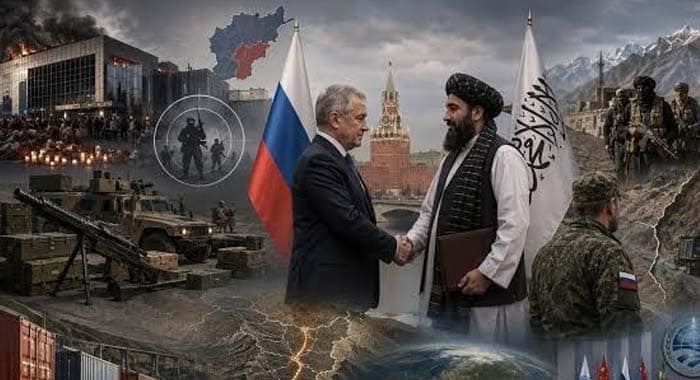
Russia is pursuing a delicate strategic balancing act in Central Asia, deepening diplomatic relations with the Taliban while preparing to reinforce Tajikistan’s defences against potential security threats originating from Afghanistan.
The apparent contradiction highlights Moscow’s broader geopolitical dilemma: maintaining its position as Central Asia’s principal security guarantor while building closer ties with Afghanistan’s Taliban authorities and managing the military and economic pressures of its ongoing war in Ukraine.
According to the information provided, Russian Foreign Minister Sergey Lavrov reaffirmed Moscow’s commitment on October 16 to supplying Tajikistan with weapons, military equipment and border-protection technology through the Collective Security Treaty Organization (CSTO), a Russian-led military alliance.
A week later, CSTO officials indicated that Russia, Kazakhstan, Kyrgyzstan and Belarus were preparing equipment deliveries, with initial shipments expected before the end of 2026. The initiative forms part of a five-year border-security programme approved in November 2024.
CSTO Secretary General Taalatbek Masadykov stressed that the programme was not directed against Afghanistan, signalling Moscow’s intention to strengthen regional defences without undermining its growing diplomatic engagement with Kabul.
Tajikistan shares more than 1,300 kilometres of mountainous frontier with Afghanistan, where difficult terrain, remote valleys and limited surveillance infrastructure present persistent border-management challenges.
These vulnerabilities came into focus in November 2025, when two attacks launched from Afghan territory reportedly killed five Chinese nationals in Tajikistan. Beijing subsequently urged Chinese businesses and personnel to leave the affected areas.
The incidents underscored the wider implications of insecurity along the Afghan frontier, particularly for Chinese investments, infrastructure projects, transport corridors and commercial activities across Central Asia.
For Moscow, the stakes extend beyond Tajikistan’s immediate security. Russia maintains a substantial military presence in the country and has historically positioned itself as the region’s principal security partner.
The CSTO’s Cobalt-2026 exercises, conducted in Tajikistan from October 18 to 23, involved specialised units rehearsing operations against armed groups and criminal networks. However, the effectiveness of the wider security effort will ultimately depend on operational readiness, intelligence coordination, surveillance capabilities and sustained support for border forces.
Russia’s approach to Afghanistan underwent a significant shift in July 2025, when Moscow became the first country to formally recognise the Taliban government.
The move created opportunities for closer diplomatic engagement, counterterrorism cooperation and economic relations, while allowing Russia to expand its influence over Afghanistan’s relationships with neighbouring Central Asian states.
Nevertheless, diplomatic recognition has not eliminated Moscow’s concerns about cross-border terrorism.
Lavrov has warned about the presence of militant groups in Afghan areas bordering Central Asia and identified Islamic State Khorasan Province (ISKP) as a major regional threat. Russian officials have also alleged that militants seek to cross borders disguised as civilians.
These assessments remain official Russian claims, and the extent of the alleged militant infrastructure and cross-border infiltration is difficult to establish independently. Taliban officials maintain that they are fighting ISKP and reject allegations that Afghanistan poses a threat to neighbouring countries.
In August 2026, Taliban spokesman Zabihullah Mujahid reportedly challenged the CSTO’s security assessments, describing the information underpinning its concerns as unreliable.
The divergence illustrates a central difficulty for Moscow: diplomatic access to Kabul does not automatically translate into reliable intelligence sharing, effective border enforcement or sustained cooperation against transnational terrorist networks.
China’s growing security engagement with Tajikistan is introducing another important dimension to the regional equation.
In March 2026, Tajikistan approved a Chinese-funded initiative to construct nine facilities along its Afghan border, incorporating infrastructure intended to strengthen surveillance, communications and the operational capabilities of Tajik border forces.
The initiative reflects Beijing’s determination to protect its citizens, investments and transport links from instability emanating from Afghanistan.
Although Russian and Chinese involvement can be complementary, their respective contributions are increasingly important to the region’s security architecture. Russia brings longstanding military partnerships, while China provides financial resources, infrastructure and technical assistance.
The implementation of these initiatives could influence how Central Asian governments distribute their security partnerships. If Chinese-funded facilities become operational while Russian equipment deliveries face delays, Tajikistan may increasingly depend on Beijing for particular surveillance and border-management capabilities.
Such a shift would not necessarily undermine Russian-Tajik relations. It would, however, demonstrate how regional influence increasingly depends on the delivery of practical security outcomes rather than historical ties alone.
Russia’s ongoing war in Ukraine presents an additional challenge to its ability to fulfil security commitments across Central Asia.
Prolonged combat places demands on military equipment, industrial production and financial resources, raising questions about Moscow’s capacity to sustain multiple security responsibilities simultaneously.
The October 23 announcement indicated that equipment suppliers had been selected and contracts were being finalised. It did not confirm that the promised equipment had reached Tajikistan or entered operational service.
Moreover, effective border security requires more than weapons and hardware. Personnel training, functioning surveillance systems, intelligence-sharing arrangements, maintenance support and rapid-response capabilities are equally essential.
The programme’s success will therefore depend on whether the promised assistance translates into measurable improvements in border monitoring, operational readiness and responses to cross-border incidents.
Russia is unlikely to abandon either its diplomatic engagement with the Taliban or its security commitments to Tajikistan. Its more probable course is to continue working with Kabul while reinforcing the defences of its Central Asian partners.
However, China’s expanding involvement is giving regional governments greater opportunities to diversify their security relationships, reducing their reliance on any single external partner.
For Tajikistan, the immediate objective is straightforward: securing its long and difficult border with Afghanistan. For Russia, the broader challenge is more complex—preserving its regional leadership while cultivating ties with a government whose territory remains central to its security concerns.
The strategic test for Moscow will not simply be whether it can maintain relations with the Taliban while arming Tajikistan, but whether it can translate diplomatic influence and military commitments into tangible security gains for Central Asia.
As Afghanistan continues to shape the region’s security environment, the delivery and effectiveness of Russia’s promised assistance will be closely watched by neighbouring governments assessing the future reliability of the CSTO and the evolving balance of regional influence.



