
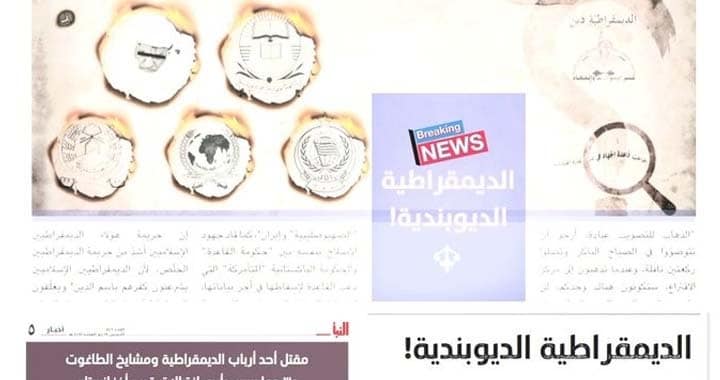
The latest edition of the Islamic State group’s weekly propaganda publication Al Naba has intensified ideological attacks against prominent Deobandi and Haqqani-affiliated religious scholars, accusing them of legitimizing democracy and deviating from extremist interpretations of jihadist doctrine.
According to analysts monitoring militant propaganda, the publication not only highlighted four recent terror attacks carried out in Khyber Pakhtunkhwa but also devoted a significant portion of its editorial to criticizing Islamist groups and clerics in Pakistan who participate in electoral politics or maintain engagement with state institutions.
Among the incidents referenced in the publication was the assassination of senior Pakistani cleric Mawlana Idris, which the group presented within its broader narrative against religious figures it accuses of ideological compromise.
The editorial reportedly argues that religious scholars and Islamist political actors who endorse democratic participation are more dangerous than secular political forces because, according to the publication, they provide religious justification for democratic systems through Islamic rhetoric.
Security observers note that the article reflects the Islamic State’s long-standing ideological hostility toward democratic governance, parliamentary participation, and state engagement by religious movements.
The editorial specifically criticizes Deobandi-linked scholars and figures associated with the Afghan Taliban and al-Qaeda-aligned circles, accusing them of abandoning “pure jihadist principles” in favor of political accommodation, diplomatic engagement, and pragmatic governance.
According to counterterrorism analysts, the publication’s rhetoric demonstrates growing ideological friction within extremist ecosystems, particularly between transnational militant groups like Islamic State Khorasan Province (ISKP) and other Islamist factions operating in the region.
Experts say the editorial reflects a broader strategic divide between Islamic State-aligned groups and movements that have transitioned toward political participation, negotiations, or governance structures.
The Islamic State has historically rejected electoral systems and constitutional politics, labeling democracy as incompatible with its extremist worldview. In contrast, various Islamist groups and Taliban-linked networks in the region have increasingly engaged in diplomatic processes, political administration, and state-level negotiations.
Analysts believe this divergence has intensified ideological competition among militant organizations, particularly following the Taliban’s return to power in Afghanistan and the evolving political posture of Islamist movements across South Asia.
“The editorial is part of a wider propaganda effort aimed at delegitimizing rival Islamist actors who no longer conform to the Islamic State’s rigid ideological framework,” a regional security observer said.
The publication’s focus on recent attacks in Khyber Pakhtunkhwa has also renewed concerns regarding militant propaganda operations targeting Pakistan’s religious and security landscape.
Counterterrorism officials warn that extremist publications such as Al Naba continue to serve as tools for ideological recruitment, operational messaging, and intra-militant influence campaigns.
The assassination of religious scholars and attacks against clerics seen as politically moderate or institutionally engaged have increasingly become part of the broader extremist strategy aimed at polarizing religious discourse and undermining competing Islamic interpretations.
Security analysts note that the targeting of Deobandi scholars by Islamic State-linked propaganda also illustrates the group’s attempt to position itself as the sole representative of uncompromising militant ideology.
Observers believe the latest editorial could further widen ideological tensions among extremist factions operating across Pakistan and Afghanistan, particularly as militant organizations compete for influence, recruits, and narrative dominance in the region.
The development comes amid continued security challenges in Khyber Pakhtunkhwa and growing concerns over the spread of digital extremist propaganda aimed at vulnerable audiences.
Authorities and independent analysts have repeatedly emphasized the need for coordinated counter-extremism strategies, digital monitoring, and stronger ideological responses from mainstream religious institutions to confront radical narratives propagated by transnational militant organizations.
Further monitoring of Al Naba and affiliated propaganda channels is expected as regional security agencies continue to assess the implications of the publication’s messaging and operational signaling.



