
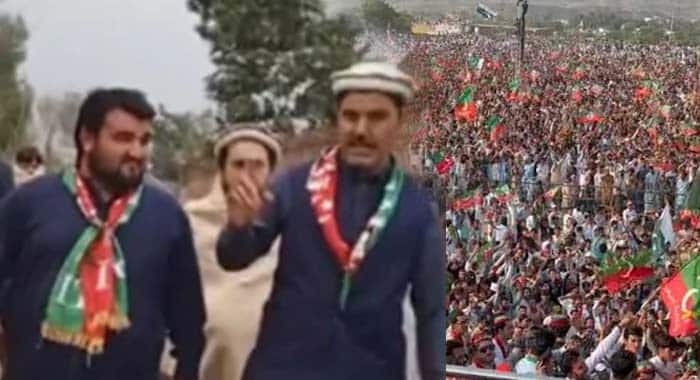
For years, one question has remained stubbornly unanswered in Pakistan’s security debate: why does PTI, or say the so–called Pakistan Tehreek-e-Insaf repeatedly find itself unable, or unwilling, to stand on the same page with the state when the subject is terrorism?
The question has acquired a sharper edge in Khyber Pakhtunkhwa, the province that has paid one of the heaviest prices for terrorism. Its people have buried soldiers, policemen, tribal elders, teachers and civilians. Its businesses have suffered, schools have been attacked, roads have been disrupted and entire communities have lived under the shadow of violence.
Yet whenever the state intensifies its campaign against terrorists, the political response from PTI circles frequently shifts the conversation towards political confrontation, alleged victimization, protests, arrests or the fate of Imran Khan.
The latest exchange at KP House Islamabad has brought that contradiction into particularly sharp focus.
A journalist asked Chief Minister Sohail Afridi why, at a time when terrorism continues to threaten KP, the provincial leadership was concentrating on protest politics and the health of Imran Khan rather than the province’s security crisis.
The answer was remarkably brief: “We are talking about Imran Khan’s health.”
That response may have been intended simply to end the question. Instead, it opened a much larger one.
Is terrorism a security emergency for PTI, or is it merely a political subject to be used when convenient?
The distinction matters because there is now a long record of PTI’s complicated engagement with the TTP question. During Imran Khan’s government, talks with the banned TTP were pursued with Afghan Taliban mediation. Khan later acknowledged that his government had considered resettling thousands of TTP fighters and their families in Pakistan. In December 2022, he said the plan involved thousands of fighters and their families returning to Pakistan.
Negotiation itself is not terrorism. States negotiate with armed groups for strategic reasons, and governments can pursue dialogue when they believe it may prevent bloodshed. But negotiations become a very different proposition when the other side refuses to disarm, reject violence or accept the Constitution.
That is precisely where the TTP process ultimately ran aground.
The proposed arrangements included issues such as the release of prisoners, return of fighters and demands concerning the former tribal areas. Parliamentary discussions at the time recorded major disagreements over the group’s demands, including withdrawal of security forces and the status of the tribal districts.
The failure of that approach did not make terrorism disappear. The TTP returned to violence, and KP once again became the principal battlefield.
This history makes the current political posture harder to dismiss as coincidence.
If PTI genuinely believes terrorism is the province’s foremost existential threat, then its political language should reflect that priority. Its provincial government should be demanding stronger counterterrorism coordination, better policing, intelligence capacity, protection of vulnerable districts and unambiguous political support for action against terrorists.
Instead, the political spotlight repeatedly returns to one man.
That is where the uncomfortable possibility emerges: terrorism may not be viewed merely as a threat by some political actors, but also as an instrument capable of creating pressure on the state.
The distinction is crucial. A political party can oppose a military operation without supporting terrorism. It can demand negotiations without becoming an accomplice of terrorists. But when political pressure consistently collides with counterterrorism operations, when violent actors are politically defended or their actions are minimized, and when the release of a political leader becomes the dominant objective, the state has every reason to examine the pattern.
Recent allegations of political facilitation of terrorist networks have intensified this debate. PTI has rejected accusations that it facilitates terrorism and has publicly called for a unified national stance against terrorism.
That denial must be heard. But it does not eliminate the need for scrutiny.
The state should investigate evidence, not political labels. If an individual is found to have facilitated terrorism, the law should take its course regardless of party affiliation. If allegations are false, the evidence should establish that too.
The same principle applies to Muhammad Hussain, the Khyber resident recently neutralized on Mall Road in Rawalpindi. According to sources, weapons, ammunition, a PTI flag and documents were recovered from him, while investigators are examining alleged political links and his reported involvement in violent protests and attacks on security personnel.
If those allegations are established, the matter cannot be reduced to “political activism.” Terrorism is terrorism, regardless of the flag carried by the perpetrator.
And that may finally explain the question that has troubled Pakistan’s security establishment for years.
The issue is not whether PTI is entitled to oppose the government. It absolutely is.
The issue is whether political objectives have at times become more important than the collective objective of defeating terrorism.
For KP, there can be no ambiguity.
The province cannot afford a politics in which terrorism is condemned in speeches but becomes negotiable when it serves a political purpose.
The people of KP need their leaders to draw one line clearly: politics on one side, terrorism on the other.
There should be no grey zone.



