
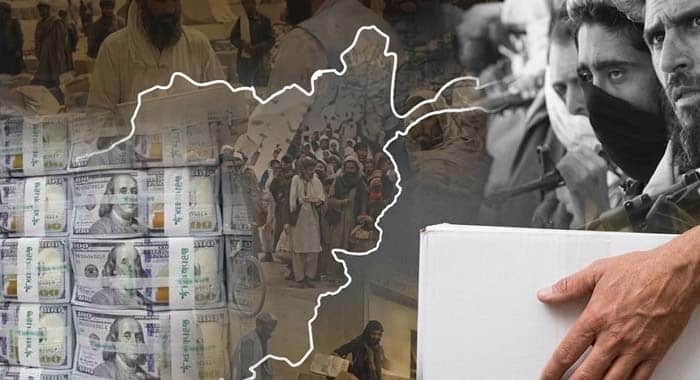
A new report by the Afghan-led Kabul Institute has raised serious questions about the transparency, traceability, and public accountability of international assistance flowing into Afghanistan since the Taliban returned to power in August 2021. According to the institute’s Who Gets the Aid Money in Afghanistan report, approximately US$8 billion in humanitarian assistance has been paid into Afghanistan’s aid response, yet only around 9 percent can be traced beyond the first recipient organisation.
The findings, published through the Afghanistan Aid Tracker, highlight a substantial gap between the international community’s financial commitments to the Afghan people and the publicly available information showing how funds move through the humanitarian system. The report does not establish that the untraceable money was stolen or misused; rather, it identifies a serious shortfall in publicly accessible financial records that prevents donors, journalists, researchers, and Afghan citizens from following the funding trail to its subsequent recipients and ultimate expenditure.
At a time when Afghanistan continues to face significant humanitarian and economic challenges, the findings raise an important question: how can the international community ensure that billions of dollars intended to support vulnerable Afghans are reaching their intended beneficiaries when the public record provides only limited visibility into what happens after the first transfer?
According to the Kabul Institute, donors have confirmed approximately US$8 billion in humanitarian payments to Afghanistan since August 2021. Of that amount, just US$721.9 million approximately 9 percent can be traced to a second organisation in the funding chain through publicly available records.
The remaining 91 percent becomes untraceable in the public record beyond the initial recipient. This does not necessarily mean the money has disappeared or been diverted. It means the available reporting does not provide a sufficiently clear, publicly verifiable account of where those funds went next.
The report identifies another significant concern: 316 payment flows, collectively worth approximately US$1.42 billion, list their recipients as “Confidential.” Although confidentiality may be justified in certain circumstances, the scale of these undisclosed recipient records raises legitimate questions about the level of transparency available to the public.
The institute also reports that no programme-level expenditure data for the humanitarian funding examined were available in a machine-readable public source. Consequently, the published records do not provide a comprehensive, systematically verifiable account of what the money ultimately purchased or which programmes received the benefit.
These findings point to a major accountability challenge not necessarily proof of financial wrongdoing, but a clear limitation in the public’s ability to independently assess the final destination and impact of international assistance.
The report identifies an additional transparency problem involving development finance. According to the Afghanistan Aid Tracker, approximately US$12.04 billion in development finance commitments across 1,208 project records has been identified in separate datasets covering Afghanistan-related projects. However, the relevant publishers do not provide payment data that would allow the tracker to establish how much of this committed funding has actually been disbursed.
This distinction is critical. A financial commitment is not the same as a completed payment, and neither necessarily demonstrates that funds have reached their ultimate beneficiaries. Without clear reporting on each stage, the public cannot reliably determine how much committed development finance has moved, how much remains outstanding, or what results have been achieved.
The humanitarian payments and development commitments therefore represent different stages of the funding process and should not be combined as though they were all money already received or spent in Afghanistan. Nevertheless, the scale of the figures underscores the need for stronger reporting standards and a more comprehensive system for tracking international assistance.
Concerns about the relationship between international assistance and Taliban-controlled institutions are not new. In May 2024, the US Special Inspector General for Afghanistan Reconstruction (SIGAR) published an audit examining whether American assistance was benefiting the Taliban-controlled government. The audit found that 38 of 65 implementing partners who responded to its questionnaire reported paying taxes, fees, duties, or utility costs to Taliban-controlled entities.
Those respondents reported payments totalling at least US$10.9 million in US-funded money. SIGAR cautioned that the actual amount could be higher because the information available was incomplete and relevant payment data were not consistently collected across the aid system.
The report also documented concerns about pressure on aid organisations and attempts to influence assistance. These findings demonstrated that funding intended to support the Afghan population could generate indirect financial benefits for authorities controlling the operating environment.
Such payments do not automatically establish illegal diversion: taxes, fees, and utility charges may arise in the ordinary course of delivering humanitarian assistance. However, the findings reinforce the importance of transparent reporting, effective safeguards, and independent oversight to ensure that aid is delivered according to its intended purpose. The wider issue is whether international donors and implementing organisations possess adequate information to identify, disclose, and address financial risks associated with delivering assistance under Taliban rule.
Afghanistan’s humanitarian needs remain a central concern for international donors and relief organisations. Millions of people depend on assistance for essential services and basic necessities, making the effective use of available resources particularly important.
The objective of humanitarian assistance is to alleviate suffering and support vulnerable communities not to provide unrestricted financial support to any governing authority. Aid organisations must therefore operate within a framework that protects beneficiaries, preserves humanitarian access, and maintains appropriate financial controls.
At the same time, a lack of public financial information should not be treated as conclusive evidence that humanitarian organisations have engaged in misconduct. The Kabul Institute’s findings concern the limits of publicly traceable data, and the distinction between missing disclosure and proven misuse must be maintained.
The central challenge is to ensure that humanitarian principles and operational requirements are matched by credible systems of accountability. The findings also invite closer scrutiny of the political rhetoric surrounding foreign influence and international assistance in Afghanistan. The Taliban authorities have repeatedly accused critics, including Pakistan, of acting on behalf of foreign interests. Yet Afghanistan’s continued reliance on international humanitarian assistance makes transparency about foreign funding an issue of considerable public importance.
The relevant question is not simply which countries or institutions provide the money. It is whether the funding is being administered transparently, whether potential benefits to Taliban-controlled entities are properly disclosed, and whether independent mechanisms can verify that assistance reaches the people for whom it was intended.
Foreign assistance is not, by itself, evidence of political subordination or improper conduct. Humanitarian funding is designed to support people in need, including populations living under governments that donors do not recognise or politically support. Nevertheless, the scale of international funding makes robust disclosure and accountability indispensable. Public confidence requires clear answers about who receives the money, how it is transferred, what deductions or operating costs apply, and what assistance ultimately reaches Afghan families.
The Kabul Institute’s findings strengthen the case for practical reforms to Afghanistan’s aid-monitoring system. International donors and implementing agencies should prioritise the following measures:
- Publish funding information across the full delivery chain: Reporting should extend beyond the first recipient to subsequent organisations and, where feasible, programme-level expenditure.
- Improve disclosure of confidential recipients: Where legitimate security or beneficiary-protection concerns prevent the publication of names, organisations should provide as much non-sensitive information as possible about recipient type, sector, and use of funds.
- Separate commitments from actual payments: Development finance records should clearly distinguish announced pledges, formal commitments, disbursements, and verified expenditure.
- Strengthen independent oversight: Donors should require consistent reporting on taxes, fees, duties, utility payments, and other financial interactions with Taliban-controlled institutions.
- Make accountability accessible to Afghans: Public reporting should enable Afghan citizens, journalists, researchers, and civil society organisations to scrutinise aid flows and assess whether assistance is meeting its stated objectives.
These measures would help protect humanitarian resources, strengthen donor confidence, and improve the ability of independent observers to identify problems before they undermine aid delivery.
The Kabul Institute’s report presents a substantial challenge for the international aid community. Approximately US$8 billion in humanitarian payments have been recorded since August 2021, yet only a small proportion can be followed beyond the first recipient through public data. A further US$1.42 billion is associated with payment records that identify recipients only as confidential, while separate development finance commitments lack published payment information in the datasets examined.
These findings do not, on their own, prove that funds have been stolen, diverted, or directly transferred to the Taliban administration. They do, however, demonstrate that the publicly available record is insufficient to provide a comprehensive account of the money’s subsequent movement and final use.
For Afghanistan’s population, the stakes are significant. Every funding gap in public reporting makes it harder to assess whether international assistance is achieving its intended humanitarian purpose. For donors, it highlights the need to strengthen financial controls and ensure that funding decisions are accompanied by meaningful transparency. Ultimately, the issue is not whether Afghanistan should receive humanitarian assistance. The Afghan people continue to have urgent needs. The issue is whether the institutions administering that assistance can demonstrate, with credible and verifiable evidence, where the money goes and what it accomplishes.
The principle is straightforward: aid intended for the Afghan people must be accompanied by accountability to the Afghan people.



