
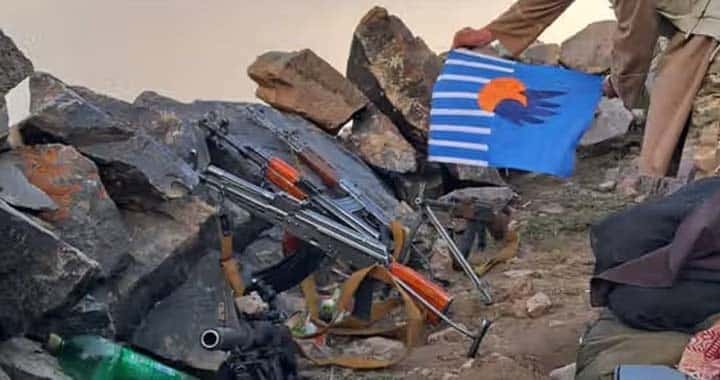
A newly formed armed group, Sepahiyan-e Mihan (Patriotic Soldiers Front), has announced its emergence after briefly taking control of Yaftali Sufla district in Badakhshan province, disarming Taliban personnel and seizing military equipment during a surprise operation.
The incident marks one of the most significant public appearances by the newly formed group, which reportedly captured the district headquarters for several hours before withdrawing following the arrival of Taliban reinforcements. The operation has drawn renewed attention to the evolving security landscape in Badakhshan, a province that has increasingly become a focal point of armed opposition activities against Taliban rule.
According to local sources, Sepahiyan-e Mihan comprises individuals from various segments of society, including local residents, activists, and some former security personnel. Sources described the group as an independent movement formed in response to what members claim are growing grievances and dissatisfaction with Taliban governance in the province.
A member of the group stated that its primary motivation was opposition to what he described as oppression and restrictions imposed by the Taliban authorities. He claimed that the group aims to mobilize local communities and resist policies that it considers harmful to the people of Badakhshan.
The group has reportedly maintained contact and coordination with several former military commanders, former mujahideen figures, and political groups; however, its members claim that Sepahiyan-e Mihan has no formal organizational affiliation with any existing faction and operates independently.
Sources reported that Sepahiyan-e Mihan launched its first known operation early Friday morning by attacking the Yaftali Sufla district headquarters and raising its flag over the government building. During the operation, the group reportedly disarmed Taliban personnel stationed at the district headquarters and took possession of weapons and military equipment. Following its withdrawal from the area, members of Sepahiyan-e Mihan displayed the captured equipment as a public demonstration of their operation.
However, the group was unable to maintain control of the district for an extended period, as Taliban forces quickly deployed reinforcements and regained control of the area. No confirmed information is currently available regarding the leadership structure, commanders, or overall strength of Sepahiyan-e Mihan.
Security observers believe that the group’s choice of Yaftali Sufla may reflect its current operational capabilities. Located near Faizabad, the district is considered more accessible and comparatively vulnerable than some of Badakhshan’s remote mountainous areas.
Analysts suggest that while the group demonstrated the ability to conduct a coordinated armed action, its decision to withdraw after Taliban reinforcements arrived indicates that it may still lack the manpower, resources, and military experience required for prolonged territorial control.
Some security sources believe the group is largely composed of local civilians rather than experienced fighters, with members joining due to political, social, or patriotic motivations.
The emergence of Sepahiyan-e Mihan adds another dimension to the changing security environment in Badakhshan, which in recent years has become one of the major areas of activity for groups opposed to Taliban rule.
Existing opposition groups, including the National Resistance Front (NRF) and the Afghanistan Freedom Front (AFF), have previously claimed responsibility for attacks against Taliban positions in the province. These operations have largely involved ambushes, guerrilla-style attacks, and strikes against checkpoints.
The appearance of Sepahiyan-e Mihan indicates that new actors may be entering the conflict landscape, potentially expanding the number of armed groups challenging Taliban authority in northern Afghanistan.
Local observers have linked the growing tensions in Badakhshan to several factors, including disputes among Taliban commanders, friction between locally based forces and personnel deployed from other provinces, competition over natural resources and mining areas, social grievances, and dissatisfaction among sections of the population.
The Taliban authorities appear to be responding seriously to the emerging security challenge in the province. Taliban Defence Minister Mullah Mohammad Yaqoob recently visited Badakhshan and toured several districts amid increasing security concerns.
The Taliban have also reportedly established a new military unit in the province and increased the deployment of security forces in an effort to strengthen control and prevent further armed challenges.
The temporary seizure of Yaftali Sufla by Sepahiyan-e Mihan highlights the continuing fragility of the security situation in parts of Afghanistan and demonstrates that Badakhshan remains a key area of contestation.
As new armed groups emerge and existing opposition networks remain active, the security dynamics in the province are expected to remain closely monitored in the coming months.



