
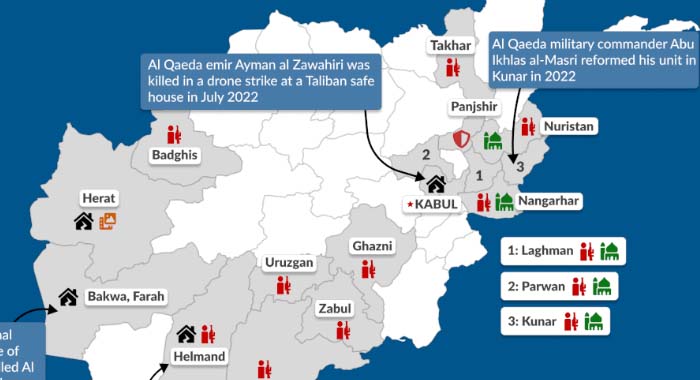
A new report by the United Nations Analytical Support and Sanctions Monitoring Team has raised fresh concerns over the continued presence and activities of Al Qaeda, ISIS-K and affiliated militant groups in Afghanistan, while highlighting the proliferation of advanced military equipment and the evolving capabilities of armed organizations operating in the region.
The 38th report of the Analytical Support and Sanctions Monitoring Team, issued as a Security Council document on August 10, provides a broad assessment of the activities, capabilities and regional footprint of ISIS, Al Qaeda and associated groups. The assessment is based largely on information and analysis provided by UN Member States and covers developments through June 9.
Among the most significant findings, the report cites information from a Member State alleging that ETIM/TIP militants were training at a newly established Al Qaeda training camp in Barg-e Matal district of Nuristan Province.
The development adds to continuing regional concerns over the ability of transnational militant organizations to maintain training, logistical and operational infrastructure inside Afghanistan.
The report also addresses developments involving the Eastern Turkistan Islamic Movement (ETIM), also known as the Turkistan Islamic Party (TIP). According to assessments provided by some Member States, the group has been expanding and reconcentrating its presence in Badakhshan, including areas around the Wakhan Corridor, while reportedly establishing additional strongholds in Kunduz.
However, the monitoring team emphasized that assessments of ETIM/TIP’s strength and capabilities differ among Member States. One government assessed that the organization remains relatively small, is not expanding, has remained militarily inactive and does not possess advanced drone capabilities or the ability to manufacture such systems. The same assessment indicated that the Taliban have imposed constraints on the group.
The UN monitoring team separately highlighted the continued availability of large quantities of military equipment and advanced weapons in Afghanistan, five years after the Taliban’s return to power. According to the report, the continued presence of substantial military stockpiles has created opportunities for the transfer of weapons to the Tehrik-e-Taliban Pakistan (TTP) and other armed groups.
Several Member States reportedly warned that the proliferation of advanced equipment, including night-vision devices, has enhanced the operational capabilities of UN-listed groups and increased their ability to conduct attacks against security forces.
The findings underscore a broader regional concern: weapons and military equipment remaining in Afghanistan can potentially move beyond their original locations and contribute to the strengthening of armed groups operating across borders.
The report also draws attention to the continuing interest of ISIS-K in chemical and biological weapons. The monitoring team noted that Al Qaeda and ISIS have historically sought such capabilities but have encountered significant technical obstacles in developing them. ISIS-K, however, has reportedly demonstrated particular interest in the area and circulated material during the past year concerning the development of ricin, a highly toxic substance.
Importantly, the report does not state that ISIS-K has successfully produced or deployed ricin or any other chemical or biological weapon.
The finding nevertheless highlights the continuing concern surrounding the group’s efforts to explore unconventional methods of attack and its attempts to expand the range of capabilities available to its operatives.
Another emerging concern identified by the monitoring team is the use of artificial intelligence tools by ISIS-K to translate and rapidly disseminate propaganda. The development reflects a broader evolution in militant communications, with extremist organizations seeking to exploit modern technologies to expand the reach of their messaging, overcome language barriers and distribute propaganda to audiences across multiple regions.
The report suggests that the use of AI-enabled tools is becoming part of a wider effort by militant groups to make propaganda production and dissemination faster, broader and more adaptable.
Taken together, the findings present a complex security landscape in which Taliban operations have reportedly weakened ISIS-K in certain areas, but have not eliminated the wider network of militant organizations operating from or connected to Afghanistan.
The continued reporting of Al Qaeda-linked training activity, concerns regarding ETIM/TIP, the movement of advanced weapons, and the evolving technological capabilities of militant groups demonstrate that Afghanistan remains an important component of the wider regional counter-terrorism environment.
At the same time, the monitoring team cautioned that reliable estimates of the strength and capabilities of individual groups remain difficult to establish. Where possible, the report distinguishes between assessments that reflect a broad consensus among Member States and those where significant differences of view remain.
The latest assessment underscores the need for sustained international monitoring of militant networks operating in and around Afghanistan, particularly with regard to cross-border movement, weapons proliferation, training infrastructure, financing, emerging technologies and propaganda operations.
The reported presence of an alleged Al Qaeda training facility in Nuristan, combined with concerns over militant regrouping, weapons availability and technological adaptation, reinforces the importance of continued information-sharing and coordinated counter-terrorism efforts among regional and international stakeholders.
The UN monitoring assessment ultimately points to a security environment that remains fluid and difficult to predict, with militant groups adapting to counter-terrorism pressure while seeking new geographic, technological and operational avenues to preserve or expand their capabilities.



