
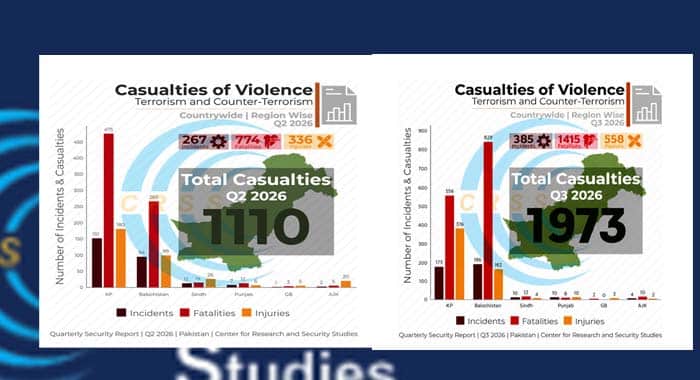
Pakistan’s security landscape underwent a dramatic transformation during the third quarter of 2026, with violence-linked fatalities rising sharply after a modest improvement in the first half of the year. According to data compiled by the Center for Research and Security Studies (CRSS), the country recorded at least 1,415 fatalities and 558 injuries across 385 incidents involving terrorist violence and counter-terrorism operations between July and September.
The figures represent an 83 percent increase in fatalities compared with the 774 deaths recorded during the second quarter. Yet the headline figure tells only part of the story. Beneath the national increase lies a more complex development: the geographical centre of violence shifted decisively from Khyber Pakhtunkhwa to Balochistan, while the number of militants killed in security operations more than doubled.
The third quarter therefore reflected not simply an increase in militant violence, but also a significant intensification of Pakistan’s counter-terrorism response.
This distinction is critical when assessing the country’s security trajectory. The sharp rise in fatalities among militants indicates that security forces were engaging terrorist networks at a substantially higher intensity. At the same time, the increase in civilian and security personnel casualties demonstrates that the threat remained serious and that militant violence continued to impose a considerable human cost.
The contrast between Q2 and Q3 provides a revealing picture of how Pakistan’s security environment evolved over the summer months. The second quarter had offered a relatively modest reason for optimism. CRSS recorded 774 violence-linked fatalities in Q2, compared with 813 during the first quarter, representing an approximately five percent decline.
That improvement, however, proved fragile. By Q3, fatalities had surged to 1,415. The number of injuries also increased from 336 to 558, while recorded incidents rose from 267 to 385. The scale of the deterioration was therefore broad-based. Pakistan did not merely experience a greater number of deaths; it witnessed more violent incidents and a substantially larger number of injuries as well.
But the data also shows that the deterioration was concentrated geographically rather than evenly distributed throughout the country. The overwhelming driver was Balochistan.
Few developments in the Q3 data are as striking as the reversal in Balochistan. During Q2, Balochistan had recorded 265 fatalities, a significant improvement from the 443 deaths registered in Q1. At that stage, the province appeared to be moving in a more favorable direction. The picture changed dramatically in Q3. Fatalities in Balochistan jumped to 829, an increase of approximately 213 percent over the previous quarter. The province also recorded 186 violent incidents, compared with 94 in Q2.
The increase was so large that Balochistan alone accounted for nearly 88 percent of Pakistan’s national rise in violence-linked fatalities between Q2 and Q3. The province consequently overtook Khyber Pakhtunkhwa as the country’s most affected region in terms of both fatalities and recorded incidents. This geographical shift is perhaps the defining characteristic of Pakistan’s Q3 security landscape.
In Q2, KP had been the principal epicentre, accounting for 475 fatalities compared with Balochistan’s 265. Three months later, Balochistan had recorded 829 deaths, while KP stood at 556. The change illustrates how quickly Pakistan’s security challenges can migrate between regions and why counter-terrorism policy increasingly requires simultaneous attention to multiple theatres.
Although Balochistan became the country’s worst-hit province in Q3, Khyber Pakhtunkhwa remained a major centre of militant activity. Fatalities in KP increased from 475 in Q2 to 556 in Q3, a rise of approximately 17 percent. Violent incidents increased from 151 to 173. More significantly, KP continued to carry the country’s heaviest injury burden.
The province recorded 376 injuries during Q3, representing more than two-thirds of the national total. This was more than double the 180 injuries recorded in KP during Q2. The figures suggest that while Balochistan experienced the sharpest escalation in fatalities, KP continued to face intense and sustained violence with a particularly heavy impact on those wounded. The two provinces together accounted for approximately 98 percent of all violence-linked fatalities recorded nationwide in Q3, confirming that Pakistan’s security challenge remains overwhelmingly concentrated in its western belt.
One of the most consequential aspects of the Q3 data is the dramatic rise in militant fatalities. Outlaw deaths increased from 453 in Q2 to 921 in Q3, representing an increase of more than 103 percent. Of the 641 additional deaths recorded nationwide between the two quarters, 468 were outlaws. In other words, nearly three-quarters of the national increase came from militant fatalities.
This is an important dimension of the Q3 story. The rise in violence occurred alongside a major increase in Pakistan’s security operations. The supplied CRSS data attributes 921 outlaw fatalities to almost 154 security operations during the quarter. The figures indicate that Pakistani security forces were not simply absorbing an increase in attacks; they were simultaneously mounting a substantially more intensive campaign against militant networks.
The result was a quarter in which the overall death toll rose sharply, but the largest increase occurred among the militants targeted by counter-terrorism operations. For Pakistan’s security establishment, this represents a significant operational dimension of the quarter: terrorist networks appear to have faced considerably greater pressure, even as their attacks continued to generate casualties.
The escalation was nevertheless costly for Pakistan’s security personnel. Security-force fatalities increased from 134 in Q2 to 240 in Q3, a rise of almost 79 percent. Injuries increased even more dramatically, from 117 to 247, representing an increase of approximately 111 percent. The Q3 figures consequently underline the risks faced by personnel conducting counter-terrorism operations. The gap between civilian and security personnel fatalities also narrowed sharply. In Q2, 187 civilians were killed compared with 134 security personnel, a difference of 53 deaths.
In Q3, the respective figures were 254 and 240. The difference was therefore reduced to only 14 fatalities. This is one of the clearest indications of the intensity of Pakistan’s security campaign during the quarter. As operations expanded and militant networks came under greater pressure, the human cost among security personnel also increased substantially.
Despite the sharp increase in militant fatalities, civilians continued to bear a significant proportion of the country’s security burden. Civilian fatalities rose from 187 in Q2 to 254 in Q3, an increase of approximately 36 percent. Civilian injuries rose from 205 to 284, an increase of approximately 39 percent. Together, civilians and security personnel accounted for 494 deaths and 531 injuries in Q3.
The figures underline the continuing challenge facing Pakistan: successful counter-terrorism operations can weaken militant networks, but terrorist attacks continue to place civilians and frontline personnel at risk. The relatively high civilian injury figure is particularly significant because it demonstrates how violence can affect communities even when militant casualties constitute the largest share of fatalities.
The methods used in violent incidents also reveal an evolving security environment. During Q2, shootings were the most common and lethal method, with 67 incidents causing 88 fatalities. Coordinated armed attacks accounted for another 53 deaths across 29 incidents. Vehicle-borne suicide attacks were also a prominent concern. Six such attacks killed 40 people and injured 43, while another six attempts were reportedly foiled.
The Q3 picture became more complex. Armed attacks remained the deadliest category, with 61 incidents resulting in 147 deaths and 116 injuries. Shootings accounted for 72 deaths and 18 injuries across 58 incidents. However, vehicle-borne suicide attacks became substantially more consequential. Nine such attacks produced 81 fatalities and 204 injuries a combined casualty figure of 285.
Compared with Q2, the number of recorded vehicle-borne suicide attacks increased from six to nine, while their combined casualty toll rose dramatically. The figures suggest that high-impact explosive attacks continued to pose a serious threat, particularly because they can generate large numbers of injuries even when the number of incidents remains relatively limited.
Another notable feature of Q3 was the clearer emergence of drone attacks as a separately quantified category. CRSS recorded 16 drone attacks during the quarter, resulting in 13 fatalities and 48 injuries. The Q2 report mentioned drone use among a broader range of militant weapons, including IEDs, grenades, rockets and mortars, but did not provide a standalone drone casualty figure.
Consequently, the available data does not establish a precise quarter-on-quarter increase in drone attacks. What it does demonstrate is that drone activity had become sufficiently significant in Q3 to warrant separate treatment in the methodology breakdown. This development points to an increasingly diverse threat environment in which militant groups are experimenting with different means of conducting attacks.
The groups claiming responsibility for attacks also present an important part of the Q3 picture. The Tehrik-e-Taliban Pakistan, or TTP, emerged as the deadliest group among those claiming attacks during the quarter. Its 13 claimed attacks were associated with 117 fatalities and 65 injuries. The Balochistan Liberation Army claimed five attacks resulting in 34 fatalities and 42 injuries, while HGB-IUM claimed three attacks associated with 27 fatalities and 129 injuries.
The figures demonstrate that the number of claimed attacks does not necessarily correspond directly to their human impact. HGB-IUM, for example, claimed fewer attacks than TTP or BLA but was associated with the highest number of injuries among the listed groups. Historically, the supplied CRSS figures show that TTP-claimed attacks have produced more fatalities than BLA-claimed attacks since 2021, although the listed 2026 tally shows BLA ahead of TTP. The competing patterns underline the increasingly fragmented nature of Pakistan’s militant threat, with different organizations employing different methods and operating in different geographical environments.
Taken as a whole, the Q2 and Q3 figures suggest that Pakistan’s security forces entered the third quarter facing a more aggressive and geographically shifting threat environment. The sharp increase in outlaw fatalities is particularly important. While the national death toll increased by 83 percent, militant fatalities more than doubled. This means the quarter’s deterioration cannot be interpreted simply as evidence of an unchecked expansion of terrorist attacks.
Rather, Q3 appears to have been characterized by a simultaneous escalation on both sides of the security equation: militant violence remained intense, while Pakistan’s security forces intensified operations against militant formations and hideouts.
That distinction is central to understanding the figures. The increase in security operations and militant fatalities suggests that Pakistani forces were actively pursuing terrorist networks rather than merely responding defensively to attacks. At the same time, the substantial rise in security-force casualties demonstrates that those operations were being conducted in an increasingly dangerous environment. The data therefore portrays a security campaign in which the state continued to impose significant costs on militant groups, even as those groups retained the capacity to inflict casualties.
The transition from Q2 to Q3 can ultimately be understood as a reversal of momentum. Q2 had offered a narrow improvement at the national level. Fatalities declined slightly, Balochistan recorded a substantial reduction, and civilian deaths fell. Q3 reversed much of that progress.
Fatalities surged. Injuries increased. Violent incidents expanded. Balochistan experienced an extraordinary deterioration. Security personnel faced substantially greater losses. And militant fatalities more than doubled as counter-terrorism operations intensified. Yet the picture is not one of uniform deterioration.
Punjab, Sindh and Gilgit-Baltistan recorded fewer fatalities in Q3 than in Q2. The country’s security challenge remained heavily concentrated in Balochistan and KP, while the overwhelming majority of additional deaths came from militant losses in security operations. This concentration also offers an important policy insight: Pakistan’s security trajectory will depend heavily on whether the state can contain the renewed escalation in Balochistan while maintaining pressure on militant networks in KP.
Q3 2026 was undoubtedly a difficult quarter for Pakistan’s security environment. The 83 percent increase in violence-linked fatalities represents a significant deterioration compared with Q2 and highlights the continuing threat posed by militant organizations. But the same data also records a substantial and sustained state response.
The more than doubling of outlaw fatalities, the sharp rise in security operations, and the intensified pressure on militant hideouts indicate that Pakistan’s security forces remained actively engaged in dismantling terrorist networks. The human cost was considerable. Security personnel fatalities increased by almost four-fifths, while their injuries more than doubled. Civilians also suffered increased fatalities and injuries.
Yet the concentration of militant deaths among the additional fatalities recorded nationwide is significant. Of the 641 additional deaths between Q2 and Q3, 468 were outlaws. That means the Q3 escalation was simultaneously a period of heightened terrorist violence and intensified counter-terrorism activity.
For Pakistan, the central challenge going forward is to convert the operational pressure reflected in the Q3 figures into a sustained reduction in militant capacity, while protecting civilians and reducing the cost borne by security personnel. The comparison between the two quarters offers no simple victory narrative and neither does it suggest that Pakistan’s security challenge is beyond the reach of the state. Instead, it points to a contest in which militant networks remain capable of generating significant violence, while Pakistani security forces continue to mount increasingly intensive operations against them. The decisive question for the coming quarters will be whether the heavy operational pressure recorded in Q3 can translate into a durable decline in terrorist violence.
For now, the data makes one development unmistakable: Pakistan’s security landscape changed dramatically between Q2 and Q3, with Balochistan emerging as the new epicentre of violence and Pakistani security forces simultaneously intensifying their campaign against militant networks.



