
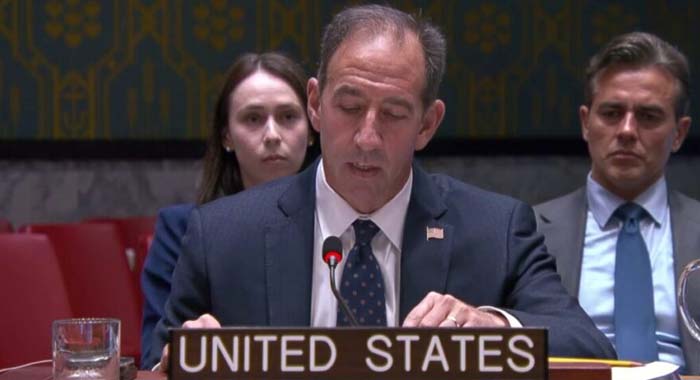
The United States has called on members of the United Nations Security Council to strongly condemn the Taliban for allegedly providing safe haven to terrorist groups, failing to meet counterterrorism obligations, and continuing practices that undermine regional and international security.
Speaking during a Security Council meeting on the situation in Afghanistan, Ambassador Jeffrey Bartos, the United States Representative for UN Management and Reform, urged Council members to adopt a firmer and more unified stance against the Taliban’s conduct.
He stated that the Taliban’s continued sheltering of terrorist organizations and refusal to implement internationally expected counterterrorism commitments pose a persistent threat to both regional stability and global security. “We call on all Council members to echo our condemnation of the Taliban’s sheltering of terrorist groups and their refusal to implement counterterrorism commitments,” he said.
Ambassador Bartos also strongly criticized what he described as the Taliban’s continued use of “hostage diplomacy,” calling on the international community to condemn the detention of United States citizens in Afghanistan. He said the practice remains a serious obstacle to constructive engagement and trust-building efforts.
“The Taliban’s abhorrent practice of hostage diplomacy continues,” he stated. “We call on all members of this Security Council to condemn the Taliban for their unjust detention of United States citizens.”
The US envoy made these remarks during a broader Security Council discussion on Afghanistan’s political, humanitarian, and human rights situation nearly five years after the Taliban’s return to power. He warned that the situation in the country continues to deteriorate under Taliban policies that restrict fundamental freedoms, obstruct humanitarian assistance, and limit access to essential services.
Ambassador Bartos particularly highlighted concerns regarding the treatment of women and girls in Afghanistan, describing the situation as deeply alarming. He stated that restrictive measures imposed by the Taliban have further worsened humanitarian conditions and contributed to the erosion of basic rights.
His remarks followed parallel warnings from United Nations officials regarding increasing restrictions on women in Afghanistan. Reports presented during the session indicated that approximately 30 women had recently been detained in Herat on allegations of violating dress code requirements imposed by the authorities.
The United States also raised concerns over restrictions placed on United Nations operations in Afghanistan. Ambassador Bartos noted that Afghan female employees working with the United Nations have reportedly been barred from accessing UN offices, significantly hampering humanitarian and operational activities.
He further questioned the effectiveness of continued international engagement with the Taliban, arguing that limited progress on key issues has raised serious concerns regarding the value of ongoing diplomatic and financial commitments.
“The Taliban’s intransigence forces us to ask hard questions about the value of continued international engagement and resources,” he said.
The US representative also referred to the United Nations Assistance Mission in Afghanistan (UNAMA), describing it as the organization’s most expensive special political mission. He called for increased scrutiny as member states prepare to review and renew its mandate, stressing that all UN missions must demonstrate effectiveness and accountability.
“All missions, including UNAMA, must provide value for money and must adapt to conditions on the ground,” he said.
Despite his criticism, Ambassador Bartos acknowledged the ongoing UN-led Doha Process as a potential framework for engagement with the Taliban. However, he emphasized that meaningful progress would require tangible and verifiable action from the Taliban authorities.
“Tangible progress in the Doha process is not optional. It is urgent,” he stated.
He further warned that continued engagement without measurable change would be unsustainable, particularly in light of ongoing concerns over terrorism, human rights violations, and the detention of foreign nationals.
“The international community cannot indefinitely sustain a framework for engagement while the Taliban detains innocent Americans, ignores the needs of the Afghan people, denies Afghan women their basic rights, and fails to meet their counterterrorism commitments,” he added.
Ambassador Bartos also called for the swift appointment of a permanent United Nations Special Representative for Afghanistan, arguing that the prolonged vacancy has weakened international coordination and accountability mechanisms.
“The absence of a permanent SRSG weakens the international community’s ability to coordinate, advocate, and hold the Taliban accountable,” he said. “That vacancy must be filled without further delay.”
The United States reiterated that it does not recognize Taliban rule and continues to condition any prospects for normalization of relations on measurable progress in human rights protections, counterterrorism commitments, and the release of detained American citizens.



