
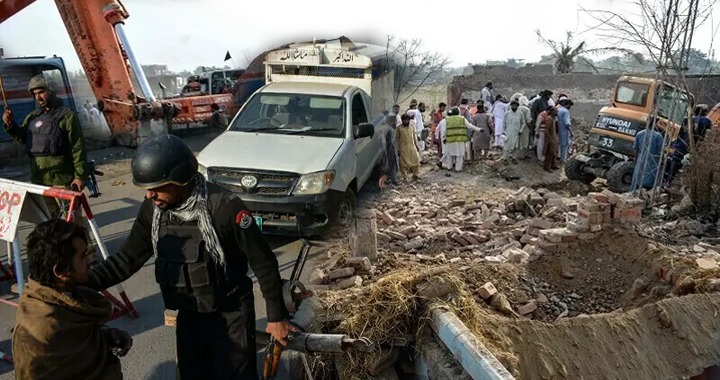
The past several days of relentless terror have once again pushed Khyber Pakhtunkhwa to the center of Pakistan’s counterterrorism challenge, as a coordinated wave of attacks across Bannu, Lakki Marwat, Kohat, Attock and adjoining regions exposed not only the operational capabilities of Fitna al-Khawarij networks, but also their growing reliance on cowardly soft-target attacks after sustained pressure from Pakistani security forces.
Within less than 48 hours, suicide bombings, infrastructure sabotage, attacks on police positions and assaults targeting civilian spaces collectively left more than twenty people dead, including police personnel and civilians, while dozens sustained injuries. The pattern, intensity and geographical spread of the attacks strongly suggest a broader and more deliberate escalation strategy by Fitna al-Khawarij-linked networks operating in northwestern Pakistan.
Among the deadliest incidents was the suicide bombing at Fateh Khel Police Station in Bannu, where an explosives-laden vehicle reportedly carrying nearly 1,500 to 1,600 kilograms of explosives rammed into the police compound. The blast reduced much of the structure to rubble, leaving fifteen policemen martyred, many of whom were trapped beneath the collapsed building.
The attack carried both tactical and psychological objectives.
Tactically, the target was a police installation located in a sensitive belt bordering North Waziristan. Psychologically, the attack was designed to project the impression that terrorist groups retain operational reach despite years of counterterrorism operations across former tribal districts.
However, the broader pattern emerging from recent attacks reveals something even more significant: terrorist organizations appear increasingly focused on “soft destabilization” rather than territorial control.
Markets, police checkpoints, bridges, isolated posts and civilian transit routes are being targeted not because terrorist groups can hold territory, but because they seek to create recurring insecurity, economic disruption and public fear.
The destruction of the strategically important Lora Bridge near Fateh Khel demonstrated this shift clearly. By targeting transportation infrastructure linking Bannu with North Waziristan, the attackers attempted to disrupt civilian movement, create logistical complications and reinforce the narrative of instability in border districts.
Similarly, the explosion in Lakki Marwat’s Sarai Naurang Bazaar showed how commercial centers and public gathering points remain vulnerable to attacks intended to maximize panic and civilian casualties.
At the same time, another important dimension has emerged from these incidents: the deliberate targeting of police forces.
Over recent months, police stations, check posts and local law enforcement personnel have increasingly become primary targets. Analysts believe terrorist groups now perceive police as comparatively exposed “soft security targets,” particularly in districts where policing infrastructure remains under-resourced or vulnerable.
This concern became especially visible after the Fateh Khel attack, where much of the loss of life occurred due to the collapse of the police station structure itself following the explosion.
The issue of policing infrastructure in Khyber Pakhtunkhwa has repeatedly surfaced after major attacks. Questions surrounding fortification standards, defensive preparedness, surveillance systems, electronic jammers and emergency response capacity continue generating debate among security observers.
At the same time, many analysts argue that operational autonomy and professional strengthening of provincial policing structures remain equally important. Calls are growing louder for insulating police institutions from political interference in transfers, appointments and operational matters, particularly in terrorism-affected districts.
Yet the current threat environment cannot be understood solely through internal dynamics.
Pakistan has repeatedly maintained that terrorist leadership linked to the TTP, Hafiz Gul Bahadur network and associated factions continue operating from Afghan territory. Islamabad has consistently raised concerns regarding cross-border sanctuaries, logistical facilitation and operational planning allegedly taking place across the border.
Recent diplomatic developments, including Pakistan summoning Afghan diplomatic representatives following the Bannu attack, reflected the seriousness with which the state views these concerns.
Security officials and analysts increasingly argue that the current militant strategy relies on a combination of cross-border sanctuaries, localized facilitation networks and propaganda operations designed to amplify fear far beyond the battlefield itself.
This propaganda dimension has also become impossible to ignore.
Over recent weeks, multiple false claims and fabricated narratives circulated through India- and Afghanistan-linked social media networks attempted to portray security incidents through misleading or distorted framing. False reports regarding attacks in Kharan, fabricated allegations concerning strikes in Kunar and misinformation surrounding Gwadar-related firing incidents formed part of what analysts describe as an information warfare ecosystem accompanying militant violence.
The objective appears twofold: first, to undermine public confidence in state institutions, and second, to generate confusion around real security operations targeting terrorist and smuggling-linked networks.
Simultaneously, another deeply concerning trend has emerged from Balochistan: the exploitation of youth, particularly students and young girls, by terrorist organizations such as the banned Baloch Liberation Army.
Recent arrests of young female suicide bombing recruits exposed how coercion, emotional manipulation and ideological grooming are increasingly being weaponized against vulnerable youth. Statements from detained girls revealed patterns of intimidation, blackmail and systematic radicalization, often involving exploitation through personal relationships or social pressure.
Security observers warn that educational institutions, urban facilitation structures and digital propaganda spaces are becoming central battlegrounds in the ideological dimension of terrorism.
The transformation of educated individuals into extremist operatives, including previous cases involving university students and academic figures linked to terrorist networks, reflects a long-term challenge extending beyond kinetic counterterrorism operations.
This evolving threat matrix means Pakistan’s counterterrorism response can no longer rely solely on reactive security operations.
Military pressure remains essential, particularly against cross-border sanctuaries and operational networks. However, analysts argue that sustainable stabilization will also require stronger policing institutions, intelligence integration, ideological countermeasures, digital information resilience and long-term socio-political stability in conflict-affected regions.
Despite the scale of recent attacks, one reality remains equally visible: terrorist groups continue failing to achieve strategic control on the ground.
Incidents such as the recent attempted propaganda appearance by Fitna al-Khawarij terrorists in Bannu’s Domel area, where terrorists fled within minutes after learning of approaching security forces, illustrate the gap between propaganda projection and operational reality.
Unable to hold territory or sustain direct confrontation against Pakistani security forces, terrorist networks increasingly appear focused on symbolic violence, psychological operations and sporadic high-casualty attacks intended to project relevance.
For Pakistan, the challenge now is not merely preventing the next attack but dismantling the broader ecosystem that enables militancy to regenerate through sanctuaries, propaganda, facilitation networks and ideological recruitment pipelines.
The recent violence across Khyber Pakhtunkhwa and adjoining regions demonstrates that the battlefield has evolved. The response, analysts warn, must evolve faster.



