
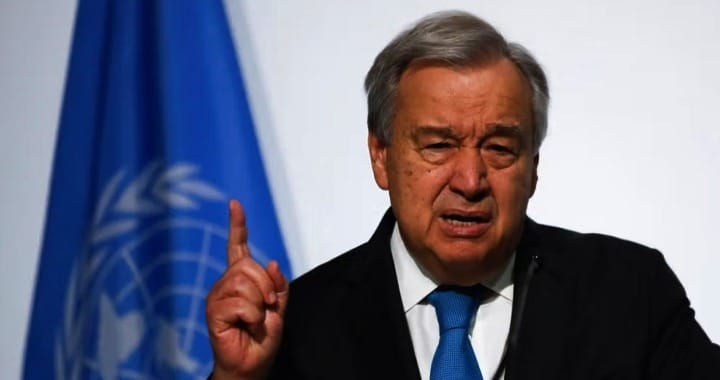
The United Nations Secretary-General António Guterres has reported a sharp deterioration in Afghanistan’s security situation, telling the United Nations Security Council that 3,687 security incidents were recorded across the country between 1 February and 30 April. This represents a 57 percent increase compared with the same period last year.
The findings are contained in the Secretary-General’s latest report, finalised on 22 May and recently released, which reviews political, security, humanitarian, and human rights developments in Afghanistan over the three-month reporting period.
Rising violence across multiple provinces
The UN report describes a widespread rise in security incidents across Afghanistan, with violence recorded in provinces including Badakhshan, Baghlan, Herat, Kabul, Kandahar, Khost, Kunar, Kunduz, Panjshir, and Zabul.
The incidents included armed engagements, attacks on checkpoints, and strikes on security convoys, reflecting what the UN describes as sustained instability across multiple regions rather than isolated hotspots.
Armed opposition activity and claimed attacks
The report states that armed groups opposing the Taliban claimed responsibility for at least 18 attacks during the reporting period.
These groups include:
National Resistance Front of Afghanistan
Afghanistan Freedom Front
National Mobilisation Front
Afghanistan Green Trend
According to the UN, 16 of these attacks were verified and occurred across multiple provinces. The incidents involved rocket fire, grenade attacks, and shootings, primarily targeting Taliban checkpoints and security convoys.
Despite these operations, the UN assessment notes that armed opposition groups have not posed a significant challenge to Taliban territorial control.
ISKP maintains operational capability
The report also highlights continuing concerns regarding the Islamic State Khorasan Province, known as Islamic State Khorasan Province.
While the group did not claim any major attacks against Taliban forces during the reporting period, UN sanctions monitoring assessments indicate that ISKP has retained both operational and combat capability inside Afghanistan.
This assessment contrasts with public statements by Taliban officials, including claims made at an international security conference in Moscow that ISKP had been fully defeated and contained.
Civilian casualties from Afghanistan–Pakistan clashes
The UN reports significant civilian harm linked to clashes between Taliban forces and Pakistan between 26 January and the end of April.
A total of 379 civilians were killed and 473 injured, with most casualties attributed to Pakistani air strikes and cross-border shelling inside Afghan territory.
The deadliest incident cited in the report is the 16 March strike on the Omid drug rehabilitation centre in Kabul, which resulted in 269 deaths and 122 injuries, according to updated UN figures.
Another major incident occurred on 27 April in Kunar province, where 88 civilian casualties were recorded, including seven deaths and 81 injuries. The UN notes that students and lecturers from Sayed Jamaluddin Afghani University in Asadabad were among those affected.
Detentions, killings, and torture of former officials
The Secretary-General reports continued human rights concerns involving former Afghan government officials and former security personnel.
The UN Assistance Mission in Afghanistan, United Nations Assistance Mission in Afghanistan, documented between 26 January and 31 March:
5 killings
20 cases of arbitrary arrest and detention
8 cases of torture or ill-treatment
These cases involved individuals linked to the former government and security structures, with the report noting ongoing concerns about due process and protection guarantees.
Tightening restrictions on women
The report states that Taliban authorities have intensified enforcement of dress regulations for women, particularly in Kandahar and Herat provinces.
In some instances, women were publicly reprimanded or humiliated while being compelled to comply with dress codes. The UN also reports detentions in Herat linked to alleged violations of hijab requirements.
These developments are presented as part of a broader pattern of increasing social restrictions affecting women’s visibility and participation in public life.
Corporal punishment cases documented
UNAMA documented 228 cases of corporal punishment during the reporting period.
Those affected included 29 women, 196 men, and three boys. The punishments were issued by Taliban courts and were linked to offences such as extramarital relations, running away from home, same-sex relations, gambling, and alcohol consumption.
The UN notes that these cases reflect continued use of corporal punishment as a judicial practice.
Nearly 300 grave violations against children
The United Nations verified nearly 300 grave violations against children in the first three months of the year.
At least 200 children, including 67 girls, were affected. The violations included killings and maiming, attacks on schools and hospitals, and obstruction of humanitarian assistance.
The report describes these incidents as part of a continuing pattern of harm affecting children in conflict-affected areas.
Legal framework concerns
The UN raises concerns over the Taliban’s penal code, published in January 2026, stating that it institutionalises gender discrimination.
According to UN Women, the code defines women primarily in relation to their roles as wives rather than as independent legal persons, reinforcing structural inequality.
The Secretary-General warns that the framework contributes to legitimising violence against women and enables discretionary enforcement practices that may increase the risk of corporal punishment.
Media restrictions continue
The report highlights ongoing restrictions on media freedom in Afghanistan.
Key developments include:
Revocation of licences for all media-support organisations except three, announced on 26 January by Taliban authorities
Suspension of Rah-e-Farda television and radio on 28 February following allegations linked to the outlet’s owner
Continued suspension of that broadcaster throughout the reporting period
Temporary closure of Khushhal Radio in Ghazni from 3 to 10 March after a programme-related incident
The UN states that these actions reflect a continuing contraction of independent media space.
Humanitarian situation deteriorates
The Secretary-General warns that Afghanistan’s humanitarian crisis has deepened due to declining international assistance, inflation, trade disruptions, mass population returns, and climate-related shocks.
The 2026 Afghanistan Humanitarian Response Plan has received only 14 percent of its required funding. Out of $1.7 billion needed, just $240.9 million has been secured.
The report estimates that 21.9 million people, or around 45 percent of Afghanistan’s population, will require humanitarian assistance in 2026. Priority needs include food aid, treatment for acute malnutrition, primary healthcare, safe drinking water, and protection services.
Aid system under pressure
Operational capacity among humanitarian organisations is also under strain:
80 percent report financial difficulties
39 percent have reduced salaries
35 percent have scaled back field operations
28 percent are planning further reductions in staffing or programmes
Displacement and climate-related shocks
The UN also expresses concern over possible forced returns of Afghan refugees from Tajikistan, warning of serious protection consequences.
By 1 April, around 94,000 people had been displaced due to Afghanistan–Pakistan border tensions. The report also notes rising risks of gender-based violence in affected areas.
Between 26 March and 16 April, heavy rainfall and flash floods affected 73,300 people and left more than 31,600 in urgent need of assistance.
Food insecurity reaching critical levels
The report estimates that around 17.4 million people are currently facing acute food insecurity, with the number expected to increase due to funding shortages and ongoing disruptions in aid delivery.
It also states that approximately 4.9 million children under five, along with pregnant and breastfeeding women, require urgent treatment for acute malnutrition.



