
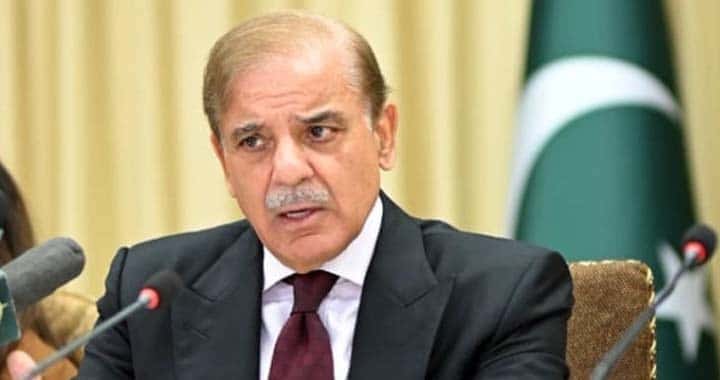
Prime Minister Shehbaz Sharif has linked the imposition of Governor’s Rule and emergency measures in Khyber Pakhtunkhwa to what he described as unavoidable circumstances, warning that delaying the decision could have exposed the province to further damage amid renewed terrorism.
Addressing the Pakistan Muslim League-Nawaz (PML-N) parliamentary party from Khyber Pakhtunkhwa, the prime minister said the government had attempted to resolve the situation through negotiations but ultimately considered intervention necessary to protect the public, the country’s economy and society.
Shehbaz said committees representing the PML-N and Pakistan Peoples Party held talks for 48 hours. The government waited for approval of a draft agreed upon during the negotiations, but the approval did not come.
He said a decision had become essential under the circumstances and maintained that the government would continue working for the province’s development, prosperity and public welfare.
PM Links Terrorism Resurgence to Return of Terrorists From Afghanistan
The prime minister directly connected Pakistan’s renewed terrorism challenge to decisions taken in 2019 and 2020, saying terrorists had been brought back from Afghanistan and resettled in Pakistan.
He said the resurgence of terrorism had inflicted significant losses on the country. Shehbaz added that he had called for a united response against terrorism, similar to the national effort made in the past, but his appeal had not been heeded.
His remarks placed counterterrorism at the center of the government’s justification for its decision on KP, presenting the province’s security situation as a challenge requiring action alongside efforts to restore governance and development.
The prime minister did not provide a breakdown of the losses caused by the renewed wave of terrorism during his address.
PM Criticizes 13 Years of Governance in KP
Shehbaz described Khyber Pakhtunkhwa as a beautiful province whose people were courageous, dignified and resilient. He also credited PML-N leader Nawaz Sharif with supporting democratic traditions in the province after the 2013 general elections, when the majority party was allowed to form the provincial government.
However, he criticized the party that had governed KP for the past 13 years, questioning how many universities and hospitals had been established during that period.
He said communities from Peshawar to Kohistan, Hazara and the province’s southern districts continued to face problems that had not received adequate attention.
The prime minister said PML-N would continue its efforts for provincial development and public service.
Negotiations Preceded Emergency Decision
Shehbaz said the government had pursued negotiations before deciding to impose Governor’s Rule and emergency measures. He argued that the public interest, national economy and social stability required a timely decision.
He also criticized the politics of long marches and sit-ins, saying protests over the past two and a half years had affected national priorities. Referring to the 2014 sit-in, he said the visit of Chinese President Xi Jinping had been postponed, although important agreements were signed during his visit to Pakistan in 2015.
Economic Relief Amid Regional Pressures
The prime minister said the country’s military and political leadership had worked jointly to stabilize the economy. He acknowledged that international developments and the Gulf conflict had caused an extraordinary rise in energy prices.
Despite these pressures, he said, the government had launched a fuel subsidy scheme to provide relief to the public.
According to Shehbaz, around 13 million people had benefited from the scheme, for which the government allocated Rs75 billion. He described relief for low-income citizens as a major priority and said the government was taking all possible measures to prevent economic instability.
The prime minister’s remarks placed the KP emergency decision within a broader argument linking renewed terrorism, governance concerns and the need for timely state action.



