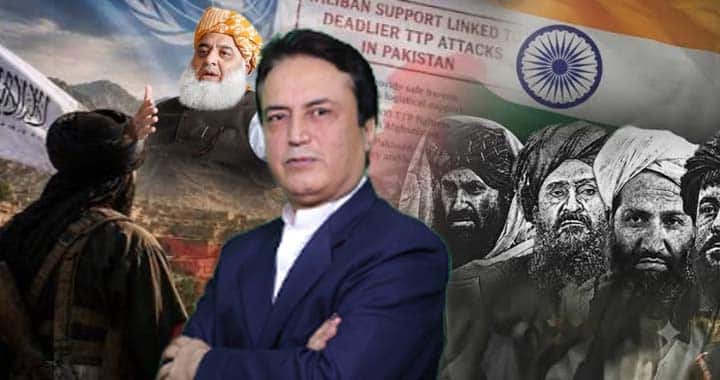
Pakistan is confronting a complex security and political environment in which internal threats, regional rivalries and domestic power struggles are increasingly intersecting. The changing operational pattern of Tehreek-e-Taliban Pakistan (TTP), reports of secret contacts involving armed organisations in Afghanistan, growing instability in Iran’s Sistan region and the political confrontation surrounding Maulana Fazlur Rehman raise serious questions about the challenges facing the state.
At the centre of this situation lies a fundamental principle: Pakistan’s sovereignty, territorial integrity and national security cannot be compromised by the ambitions of any armed organisation, political personality or regional power.
The apparent reduction in TTP attacks, reports of its continued presence across parts of Khyber Pakhtunkhwa and allegations of regional coordination involving different armed groups demand a comprehensive security response. At the same time, political disagreements must not be allowed to distract from the country’s wider national priorities.
The question is whether the changing security environment represents genuine progress or merely a transformation in the nature of the challenges confronting the state. The imposition of emergency measures in parts of the region has generated speculation that the movement of Noor Wali Mehsud and other senior TTP figures has become increasingly restricted. However, the available information does not establish that the organisation’s operational capacity has been decisively weakened.
Noor Wali Mehsud’s whereabouts have remained a subject of considerable speculation. Previous reports placed him in different locations across Afghanistan, including Kabul and Kandahar, while other information pointed towards his possible presence in Pakistan’s mountainous border regions.
A video reportedly showing him moving through the mountainous terrain of Kurram also attracted attention. The reported presence of sophisticated electronic equipment among individuals accompanying him raised further questions about the organisation’s security arrangements and awareness of surveillance.
More important, however, is the apparent change in the TTP’s operational pattern. Daily attacks that previously reached approximately 10 to 20 have reportedly declined to around five to eight in recent weeks. Their intensity has also seemingly decreased.
Although this reduction is a significant development, it should not automatically be interpreted as evidence that the security threat has been eliminated.
Reports of increased TTP visibility in Bajaur, North Waziristan, South Waziristan and Kurram present a different picture. Large gatherings and movements in local markets, streets, mosques and community spaces indicate that the security situation requires continued attention.
This raises an important question: If attacks are declining while public visibility is reportedly increasing, what does this mean for the state’s long-term security objectives?
Pakistan must not measure its security success exclusively through daily attack statistics. The real benchmark should be the restoration of effective state authority, the protection of civilians and the prevention of any armed organisation from establishing an independent sphere of influence.
The people of Khyber Pakhtunkhwa deserve lasting peace, freedom of movement and protection from intimidation. They should not have to live between competing claims of authority or face uncertainty about who controls their streets and communities.
The state’s responsibility is clear: every district must remain under the authority of constitutional institutions, and no armed organisation should be allowed to challenge that authority. A temporary reduction in attacks is welcome, but sustainable peace requires the complete restoration of security and normal civilian life.
Another development raising serious concerns involves reports of a confidential meeting between representatives of several armed organisations with connections to the region.
Information surrounding the alleged gathering has linked it to Al-Qaeda, Jaish al-Adl and other organisations, with possible participation by individuals associated with Baloch armed groups. Although the precise location and full details of the meeting remain unverified, its reported connection to developments in Iran’s Sistan region makes the issue particularly significant.
The security environment in Sistan has become increasingly volatile, with organised attacks, Iranian security operations and growing tensions along the Pakistan-Iran border.
Iran has previously conducted an operation inside Pakistani territory, prompting a response from Pakistan. This episode demonstrated the seriousness of cross-border security concerns and the potential consequences of allowing regional tensions to escalate.
For Pakistan, the lesson is straightforward: border security is inseparable from national sovereignty, and developments across neighbouring territories must be monitored with considerable seriousness.
The alleged Kandahar meeting raises another important question: Are different armed organisations developing overlapping interests in the region, particularly concerning developments inside Iran?
One dimension of the emerging discussion involves the possibility of a broader regional pressure strategy directed at the Islamic Revolutionary Guard Corps (IRGC), potentially connected to the Houthis and their activities involving Saudi Arabia.
The theory suggests that increasing pressure on Iranian security institutions could influence Tehran’s position regarding Houthi activities and attacks against Saudi Arabia. However, these alleged connections should not be confused with established evidence of a centrally coordinated operation. Nevertheless, the wider security implications deserve serious examination.
Afghanistan, Pakistan and Iran share geographical realities that cannot be separated from their security interests. Instability in one territory can generate consequences across neighbouring borders.
Pakistan therefore has a legitimate interest in preventing its territory from becoming vulnerable to the rivalries, calculations and activities of external organisations. The country’s security policy must remain guided by sovereignty, diplomatic responsibility and the protection of its citizens. No regional arrangement should come at the expense of Pakistan’s territorial integrity.
While regional security developments demand immediate attention, the growing political dissatisfaction of Maulana Fazlur Rehman presents another important challenge within the domestic political landscape.
The central issue is not simply whether Maulana is dissatisfied with the current political arrangement. It is whether the political confrontation surrounding him is being managed in a manner consistent with democratic accountability, institutional stability and the wider national interest.
Maulana has spent decades navigating Pakistan’s complicated political environment. His leadership of the Pakistan Democratic Movement (PDM) and his role in the political campaign that resulted in Imran Khan’s removal from office placed him at the centre of a major political transition.
His political engagement with the then army chief, General Qamar Javed Bajwa, and his own public statements about his role in the removal of Imran Khan demonstrate his involvement in the country’s power politics. This history is important when examining his present political position. Maulana has every constitutional right to disagree with the government, criticise state policies and demand political concessions. However, political influence also comes with responsibility.
No political leader should place personal political calculations above the broader interests of democratic institutions and national stability. The same principle applies to every political party and every institution.
Pakistan’s political system cannot function effectively if political relationships are treated merely as arrangements for acquiring influence, negotiating power or securing positions within government. Political cooperation must be based on constitutional principles, institutional accountability and the interests of the public.
Maulana’s current political dissatisfaction should therefore be examined through the same standards applied to every other political figure: political consistency, public accountability and the consequences of political decisions.
The controversies surrounding Maulana’s political and financial affairs have added another dimension to the current disagreement. Questions have been raised about his assets, religious institutions and financial resources. His son Mahmood has also reportedly received a NAB notice following allegations involving recruitment irregularities and commissions in government contracts.
These matters require proper investigation and due process. Allegations alone cannot establish guilt, and no individual should be considered responsible for an offence without the necessary legal findings.
However, the principle of accountability must apply equally to everyone. Political influence, religious standing, parliamentary experience or connections with powerful institutions should not place anyone beyond the reach of lawful scrutiny.
Equally, accountability mechanisms must not be used as instruments of political pressure or selective retaliation. Pakistan needs institutions that can investigate allegations transparently, establish facts and ensure that the law applies without discrimination.
The credibility of accountability depends not on the political identity of the person being investigated but on the fairness and independence of the process. This principle is essential for public confidence and the long-term strength of the state.
One of the most important questions emerging from Maulana’s present political position concerns the relationship between political parties and the establishment. There appears to be a wider problem of inconsistent political engagement, with public criticism sometimes existing alongside private attempts at reconciliation.
Such contradictions can deepen mistrust and make political negotiations increasingly difficult. The establishment must recognise that political figures cannot all be approached through identical strategies. Maulana Fazlur Rehman has considerable experience in political negotiations and has participated in multiple political arrangements throughout his career.
However, his political experience does not exempt him from accountability, just as the authority of state institutions does not exempt them from constitutional responsibility. The solution is neither unrestricted political accommodation nor unnecessary confrontation.
It is a transparent political process in which disagreements are resolved through dialogue, constitutional mechanisms and democratic accountability. The same standard must apply to the PPP, PML-N, PTI, JUI-F and every other political organisation.
Pakistan cannot afford a political environment in which public criticism, private negotiations and institutional pressure become substitutes for a coherent democratic framework. The national interest must remain above individual political calculations.
Pakistan’s history provides a painful reminder of the consequences of political failures and institutional mistrust. The breakup of the country in 1971 was a devastating national tragedy. Political disagreements, institutional confrontation and the failure to reach a sustainable political settlement contributed to a crisis whose consequences extended far beyond the competing political actors.
The lesson remains relevant. Political competition is an unavoidable feature of democratic life. Governments can be challenged, opposition parties can organise protests and political leaders can question state policies.
But political competition must operate within constitutional boundaries, and institutional disagreements must have peaceful mechanisms of resolution.
The confrontation involving Maulana Fazlur Rehman, alongside other political disputes, should be viewed within this broader historical context.
The developments surrounding Sohail Afridi also illustrate the difficulties that can emerge when political disagreements become entrenched and communication breaks down.
When political actors and state institutions become locked in prolonged confrontation, the costs are ultimately borne by ordinary citizens. No political leader, party or institution should consider its immediate interests more important than the country’s stability. The experience of 1971 should remain a reminder that political miscalculations can have consequences that generations may continue to bear.
Pakistan’s current challenges are interconnected, even though they require different policy responses. The TTP’s changing operational pattern demands sustained attention from security institutions. Reports of continued public visibility must be examined rather than dismissed simply because the frequency of attacks appears to have declined.
The alleged contacts involving regional armed organisations in Kandahar require careful assessment, particularly in the context of developments in Iran’s Sistan region and the security implications for neighbouring countries. At the domestic level, the political confrontation surrounding Maulana Fazlur Rehman highlights the importance of constitutional politics, transparent accountability and responsible engagement between political parties and state institutions.
These challenges must not be allowed to distract the country from its fundamental priorities.
Pakistan needs:
- Effective state authority throughout Khyber Pakhtunkhwa and other affected regions.
- Protection of civilians and the restoration of normal life in communities affected by insecurity.
- Strong border security and responsible diplomatic engagement with Afghanistan and Iran.
- Evidence-based investigations into alleged regional security arrangements.
- Equal application of the law and transparent accountability for public officials and political figures.
- A political environment in which disagreements are resolved through constitutional and democratic processes.
Above all, Pakistan must reject the notion that any armed organisation can substitute its authority for that of the state. Likewise, political disagreements must never become a justification for undermining constitutional institutions or compromising public interests.
Pakistan’s security and political challenges require clarity, consistency and strategic discipline. The apparent reduction in TTP attacks should not create complacency. The continued reports of its presence in different areas demand a sustained commitment to public safety and the restoration of effective state authority.
The alleged Kandahar contacts and developments in Iran’s Sistan region demonstrate the importance of regional security cooperation and the protection of national borders.
At the same time, the political disagreement involving Maulana Fazlur Rehman must be addressed through constitutional politics, democratic accountability and meaningful dialogue. No political personality should be above scrutiny, and no state institution should operate beyond constitutional responsibility.
Pakistan’s future cannot be determined by the calculations of armed organisations, the political ambitions of individual leaders or the competing interests of regional actors.
The country needs lasting security, functioning democratic institutions, responsible political leadership and a foreign policy guided by national sovereignty. The people of Pakistan deserve peace, stability and a political system that serves their interests rather than becoming consumed by endless struggles for influence.
The ultimate principle must be non-negotiable: Pakistan’s sovereignty is not a bargaining chip, its territory is not a platform for armed organisations, and its national interest must never become subordinate to the political ambitions of individuals or groups.
That is the foundation upon which lasting security, political stability and national strength must be built.