
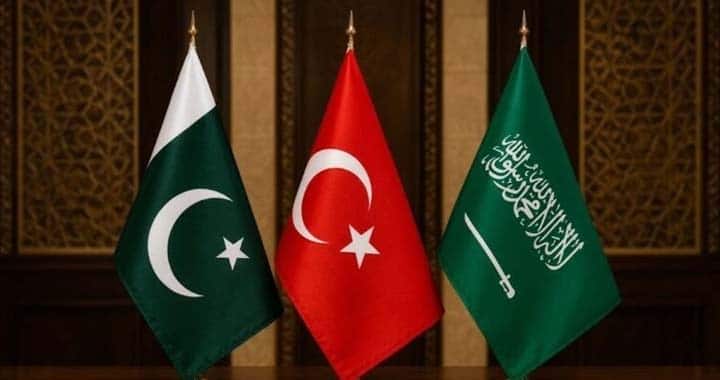
The Pakistan-Saudi Arabia-Türkiye strategic defence partnership has reached a major milestone, with the Turkish Parliament approving the Makkah Joint Defence Agreement, marking a significant step towards institutionalising collective security and strengthening the trilateral defence architecture.
The landmark parliamentary approval, secured with 279 votes in favour and 119 against, represents a major advancement in the implementation of the agreement signed by the leadership of the three countries in Makkah on August 7. The development reinforces a shared commitment to safeguarding sovereignty, territorial integrity and national security while enhancing strategic coordination in an increasingly challenging regional security environment.
Under the agreement’s collective defence framework, an external armed attack against any one of the three participating countries will be treated as an attack against all three. The agreement provides for collective assistance, with the nature and scope of the response to be determined through consultations and mutual agreement in accordance with the respective national laws and constitutional procedures.
The Turkish parliamentary approval assumes particular significance amid growing regional security challenges, including Houthi attacks targeting Saudi Arabia and heightened tensions across the Middle East. It establishes a stronger institutional foundation for coordinated security responses and reinforces the principle that the security concerns of the three partner nations require collective attention and cooperation.
Importantly, the agreement is not directed against any third country. Turkish officials have emphasised that the alliance is exclusively defensive in nature, with its primary objective being to strengthen deterrence, prevent conflict and promote regional peace and stability.
Beyond collective defence commitments, the agreement envisages expanded military coordination, intelligence cooperation, joint defence initiatives and closer collaboration in defence-related capabilities. It also provides a framework for strengthening institutional linkages and enhancing cooperation among the armed forces of the three countries.
A significant institutional dimension of the agreement is the establishment of its secretariat in Riyadh. Pakistan’s retired Lieutenant General Nauman Mahmood has been appointed as the alliance’s first Secretary-General for a three-year term, reflecting Pakistan’s central role in shaping and advancing the trilateral security framework.
The three countries have already undertaken high-level consultations through meetings in Istanbul and Riyadh. Their senior-level engagements, including discussions in Tehran last month, underscore the broader diplomatic dimension of the partnership and the shared interest in preventing further regional escalation.
The agreement also provides an institutional framework through which additional regional countries may participate, subject to the founding members’ consent and adherence to international law, respect for sovereignty, territorial integrity and the principle of non-interference in internal affairs.
The agreement will remain in force without a fixed expiry date. Withdrawal is not permitted during the initial ten-year period, after which any participating country may withdraw by providing three months’ prior written notice.
The Turkish Parliament’s approval marks more than a legislative development; it represents a significant step towards translating the strategic understanding among Pakistan, Saudi Arabia and Türkiye into a structured and enduring defence partnership.



