
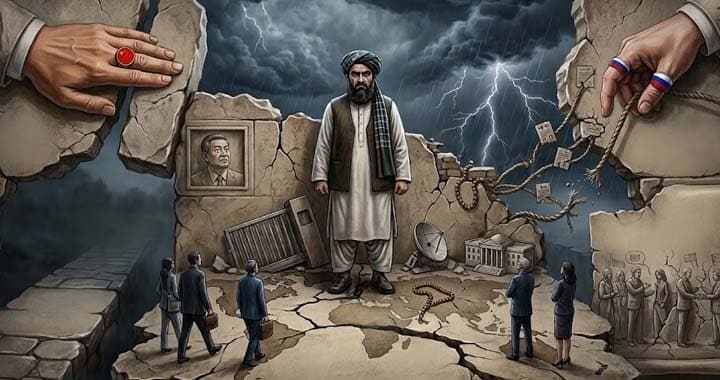
The Afghan Taliban administration is facing an increasingly challenging diplomatic landscape as major global powers reassess their engagement with Kabul, with China reportedly downgrading its political relationship with the Taliban to a predominantly commercial partnership and Russia considering a possible suspension of its formal recognition of the regime.
The reported developments mark a significant setback for the Taliban leadership, whose efforts to secure international legitimacy and establish Afghanistan as an accepted member of the international community appear to be encountering growing resistance. What was once an ambitious diplomatic outreach is increasingly being overshadowed by mounting regional security concerns, unresolved political questions and the administration’s failure to address key international demands.
According to reports, Beijing has quietly recalibrated its approach towards Kabul, shifting its engagement towards trade and commercial interests rather than extending broader political support to the Taliban administration. Even more significantly, Russia is reportedly considering suspending its recognition of the Taliban leadership following a request from Beijing. If confirmed, such a move would represent a major diplomatic reversal and deal another blow to the regime’s international standing.
The significance of these developments extends well beyond bilateral relations. China and Russia have both maintained important diplomatic and strategic engagement with Afghanistan since the Taliban returned to power in August 2021. Any substantial reduction in their political engagement would further narrow Kabul’s diplomatic space and complicate its efforts to secure international acceptance.
The Taliban leadership is increasingly confronting the consequences of its inability to transform territorial control into credible and responsible governance. Five years after returning to power, fundamental questions remain over political inclusivity, restrictions on women’s rights and education, governance standards, economic stability and the continued presence of armed groups operating from Afghan territory.
The growing international reservations also reflect persistent concerns among Afghanistan’s neighbours regarding the use of Afghan soil by terrorist organisations to threaten regional security. Pakistan, in particular, has repeatedly raised serious concerns over cross-border terrorism and the presence of anti-Pakistan militant networks operating from Afghanistan. Islamabad has consistently called for verifiable action against these elements, making security cooperation and the prevention of cross-border terrorism central to its engagement with Kabul.
Pakistan’s earlier diplomatic engagement also helped create opportunities for the Taliban administration to interact with regional and international stakeholders. However, diplomatic facilitation cannot substitute for responsible governance, credible security commitments and constructive relations with neighbouring countries. The Taliban leadership must recognise that international legitimacy cannot be secured through diplomatic outreach alone while fundamental regional and international concerns remain unresolved.
The reported developments involving China and Russia also highlight the difference between maintaining commercial or diplomatic contacts and extending formal political recognition. Economic engagement does not necessarily translate into political endorsement, and the Taliban administration’s ability to attract trade and investment cannot, by itself, overcome the broader challenges confronting its international standing.
From Washington to Beijing and Moscow, international engagement with Kabul continues to be shaped by questions of security, governance and political credibility. The Taliban leadership’s failure to adequately address these concerns risks further restricting Afghanistan’s diplomatic options and deepening its international isolation.



