
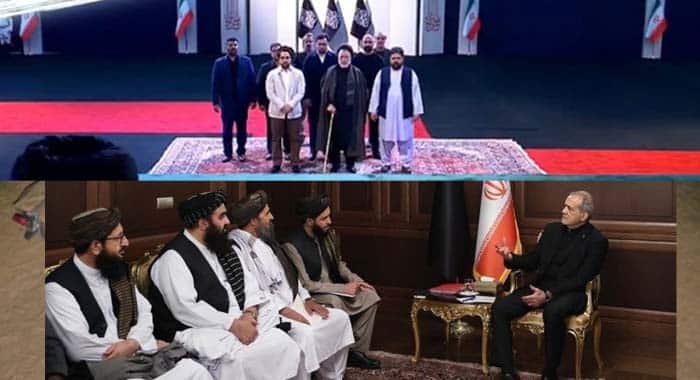
Political history often turns on moments that appear ceremonial rather than strategic. A funeral, after all, is typically associated with closure, remembrance, and symbolism not with the beginning of diplomatic realignment. Yet the simultaneous presence of Taliban representatives alongside prominent anti-Taliban figures at the funeral ceremony of the Islamic Republic’s leader created one of the most remarkable political images Afghanistan has witnessed since the Taliban returned to power nearly five years ago.
The ceremony itself will soon fade into history. The photographs will disappear from the headlines, and official statements will be forgotten. What will remain, however, is a far more consequential question: was this simply a diplomatic courtesy extended to all Afghan factions, or does it mark the beginning of a gradual shift in how regional powers and Iran in particular approach Afghanistan’s political future?
The answer matters because, for almost five years, one assumption has dominated regional diplomacy: political authority in Afghanistan resides exclusively with the Taliban, making engagement with the movement both inevitable and sufficient. Whether governments recognized the Taliban formally or not, most concluded that meaningful diplomacy required dealing primarily with Kabul’s de facto rulers.
This assumption gradually pushed Afghanistan’s political opposition to the margins.
Although opposition leaders occasionally attended conferences, held meetings abroad, or organized forums in exile, these activities rarely translated into meaningful regional diplomacy. Governments generally viewed such engagements as symbolic rather than politically consequential. Regional capitals maintained contact with opposition figures without granting them any significant diplomatic status. The Taliban became the sole practical address through which Afghanistan was discussed.
Against this backdrop, Tehran’s decision to host both Taliban officials and prominent opposition leaders including Ahmad Massoud and Mohammad Mohaqiq deserves closer attention than it has so far received.
To be clear, this development should not be exaggerated. There is no convincing evidence that Iran has abandoned its pragmatic engagement with the Taliban or that it intends to sponsor a new anti-Taliban coalition. Tehran’s security, economic, and border interests continue to require regular communication with Afghanistan’s rulers. Nothing that occurred during the funeral ceremony fundamentally alters that strategic reality.
Nevertheless, diplomacy is often driven as much by symbolism as by formal declarations.
The significance of the funeral lies less in any immediate policy shift than in the message conveyed by the invitations themselves. For the first time since the Taliban’s return to power, a major regional actor publicly treated Afghanistan as politically more complex than a single governing authority. By inviting both the government and some of its principal opponents, Iran implicitly questioned the notion that Afghanistan’s future can be discussed exclusively through one political address.
This distinction is subtle but important.
The event did not weaken the Taliban’s control over Afghanistan. Nor did it strengthen the opposition militarily or politically overnight. Yet it challenged a diplomatic assumption that had become increasingly entrenched: that Afghanistan’s opposition had become irrelevant to regional calculations.
Even a modest reconsideration of that assumption could have significant consequences.
If Tehran’s approach evolves into a sustained policy rather than remaining an isolated gesture, other regional governments may eventually conclude that maintaining constructive relations with the Taliban does not require ignoring alternative Afghan political actors. Such a shift would not necessarily imply support for regime change or efforts to undermine the Taliban. Rather, it would acknowledge a reality familiar to experienced diplomats: maintaining multiple channels of communication provides greater flexibility than relying exclusively on one actor.
In practical terms, this could normalize invitations for opposition leaders to regional conferences, security dialogues, academic forums, and official consultations. Such participation would not amount to diplomatic recognition or political endorsement. Yet it would gradually reduce the political isolation that has constrained the opposition since 2021.
For Afghanistan’s fragmented opposition, however, this opportunity may prove as challenging as it is promising. The greatest obstacle facing anti-Taliban forces over the past five years has not been solely the Taliban’s political dominance. Equally damaging has been the opposition’s persistent inability to establish unity among itself.
Internal rivalries have frequently overshadowed strategic coordination. Questions of leadership, legitimacy, representation, and political ownership have repeatedly divided groups that ostensibly share the same objective. Rather than presenting a coherent alternative to Taliban rule, opposition movements have often competed with one another for international attention, funding, and diplomatic access. If regional governments begin reopening political space for selected opposition figures, those longstanding rivalries may intensify.
Who, after all, speaks on behalf of Afghanistan’s opposition?
Does Ahmad Massoud represent the entire resistance movement? Does Mohammad Mohaqiq speak primarily for a particular constituency? What role remains for other political leaders, former officials, civil society actors, women activists, or younger generations of opposition figures living in exile? These questions have never been satisfactorily answered. Increased regional engagement may make them even more contentious.
If Tehran’s outreach primarily benefits a limited number of recognizable personalities, other opposition groups may perceive themselves as excluded. That perception could deepen existing divisions precisely at the moment when greater cohesion would be most valuable. The irony is striking. Regional recognition, intended to broaden political inclusion, could inadvertently fuel greater competition within the opposition itself.
Yet perhaps the most intriguing consequence of the Tehran meeting lies elsewhere in the changing political psychology of Afghanistan’s opposition. For more than two decades, engagement with neighboring countries, particularly Iran and Pakistan, has carried a political stigma among many anti-Taliban circles. Relationships with these states have frequently been portrayed as evidence of dependency, foreign influence, or even political servitude. By contrast, similar engagement with Western governments has often been celebrated as diplomatic achievement and international legitimacy. This asymmetry has become deeply embedded in the opposition’s political culture.
The Tehran visit quietly challenged this double standard. Whether intentionally or not, the presence of Massoud and Mohaqiq demonstrated that regional diplomacy need not automatically be interpreted as political submission. Geography imposes realities that ideology cannot erase. Afghanistan’s neighbors will inevitably remain central actors in its political future, regardless of who governs Kabul.
Ignoring regional capitals has never constituted a sustainable foreign policy.
Indeed, every major Afghan government during the past half-century has eventually recognized that stable governance requires balancing relations among neighboring countries, regional powers, and global actors simultaneously. Exclusive reliance on either Western or regional partners has repeatedly produced strategic vulnerabilities.
The opposition may now be approaching a similar realization. If it hopes to regain political relevance, it cannot afford to view diplomacy through a binary framework in which engagement with Western capitals represents legitimacy while engagement with neighboring states invites suspicion. Effective diplomacy requires maintaining relationships across multiple geopolitical centers simultaneously.
Whether the opposition is prepared for such a transition remains uncertain.
Another variable complicates these calculations: the future relationship between Tehran and Washington. As long as tensions between Iran and the United States remain high, some Afghan opposition figures may continue avoiding close association with Tehran, fearing that such engagement could complicate their standing with Western governments or international institutions.
However, geopolitical alignments rarely remain static. Should relations between Iran and the United States gradually improve or even stabilize the political costs associated with engagement with Tehran would likely diminish. Afghan political actors would gain greater freedom to pursue regional diplomacy without being perceived as aligning themselves with a particular international bloc.
In that scenario, visits to Tehran, Islamabad, Ankara, Doha, Brussels, or Washington would increasingly be viewed not as ideological declarations but as normal components of a diversified diplomatic strategy. Ultimately, however, the central question remains unanswered. Was the funeral invitation an isolated act of protocol, or the first indication of a broader Iranian recalibration?
No single ceremony, regardless of its symbolism, can answer that question.
The real test lies in what follows. Will Iran continue inviting opposition leaders to official consultations? Will regular political dialogue emerge alongside Tehran’s existing engagement with the Taliban? Will other regional governments adopt similar practices? Will the Taliban tolerate such parallel diplomacy, or seek to discourage it? And perhaps most importantly, can Afghanistan’s divided opposition capitalize on any new political space without allowing internal competition once again to undermine collective strategy?
These questions cannot be answered by photographs or ceremonial seating arrangements. They will be answered over the coming months through sustained diplomatic behavior rather than symbolic gestures. If Tehran continues engaging both the Taliban and their opponents, historians may eventually identify this funeral ceremony as the quiet beginning of a broader transformation in regional diplomacy toward Afghanistan a shift from exclusive engagement with one governing authority toward a more flexible recognition of Afghanistan’s wider political landscape.
If, however, the invitations prove to have been nothing more than an exceptional act of diplomatic courtesy, then the prevailing regional framework will remain largely intact. The Taliban will continue serving as Iran’s principal interlocutor, while the opposition will once again find itself relegated to the margins of regional politics.
For now, the funeral should not be remembered primarily as the end of one political era. Its greater significance may lie in the possibility still uncertain, still fragile that it marked the beginning of a new conversation about Afghanistan’s place in regional diplomacy. Whether that possibility becomes reality will depend not on symbolism, but on the choices made by Tehran, the Taliban, and Afghanistan’s fragmented opposition in the months and years ahead.



