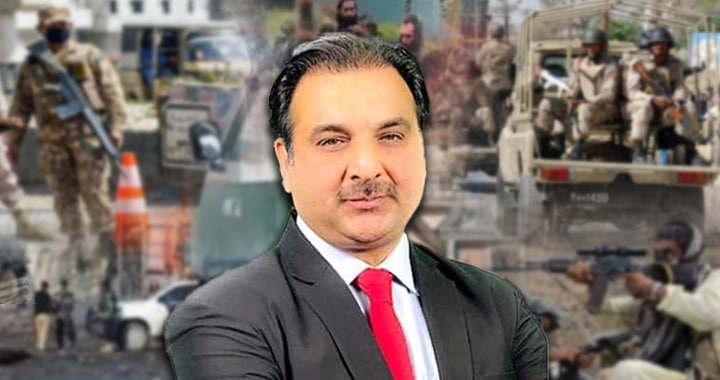
(Irfan Khan)
For decades, Pakistan has remained on the front line of the global struggle against terrorism. Yet the nature of this conflict has continued to evolve. What was once a conventional security challenge has transformed into a complex battlefield involving violent extremism, technology-driven attacks, political narratives, and information warfare. Today, the provinces of Khyber Pakhtunkhwa and Balochistan stand at the centre of this challenge, carrying the heaviest burden of instability and insecurity.
The resurgence of terrorism in these regions is not merely a question of law and order; it is a test of political responsibility, institutional coordination, and national unity. The debate is no longer limited to military action alone. It now involves the ability of the state to protect citizens, counter extremist propaganda, strengthen public confidence, and ensure that political differences do not weaken the collective response against threats.
Recent discussions among security analysts and political observers highlight a troubling reality: while security forces continue operations against militant networks, questions remain about the ownership of security responsibilities at the provincial level, the role of political leadership, and the battle over public perception.
Khyber Pakhtunkhwa, due to its geography and history, has faced the most severe consequences of terrorism. The province shares difficult terrain and sensitive borders, making it vulnerable to cross-border militancy, extremist infiltration, and organised attacks. Balochistan faces similar challenges, where security threats are linked with geography, foreign interference, and local vulnerabilities.
However, one important lesson from previous experiences is clear: terrorism cannot be defeated through the efforts of one institution alone. Success requires a unified national approach where political leadership, security institutions, and society move in the same direction.
One of the biggest concerns raised in recent debates is the issue of political ownership. Security matters at the district level largely fall within the responsibilities of provincial governments. A province facing repeated attacks must have leadership that openly acknowledges the seriousness of the threat and actively participates in developing solutions.
The argument is that security cannot become a responsibility only of security institutions while political governments remain distant observers. The chief executive of a province is not merely an administrator; the position carries the responsibility of coordinating governance, public safety, and crisis management.
The history of counterterrorism efforts shows that whenever political and security leadership worked together, results improved. During the fight against militancy in Swat, the state adopted a coordinated strategy involving both civilian and security leadership. Once there was a common direction and shared responsibility, the situation improved significantly, and normal life gradually returned.
This historical example demonstrates that the fight against terrorism requires unity. Divided responses create opportunities for extremist groups to exploit political disagreements and weaken public trust.
A major debate in Pakistan has been whether negotiations or operations are the best solution to terrorism. Dialogue is often considered an important tool in resolving conflicts, but dialogue requires willingness from both sides. When militant groups refuse to abandon violence, continue attacks, target civilians, and challenge state authority, the question arises: who exactly is there to negotiate with?
A state can negotiate political disagreements, but it cannot compromise on the safety of its citizens or sovereignty. No country can allow armed groups to operate outside the law indefinitely. The experience of previous operations suggests that security actions, when supported by political ownership and followed by effective governance, can restore stability. The objective of any counterterrorism strategy should not only be eliminating threats but also creating conditions where extremism cannot return.
The challenge today is different because militant organisations have adapted. They no longer rely only on traditional weapons or direct attacks. They are using modern technology, propaganda networks, and psychological warfare.
The methods of extremist groups have changed dramatically. The use of drones, quadcopters, improvised weapons, and digital platforms has introduced a new dimension to the conflict. Small drones that were once associated with advanced militaries are now being modified and used by non-state actors. These technologies allow militants to conduct attacks from a distance, create fear, and challenge traditional security methods. However, technology alone does not explain the problem. Such attacks require planning, training, resources, and local support networks. Extremist groups often depend on hidden facilitators, information channels, and individuals who provide assistance.
This means counterterrorism cannot focus only on the battlefield. It must also address recruitment, financing, propaganda, and the networks that allow extremist organisations to survive.
One of the most dangerous aspects of modern terrorism is the information war surrounding it. Extremist organisations and their supporters increasingly use social media to spread propaganda, influence public opinion, and undermine trust in state institutions. After security operations, false or misleading narratives can quickly spread, creating confusion about what actually happened. This is why communication has become a critical part of national security.
When militant groups attack security personnel or civilians, they often attempt to present themselves as victims or blame the state. Their objective is not only physical damage but also psychological impact. A society divided by misinformation becomes more vulnerable. If citizens lose confidence in institutions responsible for their protection, extremist groups gain space to operate. The response, therefore, requires transparency, timely information, and stronger public engagement. Winning the narrative battle is as important as winning the physical battle.
Another important aspect is the responsibility of political and social groups. In a democracy, criticism of government policies and institutions is a legitimate right. However, criticism must be based on facts and should not unintentionally strengthen extremist propaganda. The distinction between peaceful political disagreement and narratives that benefit violent groups must remain clear.
Pakistan’s history shows that terrorism has harmed communities across political, ethnic, and social lines. No single party or region has remained untouched. Many political workers, religious scholars, security personnel, and ordinary citizens have lost their lives. This shared suffering should become a reason for unity rather than division.
The security situation cannot be viewed only within Pakistan’s borders. Regional developments, especially in Afghanistan, have a direct impact on Pakistan’s security environment. The presence of militant networks, training structures, and cross-border challenges creates complications that require diplomatic engagement alongside security measures. Pakistan has repeatedly expressed concerns regarding the use of foreign territory by groups targeting Pakistan. Addressing this issue requires cooperation, accountability, and effective regional mechanisms. However, states usually act according to their own interests, and expectations must be based on realistic assessments of regional politics.
For years, security responses often followed attacks. A militant strike occurred, and then the state responded. The emerging approach is increasingly focused on prevention rather than reaction. Preventive security requires intelligence gathering, community cooperation, modern technology, and early identification of threats. The objective should be to stop attacks before they happen, rather than only respond afterward. This approach demands investment in institutions, training, technology, and governance. It also requires addressing social and economic conditions that extremist groups attempt to exploit.
Pakistan’s fight against terrorism is entering a new phase. The country is not only fighting armed groups but also confronting propaganda, digital warfare, political divisions, and regional complexities. The greatest requirement at this stage is national ownership. Security forces cannot carry the burden alone. Provincial governments must actively participate. Political leaders must rise above short-term interests. Society must reject extremist narratives. Media platforms must promote responsible discussion based on facts. The lesson of history is simple: terrorism thrives where there is division and uncertainty. It weakens when institutions, political leadership, and citizens stand together.
Khyber Pakhtunkhwa and Balochistan are not merely security challenges; they are regions whose people deserve peace, development, and stability. The fight against terrorism is ultimately a fight to protect ordinary citizens, their future, and the idea of a peaceful state. The battlefield may have changed, the methods of extremists may have evolved, and the propaganda may have become more sophisticated but the solution remains rooted in unity, responsibility, and a clear national direction.
Pakistan’s victory against terrorism will not come only from weapons or operations. It will come when the entire state and society move together with one purpose: defending peace.