
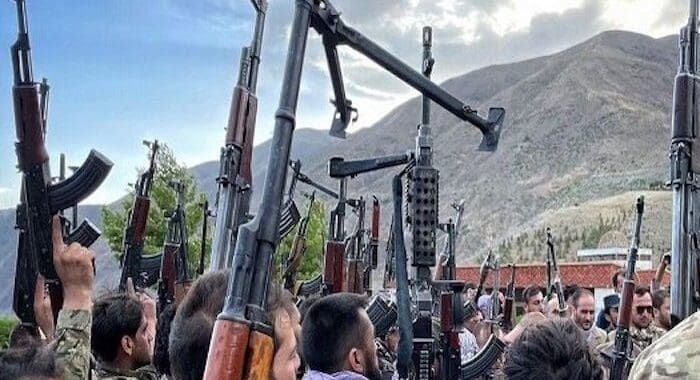
Afghanistan’s security landscape continues to face persistent challenges as anti-Taliban resistance groups report an expansion of guerrilla activities across several provinces, exposing ongoing vulnerabilities in the Taliban’s security environment despite its continued territorial control over the country.
Groups including the National Resistance Front (NRF), Afghanistan Freedom Front (AFF), Afghanistan United Front, and Homeland Soldiers Front have reportedly intensified their operational activities across multiple regions, including Panjshir, Badakhshan, Baghlan, Takhar, and other parts of Afghanistan.
The reported activities, involving hit-and-run attacks, ambushes, and improvised explosive device (IED) incidents, reflect the continuing presence of armed opposition to Taliban rule and the persistent security challenges confronting the country’s de facto authorities. The geographical spread of reported resistance activity highlights the continuing difficulties faced by the Taliban in establishing an uncontested security environment across Afghanistan.
From the mountainous terrain of Panjshir to the strategically significant regions of Badakhshan, Baghlan, and Takhar, anti-Taliban groups have continued to claim attacks against Taliban personnel and security positions.
The reported activities indicate that armed opposition remains active across geographically dispersed areas, challenging the Taliban’s efforts to consolidate security and demonstrate complete control over the country’s security environment.
A particularly significant development occurred on 17 July 2026, when anti-Taliban resistance elements reportedly temporarily seized the district centre of Yaftal-e Sufla in Badakhshan.
Although Taliban forces subsequently regained control of the area, the incident demonstrated the ability of opposition groups to temporarily challenge Taliban security positions and disrupt administrative control.
The episode attracted attention because of its geographical significance and highlighted the continuing contest over local security and authority in parts of northern Afghanistan.
Despite the reported expansion of anti-Taliban activities, the Taliban continue to maintain control over Afghanistan’s provincial capitals and the overwhelming majority of the country’s territory.
It is important to distinguish between reported resistance activity and actual territorial control. The presence of attacks, ambushes, or temporary seizures of administrative centres does not necessarily indicate sustained territorial gains or the establishment of liberated areas.
The available picture therefore reflects a security environment in which the Taliban retain nationwide territorial dominance while facing continuing armed opposition in several provinces.
The continued activities of anti-Taliban resistance groups underscore the unresolved security and political challenges facing Afghanistan. The geographical distribution of reported incidents, the persistence of armed opposition, and the temporary disruption of Taliban control in certain localities demonstrate that the country’s security environment remains complex and contested.
The situation also highlights the distinction between maintaining territorial control and achieving comprehensive security and political stability.



