
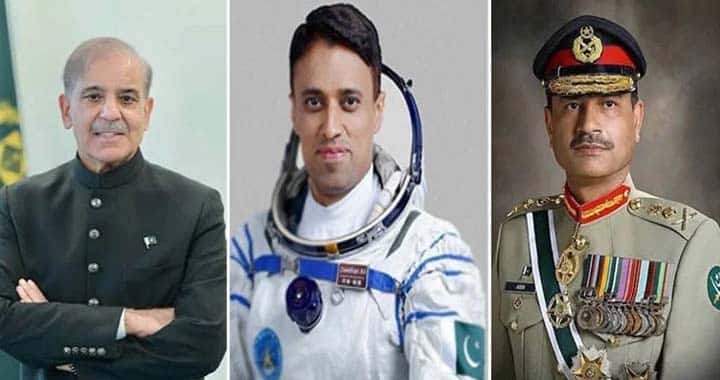
In a landmark achievement for Pakistan’s emerging space programme, Prime Minister Muhammad Shehbaz Sharif and Chief of Army Staff and Chief of Defence Forces, Field Marshal Syed Asim Munir, held a historic direct conversation with Wing Commander Muhammad Zeeshan Ali, Pakistan’s first astronaut, currently aboard China’s Tiangong Space Station.
According to the China Manned Space Agency, the historic communication took place on Saturday at the headquarters of Pakistan’s Space and Upper Atmosphere Research Commission (SUPARCO), providing the country’s political and military leadership with a unique opportunity to interact directly with its astronaut orbiting Earth.
The unprecedented engagement marks a significant milestone in Pakistan’s journey towards human spaceflight and reflects the country’s growing participation in international space exploration, scientific research, and advanced technological collaboration.
The direct conversation with Pakistan’s astronaut aboard an operational space station represents a moment of national significance, highlighting the country’s expanding scientific ambitions and its determination to become an active participant in the rapidly advancing global space sector.
Wing Commander Muhammad Zeeshan Ali reached China’s Tiangong Space Station on 25 November aboard the Shenzhou-24 space mission, marking a historic chapter in Pakistan’s human spaceflight journey.
Serving as a payload specialist, he is participating in the mission alongside two Chinese astronauts, Tang Hongbo and Wu Yi. The crew is engaged in scientific activities and research aboard the orbital laboratory, contributing to collaborative experiments and advancing scientific understanding under microgravity conditions.
His presence aboard the Chinese space station represents an important step forward for Pakistan’s scientific community and provides an unprecedented opportunity to develop national expertise in human spaceflight and space-based research. During the mission, the Pakistani astronaut is participating in joint scientific experiments with Chinese counterparts. These activities include the installation of experimental samples and scientific equipment, assessment of their performance, and conducting research under microgravity conditions.
The scientific engagement is expected to contribute towards strengthening Pakistan’s research capabilities, expanding technical expertise, and creating opportunities for future cooperation in advanced space technologies.
The mission also underscores the importance of Pakistan-China scientific collaboration, opening new avenues for knowledge exchange, technological advancement, and capacity-building in the field of space exploration.
The historic interaction between Pakistan’s highest leadership and its astronaut aboard the Tiangong Space Station reflects the national significance attached to the country’s growing space ambitions.
It also symbolizes the dedication of Pakistani scientists, engineers, researchers, and technical professionals working to advance the country’s capabilities in space science and exploration.
Pakistan’s participation in this mission represents more than an individual achievement; it is an important opportunity to inspire the next generation of scientists, researchers, engineers, and innovators to pursue excellence in science and technology.
The historic direct communication from Earth to orbit stands as a remarkable milestone in Pakistan’s scientific journey and a testament to the country’s aspirations to expand its presence in the global space arena.
With Wing Commander Muhammad Zeeshan Ali conducting scientific activities aboard the Tiangong Space Station, Pakistan has taken another important step towards strengthening its human spaceflight ambitions and advancing its role in international scientific cooperation.



