
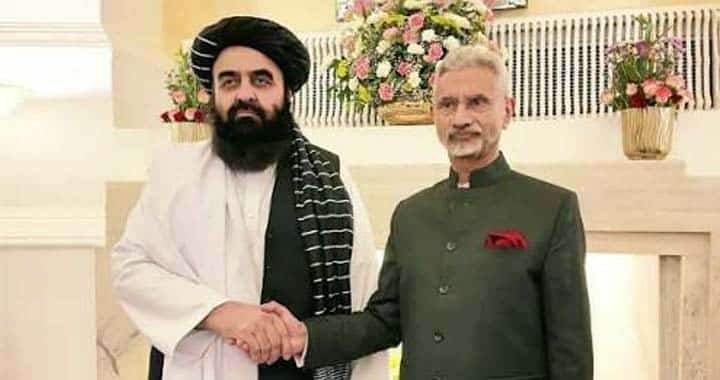
Taliban’s acting Agriculture Minister Attaullah Omari has described India as Afghanistan’s “good and old friend” during his official visit to New Delhi, a characterization that is likely to invite scrutiny in light of the complex history between the Taliban and India over the past three decades.
Addressing a press conference in the Indian capital, Omari praised the reception extended by Indian officials, saying the hospitality made the Taliban delegation feel as though they were in their own country. He expressed optimism that New Delhi would play a greater role in supporting Afghanistan’s agricultural sector through technical cooperation, modernization and mechanization.
Omari said the Taliban administration hopes to benefit from India’s expertise to improve Afghanistan’s agricultural productivity and expand bilateral economic cooperation.
His remarks came as Taliban officials and their Indian counterparts held meetings under a joint cooperation mechanism to explore avenues for deeper economic and technical engagement. During the visit, Omari also met several senior Indian officials.
The visit marks the fourth trip to New Delhi by a Taliban cabinet minister since the group’s return to power in 2021, underscoring the rapidly expanding diplomatic engagement between India and the Taliban administration.
However, Omari’s description of India as an “old friend” is likely to be viewed as historically debatable. For much of the Taliban’s previous rule and the years that followed its ouster in 2001, India was widely regarded as being aligned with political and military forces opposed to the Taliban, while New Delhi consistently backed successive governments in Kabul after the fall of the Taliban regime. The two sides had little formal engagement during that period, making the Taliban minister’s characterization difficult to reconcile with the broader historical record.
The recent warming of ties appears to be driven less by historical affinity than by evolving regional dynamics. Since the Taliban’s return to power, New Delhi has gradually re-engaged with Kabul, while relations between Pakistan and the Taliban administration have deteriorated over border disputes and Islamabad’s repeated concerns over the continued presence and activities of anti-Pakistan terrorist groups operating from Afghan soil.
Pakistan has consistently maintained that Afghanistan is a sovereign and independent country, free to establish diplomatic and economic relations with any state of its choosing. Islamabad’s stated position, however, is that such relationships should not come at the expense of Pakistan’s security or involve cooperation, directly or indirectly, with elements engaged in anti-Pakistan terrorism or other hostile activities.
Against this backdrop, the accelerating engagement between New Delhi and the Taliban administration is being watched closely across the region, with analysts viewing it as part of a broader geopolitical realignment in which former adversaries have found common ground amid changing strategic calculations.



