
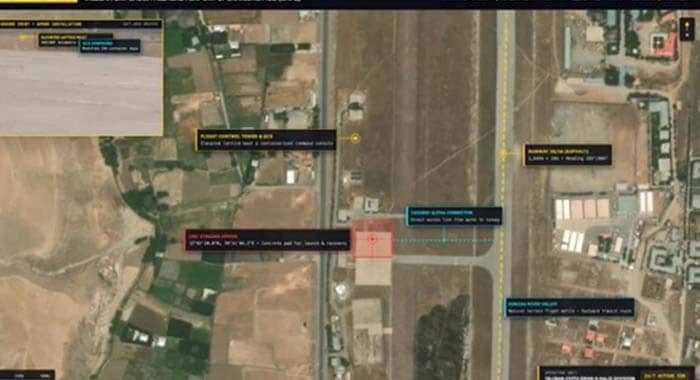
The reported expansion of the Taliban’s drone operations network in northeastern Afghanistan is raising significant questions about the group’s evolving security capabilities, the procurement of commercial aviation technology, and the growing use of aerial surveillance over civilian communities.
Recent reporting by Afghanistan International indicates that the Taliban has established a second drone operations centre on Kala Minar Hill in Faizabad, Badakhshan, following the reported activation of an earlier facility near Faizabad Airport. The expansion comes amid increasing insecurity, repeated attacks on Taliban installations, and clashes with armed opposition groups across the province. The reported developments suggest that drone technology is becoming an increasingly important component of the Taliban’s security infrastructure.
According to sources cited by Afghanistan International on 19 October 2026, the second facility is intended to strengthen security around the provincial governor’s compound and other Taliban administrative installations. Sources also indicated that the administration was considering establishing additional operations centres in vulnerable areas.
The earlier facility near Faizabad Airport was reportedly established to support intelligence gathering and reconnaissance across Badakhshan. Local residents have described repeated drone flights over Faizabad, including low-altitude operations during the night.
These developments point to a growing reliance on aerial surveillance as the Taliban seeks to monitor potential threats and strengthen control over strategically important locations. However, the full scale of the reported network, the number of aircraft involved, and the precise nature of its operational capabilities remain unclear.
Alongside security concerns, the reported drone activity has prompted complaints from residents who say aircraft have flown at low altitudes over their homes and residential courtyards. According to residents quoted in media reports, the flights have created anxiety among families and raised concerns about privacy and the ability to carry out everyday activities without intrusive monitoring.
On 10 October, the Taliban’s Ministry of Urban Development reportedly issued a public notice describing the drone flights as activities related to topographical surveys and urban planning. However, local sources subsequently told Afghanistan International that uniformed personnel were operating the aircraft and that the flights appeared to serve security-related purposes. The differing accounts underscore the need for greater transparency. The administration should clarify the objectives of the flights, the agencies responsible for operating the aircraft, and the safeguards in place to protect civilians from unnecessary surveillance.
The investigation also raises questions about the reported use of commercially available components in Taliban-operated unmanned aerial vehicles. Information provided for this report describes recovered drone wreckage attributed to an incident in the Zebak area of Badakhshan. The Afghanistan Freedom Front (AFF) has previously claimed that its fighters brought down Taliban drones in the district. Such claims, however, do not independently establish the aircraft’s full technical specifications, their procurement history, or the circumstances of their deployment.
Commercial engines, electronic components, servos, and composite materials are widely used in civilian aviation, model aircraft, and industrial applications. Their presence in an aircraft does not, by itself, establish military use or sanctions evasion. Determining whether such components have been diverted into military systems requires reliable forensic examination and supporting procurement records. Nevertheless, the reported development of domestic drone-assembly capabilities raises legitimate questions about the sourcing of components, the role of technical personnel, and the distinction between civilian engineering and military applications.
The specific claims concerning the procurement chain, the involvement of individual institutions, and the alleged modification of aircraft for offensive purposes require independent corroboration before they can be treated as established findings.
The reported expansion of drone infrastructure in Badakhshan highlights a wider challenge facing regional security: commercially accessible technology can be adapted for increasingly sophisticated surveillance and military applications. For neighbouring countries and international monitoring bodies, the key questions concern the scale of the Taliban’s technical capabilities, the intended uses of its drone fleet, and the extent to which procurement networks may be supporting military development.
These questions are particularly relevant in a region where political instability, armed opposition, and cross-border security concerns continue to complicate efforts to establish lasting peace. A credible assessment will require independent technical analysis, reliable documentation, and transparent reporting. Any allegations of unlawful procurement or violations of applicable international restrictions should be investigated on the basis of verifiable evidence rather than assumption.
The reported establishment of a second operations centre represents a significant development in the evolving security landscape of Badakhshan. Yet important questions remain regarding the scale of the facilities, the aircraft being operated, the sources of their components, and the extent of surveillance conducted over residential areas.
The Taliban administration has an opportunity to address these concerns by clarifying the purpose of its drone operations, explaining the relationship between civilian survey activities and security deployments, and outlining safeguards for residents’ privacy.
The central issue extends beyond the expansion of drone facilities: it concerns the transparency of their use, the origins of the technology supporting them, and the protection of civilians living beneath their surveillance.



