
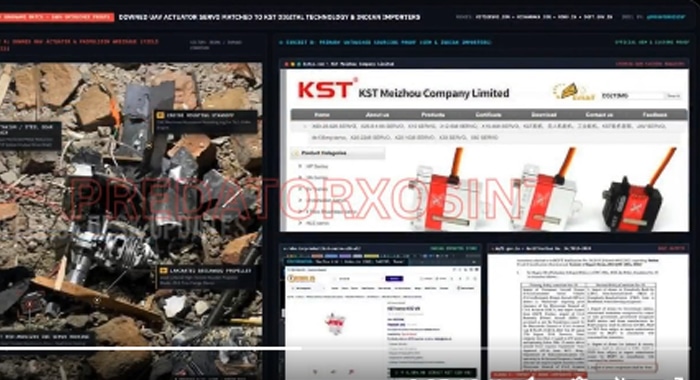
An investigation into the components reportedly recovered from a downed Afghan Taliban tactical drone in Zebak, Badakhshan, has raised serious questions about the procurement channels supplying the regime’s emerging military drone programme. The reported identification of Chinese-manufactured engines and precision flight-control components, alongside their commercial availability through Indian distributors, has brought the potential role of India’s civilian technology supply chains under renewed scrutiny.
The findings challenge the Taliban regime’s claims of indigenous military drone production and raise questions about how commercially available Chinese technology is being acquired, assembled and potentially diverted for military applications in Afghanistan.
The reported evidence points towards a supply-chain model in which foreign-manufactured components are procured through civilian commercial markets and subsequently incorporated into military-capable unmanned aerial systems.
While the identification of commercial components does not, by itself, establish their onward transfer to the Taliban or state involvement in such transfers, the reported similarities between recovered components and products available through Indian distributors warrant serious investigation.
The physical examination of the reportedly recovered drone wreckage from Zebak identified a Chinese-manufactured DLE-35RA, 35cc, 4.1 HP petrol engine as its propulsion system. The procurement trail identified in the supplied investigation points towards Shahputra Trading Pvt. Ltd., operating under the commercial name RC Dhamaka in Bengaluru, India.
The company is reportedly associated with the commercial sale of DLE engines, with the DLE-35RA listed at approximately ₹35,403.81. This raises an important question: how are commercially available foreign-manufactured propulsion systems entering military-capable drone platforms reportedly operated by the Afghan Taliban?
The presence of a commercially sourced engine does not establish who purchased or transferred the specific unit recovered in Zebak. However, it demonstrates the importance of tracing the complete procurement chain, including importers, distributors, intermediaries and ultimate end-users.
The investigation also identifies precision digital servos reportedly recovered from the same drone wreckage. The components have been described as red-anodized CNC aluminium digital servos, reportedly matching products manufactured by China’s KST Digital Technology Co., Ltd. The reported identification includes precision metal gearing, titanium gear trains and 25T spline configurations.
The investigation further identifies Robu.in, operated by Macfos Ltd. in Pune, as an Indian commercial distributor offering KST servo products. Publicly available listings confirm that Robu.in markets KST servo motors for commercial remote-controlled aircraft and other hobby applications, including products listed at approximately ₹6,509. This establishes commercial availability, but does not independently establish that the specific recovered components passed through this distributor.
The reported presence of comparable components in military drone wreckage nevertheless highlights the dual-use nature of civilian aviation technology and the importance of monitoring potential diversion into unauthorized military applications.
A central aspect of the investigation concerns India’s Directorate General of Foreign Trade (DGFT) Notification No. 54/2015-2020, dated 9 February 2022. Under the notification, imports of complete drones in completely built-up, semi-knocked-down and completely-knocked-down forms were prohibited, subject to specified exceptions and authorization requirements.
However, the notification explicitly classified the import of drone components as “Free.” This distinction is important. While complete foreign drones face import restrictions, individual components can enter the Indian commercial market under the applicable import framework.
This creates a legitimate regulatory question concerning the tracking of dual-use components after importation, particularly when commercially available propulsion systems, servos and associated electronics can be incorporated into military-capable platforms. The existence of a free-import classification does not establish that the Indian government authorized or facilitated the transfer of these components to Afghanistan. Nor does it demonstrate that the provision was deliberately designed to facilitate military diversion.
Nevertheless, the potential movement of dual-use technology from civilian markets into unauthorized military applications deserves closer scrutiny. The reported component findings point towards a possible procurement chain involving several commercial and manufacturing layers: Chinese manufacturers produce commercially available propulsion systems, digital servos and other dual-use aviation components.
Commercial distributors in India publicly offer products from Chinese manufacturers, including engines and precision control components. The central unresolved issue is whether specific components purchased through these commercial channels were subsequently diverted, directly or through intermediaries, to unauthorized military end-users in Afghanistan.
Independent media reporting has described a Taliban-linked engineering team involving students from Kabul University and Kabul Polytechnic University that has reportedly been modifying and assembling drones using imported components.
Afghanistan International has also reported that the Taliban’s drone programme relies on commercially available imported components and local technical expertise. These reports indicate that the regime’s drone capabilities involve a combination of imported technology and domestic assembly rather than necessarily requiring the indigenous manufacture of every component.
The distinction between indigenous manufacturing and domestic assembly is fundamental. Assembling an aircraft inside Afghanistan does not mean that its engine, flight-control system, electronics or other critical components were manufactured domestically. A military platform can be assembled locally while relying heavily on foreign-designed and foreign-manufactured technology. The reported identification of Chinese commercial components in the Zebak wreckage therefore raises legitimate questions about the extent of the Taliban regime’s actual domestic manufacturing capabilities and its dependence on international commercial supply chains.
The Taliban administration must clarify the origin of the components used in its military-capable drone platforms and the channels through which these technologies are acquired.
The issue assumes additional significance in light of India’s domestic defence procurement concerns over Chinese-origin components. In February 2025, Indian media reported that the Indian Army cancelled drone procurement contracts worth approximately ₹230 crore following concerns over the presence of Chinese-origin electronic components in the proposed systems.
The reported cancellations highlighted the security sensitivities associated with incorporating Chinese technology into military platforms. This raises a broader question of consistency: if Chinese-origin components are considered a potential security concern in India’s own military procurement, how are civilian commercial supply chains ensuring that comparable dual-use technologies are not diverted to unauthorized foreign military end-users?
The issue is not the ordinary commercial sale of civilian technology. It is the potential diversion of such technology into military systems and the absence of publicly established evidence identifying the ultimate recipients of the specific components reportedly recovered in Zebak.
The proliferation of commercially available drone technology has significantly lowered the barriers to developing military-capable unmanned systems. Petrol engines, digital servos, flight-control electronics and other commercially available components can be incorporated into platforms with military applications.
Consequently, the distinction between civilian commercial supply chains and military procurement has become increasingly important. If components imported through ordinary commercial channels are being diverted to armed groups or unauthorized military programmes, the implications extend beyond Afghanistan.
Such diversion could undermine regional security, complicate arms-control efforts and increase the risks associated with the proliferation of low-cost aerial attack systems. The reported wreckage findings therefore warrant a comprehensive investigation into the origin, ownership, procurement records and onward movement of the identified components.
The emerging allegations raise several important questions:
- Who purchased the specific DLE-35RA engine reportedly recovered from the Zebak drone?
- Can its manufacturing and distribution records establish its route from China to its ultimate user?
- Through which channels were the reportedly identified KST components procured?
- Were any of the identified components exported or transferred to Afghanistan through Indian commercial intermediaries?
- What end-user verification mechanisms apply to potentially sensitive dual-use components?
- Have Indian authorities investigated the possibility of commercial drone components being diverted to unauthorized military end-users?
- What evidence can the Taliban regime provide to substantiate its claims of indigenous drone manufacturing?
These questions require documentary evidence, transaction records, customs information and independent forensic examination rather than assumptions based solely on product similarities.



