
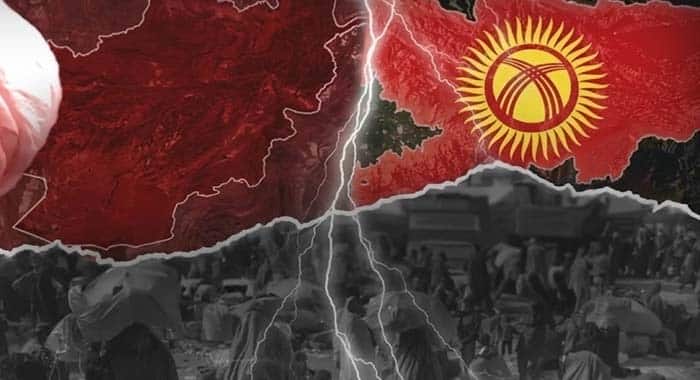
Kyrgyzstan has rejected a European proposal to accept Afghan and African migrants in exchange for employment opportunities for its citizens in the European Union, adding to the growing debate over migration management, security screening and the consequences of Afghanistan’s political and security environment under Taliban rule.
Kyrgyz Foreign Minister Jeenbek Kulubaev said on October 14 that Bishkek opposed the arrangement, arguing that European countries could recruit Kyrgyz workers directly rather than make their employment conditional on Kyrgyzstan accepting migrants from elsewhere.
The proposal comes as European countries explore options for processing or transferring migrants outside EU territory. Five EU member states, Denmark, Austria, Greece, Germany and the Netherlands, have reportedly expressed interest in a pilot arrangement involving centers outside the bloc for migrants whose asylum applications have been rejected.
Beyond the immediate dispute over migration policy, Afghanistan’s situation under the Taliban has wider implications for regional security. The international concern is not simply the movement of Afghan nationals across borders, but the persistence of extremist organizations, the spread of radical ideologies and the potential for terrorist networks operating from Afghan territory to threaten other countries.
A United Nations Security Council monitoring report published in December 2025 identified more than 20 international and regional terrorist organizations operating in Afghanistan, including al-Qaeda, the banned Tehreek-e-Taliban Pakistan (TTP), and groups linked to Central Asian militant networks. The report warned that several of these organizations sought to expand their reach beyond Afghanistan.
This security environment has intensified concerns among Afghanistan’s neighbors, particularly Pakistan and Central Asian states, about cross-border militancy, recruitment networks and the potential spillover of extremist violence. The European Union has also identified preventing Afghanistan from serving as a base for hosting, financing or exporting terrorism as a benchmark in its engagement with the Taliban authorities.
The Taliban’s ideological model, often described by critics as a process of Talibanization, has also drawn international scrutiny because of its restrictions on women and girls, its enforcement of religious rules and its approach to governance. The wider concern is that the normalization of coercive religious rule, alongside the continued presence of terrorist organizations, could reinforce extremist narratives and create conditions conducive to radicalization.
However, ideological influence, terrorist activity and migration are distinct issues. Afghan refugees cannot collectively be treated as security threats, and migration decisions must distinguish individuals seeking protection from people credibly linked to criminal or terrorist activity.
For Kyrgyzstan and other countries in Central Asia, the challenge is therefore twofold: managing migration arrangements on their own terms while addressing demonstrable security risks associated with extremist networks operating in and around Afghanistan.
The dispute also highlights a broader question for the international community: how to support Afghans fleeing repression and economic hardship without overlooking the need to prevent terrorist groups from exploiting regional mobility, recruitment channels and transnational networks.
The Taliban authorities’ ability to prevent Afghan territory from being used by terrorist organizations remains a central test of their security commitments. Until that concern is credibly addressed, Afghanistan’s political and security conditions are likely to remain an important factor in regional counterterrorism cooperation and international policy toward the country.



