
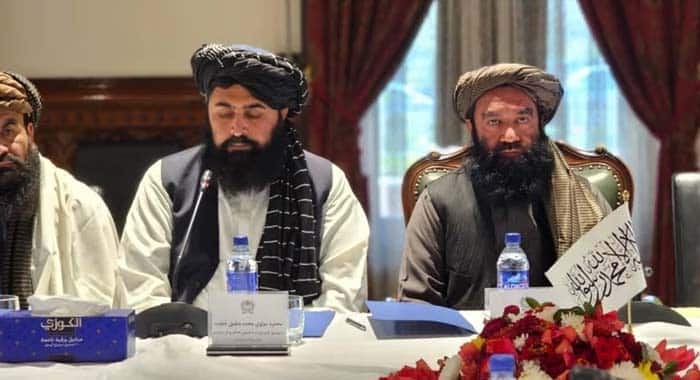
The Taliban’s Minister for Borders, Ethnic Groups, and Tribal Affairs has again raised concerns over what he describes as foreign intelligence activity inside Afghanistan, alleging that such involvement is destabilizing the country’s security environment and advancing what he termed “negative and malicious objectives” in coordination with external actors, including Pakistan.
The remarks were made during a gathering in Badakhshan titled “Defending and Supporting the Islamic System,” where the minister avoided naming countries directly but clearly framed external interference as a central challenge to Afghanistan’s internal stability.
He asserted that the Taliban administration seeks diplomatic and political relations with all states but will not permit any form of external interference on Afghan territory. The statement reflects an ongoing narrative from Kabul that seeks to balance engagement with regional actors while maintaining a hard line on sovereignty.
Earlier during a visit to Takhar province, the same official alleged that Pakistan does not support the emergence of a stable government in Afghanistan and is attempting to push for recognition of the Durand Line as an internationally accepted border. He also linked such positions to broader geopolitical calculations involving external powers.
The minister further dismissed the operational significance of groups such as the National Resistance Front and ISIS within Afghanistan, describing their activities as largely propagandistic in nature and aimed at securing foreign attention and support rather than reflecting sustained internal capability.
In recent weeks, he has undertaken visits to multiple northern provinces, reinforcing the Taliban leadership’s messaging on territorial control and administrative consolidation in those regions.
He also reiterated the Taliban position on the Pakistan-Afghanistan border, describing the Durand Line as an “imaginary line” and rejecting its status as an official international boundary, framing it instead as a “national issue” tied to Afghan sovereignty.
At the same time, he stated that opposition to the Taliban administration would ultimately prove ineffective, while maintaining that channels for dialogue with opposing actors remain open.
The statements collectively highlight a recurring tension in Taliban discourse: asserting openness to engagement while simultaneously framing neighboring states and regional dynamics as sources of instability. This raises a broader strategic question for the region, whether Afghanistan under Taliban rule is primarily responding to external threats, or whether its internal governance model itself contributes to the cycle of insecurity that it attributes to others.



