
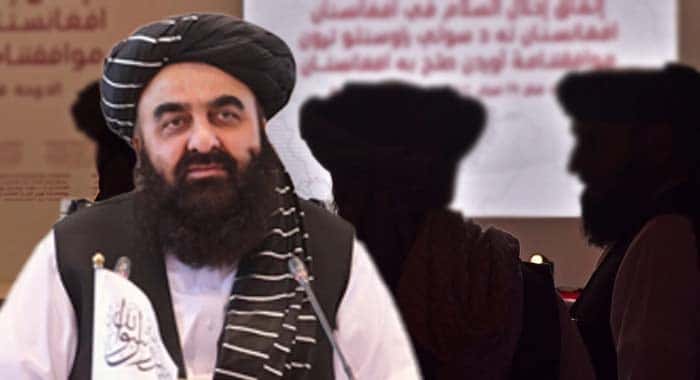
Claims of inclusivity by the Afghan Taliban have once again come under scrutiny, as their top leadership insists that the current administration reflects Afghanistan’s ethnic diversity, a position widely questioned by observers and stakeholders alike.
Speaking in Kabul, Amir Khan Muttaqi stated that members of different ethnic groups are part of the Taliban’s governing structure, describing it as a “balanced system” that ensures stability. He also maintained that the group follows a balanced foreign policy, avoiding alignment with any single country.
The remarks were delivered during a meeting focused on implementing directives issued by Hibatullah Akhundzada regarding the enforcement of what the group terms as “preventing harmful practices.” Muttaqi emphasised that the Taliban leadership carries the responsibility of enforcing its interpretation of religious principles, while also urging officials to engage with modern education alongside religious studies.
However, these claims raise a more fundamental question, whether representation can truly exist within a structure defined not by diversity of thought, but by uniformity of ideology.
Critics argue that while individuals from different ethnic backgrounds may be present, the defining feature of the Taliban remains its rigid ideological framework. In this view, ethnicity becomes secondary, as all members operate under the same doctrinal lens, one that has repeatedly been challenged not only internationally, but also within the broader Muslim world.
Over the past four years, the Taliban administration has faced sustained criticism for consolidating power within a narrow circle, excluding women from public life, and failing to establish an inclusive political system that reflects Afghanistan’s complex social fabric. The absence of electoral legitimacy further deepens these concerns, as the current structure has not emerged through a representative or participatory process.
Analysts note that governance cannot be measured solely by the presence of individuals from varied ethnic origins, particularly when decision-making authority remains centralised and ideological conformity is non-negotiable. In such a system, the notion of diversity risks being reduced to appearance rather than substance.
The international community, including multilateral forums, has consistently emphasised the need for an inclusive framework in Afghanistan, one that accommodates not just ethnic variation, but also political plurality, gender representation, and broader societal participation.
Against this backdrop, Muttaqi’s assertion of balance appears to stand at odds with ground realities, where questions of legitimacy, representation, and inclusivity remain unresolved.
As Afghanistan continues to seek international engagement and recognition, the credibility of such claims will likely depend not on statements, but on demonstrable changes within its governing structure.



