
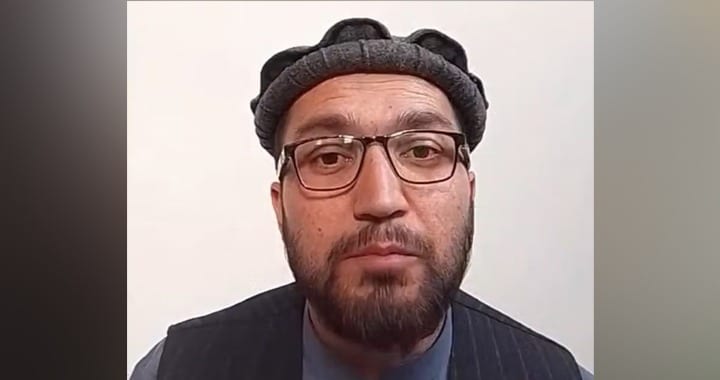
The Taliban authorities have arrested a teacher and outspoken critic in Herat after he publicly condemned the group’s policies, accused it of exploiting religion for political and ethnic objectives, and called for separating religion from politics.
Navidullah Fitrat was arrested in Herat city on Wednesday morning, August 26, according to sources familiar with the incident. He was reportedly detained near the city’s Cinema Square at around 8 a.m.
The Taliban also reportedly arrested a family accused of hosting Fitrat.
No official explanation has been given for the arrests, underscoring the growing intolerance of the Taliban authorities toward even peaceful criticism of their rule.
Criticism that Taliban could not tolerate
Days before his arrest, Fitrat posted a video on Facebook in which he sharply criticized the Taliban’s conduct and policies. He accused the group of using a religious façade to pursue ethnic objectives and urged it to separate religion from politics.
Fitrat also blamed the Taliban for depriving Afghans of opportunities, disrupting social order and imposing an authoritarian system in which religion is allegedly being used as a political instrument.
He further called on religious scholars to speak out against the Taliban’s actions rather than remain silent.
In an ominous warning that now appears particularly significant, Fitrat said the video could be his last, but insisted that he would tell the truth before he died.
His remarks were widely circulated on social media, prompting concern among users over his safety and fate.
The reported arrest exposes the Taliban’s deeply intolerant approach to dissent. A teacher voicing criticism, questioning the political use of religion and urging religious figures to speak against wrongdoing hardly represents a threat to public order. Yet the Taliban’s response has reportedly been arrest and intimidation, extending even to a family alleged to have provided him shelter.
Such conduct leaves little room for the Taliban’s repeated claims of governance, justice and religious legitimacy. Their apparent inability to tolerate peaceful and constructive criticism instead points to a regime increasingly threatened not by armed opposition alone, but by anyone willing to question its authority.



