
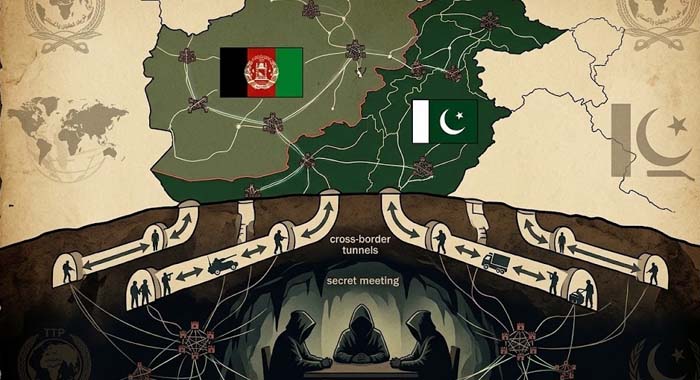
Serious regional security concerns have emerged over claims of confidential meetings held during June and July involving Afghanistan’s General Directorate of Intelligence (GDI), India’s Research and Analysis Wing (RAW), and senior leadership figures associated with the Afghan Taliban (TTA) and the banned Tehreek-e-Taliban Pakistan (TTP). The information points to discussions concerning media messaging, clandestine cross-border routes and a possible shift towards smaller terrorist groups operating against Pakistan.
The claims describe three key areas of concern: a coordinated media campaign intended to portray the Afghan Taliban and TTP as having no coordination, plans to establish approximately eight underground tunnels connecting Afghanistan with Pakistan, and an expansion of TTP activities through smaller, decentralised groups.
If substantiated, these developments would have serious implications for Pakistan’s national security, border management and counterterrorism strategy. The claims also raise broader questions about regional intelligence activities and the potential use of information campaigns to influence perceptions of cross-border security threats.
The meetings, participants and objectives have not been independently verified. Their significance therefore requires careful assessment based on credible evidence and independent confirmation. The information concerning the June–July meetings places Afghanistan’s intelligence apparatus, India’s RAW and senior figures associated with the Afghan Taliban and TTP within the same reported discussions.
The nature of these claims has drawn attention to possible interactions among intelligence organisations and militant networks operating in the region. Any confirmed coordination involving state intelligence agencies and terrorist organisations would represent a serious security concern requiring a response through appropriate investigative, diplomatic and security channels.
The central questions concern the purpose of the meetings, the nature of the discussions and whether any decisions were translated into operational activity. Establishing these details would be essential to understanding the potential implications for Pakistan and the wider region.
A central element of the information concerns a proposed media campaign designed to portray the Afghan Taliban and TTP as having no coordination. The stated objective raises concerns about the possible use of strategic messaging to shape domestic and international perceptions of the relationship between the two organisations.
Information campaigns can influence how security developments are interpreted, particularly when questions arise about the presence of terrorist networks, cross-border activity and the responsibilities of authorities in preventing attacks.
A clear distinction must be maintained between public messaging and verifiable evidence. Statements denying coordination do not, by themselves, establish whether operational links exist. Any assessment must consider independently corroborated information, documented interactions and credible investigative findings. The authenticity, scope and implementation of the described media strategy remain matters requiring verification.
Another major concern involves plans to construct approximately eight underground tunnels connecting Afghanistan with Pakistan.
If such infrastructure exists or is under construction, it could create additional challenges for border monitoring and efforts to prevent unauthorised cross-border movement. Underground routes can complicate conventional surveillance and raise concerns about the possible movement of individuals or prohibited materials. However, the available information does not establish the locations, construction status, ownership or intended use of the eight tunnels.
These details require independent confirmation before conclusions can be drawn about the scale or immediacy of the threat. Any credible evidence of clandestine cross-border infrastructure should be assessed by the relevant authorities to determine its security implications. The issue underscores the importance of effective border surveillance, intelligence coordination and the investigation of suspected unauthorised crossing routes.
The information also points to a possible expansion of TTP activity through smaller, decentralised groups. Such a development, if confirmed, could complicate threat assessments by dispersing organisational activity across multiple locations rather than concentrating it in larger formations. It would also highlight the importance of monitoring changes in terrorist networks and assessing their implications for public safety.
The available information does not establish the number of groups involved, the extent of any organisational restructuring or whether the proposed change has been implemented. Nevertheless, the possibility of a more dispersed operational structure highlights the continuing need for effective intelligence-led counterterrorism measures, cooperation among law enforcement agencies and timely investigation of threats.
Pakistan’s priority remains preventing terrorist attacks, disrupting violent networks and protecting civilians and security personnel.
The three central issues strategic media messaging, underground cross-border routes and the expansion of smaller terrorist groups raise distinct but interconnected security questions. If credible evidence confirms these developments, Pakistan would need to assess their implications for border security, intelligence priorities and counterterrorism planning. Any response should be based on verified information, clear threat assessments and appropriate coordination among relevant institutions.
Claims involving foreign intelligence agencies and terrorist organisations are particularly consequential because they can affect regional diplomatic relations and security calculations. Establishing responsibility therefore requires reliable evidence rather than conclusions drawn solely from the content of circulating claims.
A disciplined, evidence-based approach would help distinguish genuine threats from misinformation while ensuring that credible security concerns receive appropriate attention.



