
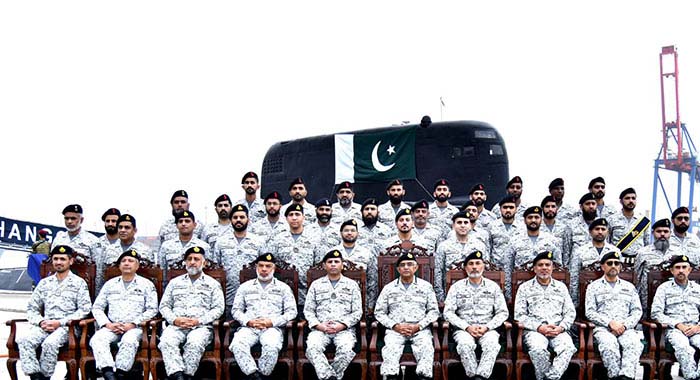
The Pakistan Navy has commenced its major maritime exercise ‘Sea Spark 2026’ in Karachi, bringing together a broad spectrum of naval, air, land and specialized military capabilities in a comprehensive test of operational preparedness against both conventional and emerging maritime threats.
The exercise was formally inaugurated with an opening briefing chaired by the Chief of the Naval Staff, with senior officers from the Pakistan Army and Pakistan Air Force also in attendance. The participation of senior leadership from all three services underscores the increasingly joint nature of modern military operations and the importance of integrated responses to a rapidly evolving security environment.
According to the Inter-Services Public Relations (ISPR), the primary objective of Sea Spark 2026 is to assess and enhance the Pakistan Navy’s war-fighting preparedness against a range of conventional and modern maritime threats. The exercise is designed not only to evaluate individual capabilities, but also to test the ability of different formations and platforms to operate together under complex and demanding operational conditions.
A wide range of assets and personnel are participating in the exercise, including frontline warships, submarines, aircraft, unmanned systems, Marines and Special Forces. Elements of the Pakistan Army and Pakistan Air Force are also taking part, providing an important joint-services dimension to the exercise and allowing participating forces to rehearse coordinated operations across multiple domains.
Sea Spark 2026 reflects the changing character of contemporary warfare, in which military operations are no longer confined to a single battlefield or domain. According to ISPR, the exercise incorporates maritime, air, land, cyber and space-enabled support capabilities, creating an integrated operational environment in which participating forces can train to respond to complex and rapidly changing scenarios.
The exercise therefore represents more than a conventional naval drill. It is intended to provide an environment in which forces can assess their ability to detect, respond to and counter threats across interconnected operational domains while maintaining effective command, control and coordination.
The integration of unmanned systems, specialized forces and air and maritime platforms further expands the scope of the exercise. Such capabilities are increasingly important in modern military operations, where situational awareness, speed of decision-making, precision and the ability to operate across multiple environments can determine operational effectiveness.
One of the notable components of Sea Spark 2026 is its focus on operations within the information environment. The exercise includes training aimed at achieving decisive advantage in the information-warfare domain and integrating those activities with ongoing conventional military operations at sea.
The emphasis reflects the growing importance of information as a strategic component of modern conflict. Military forces increasingly operate in an environment where the ability to collect, process, protect and exploit information can directly influence battlefield outcomes.
By incorporating information operations into a broader maritime exercise, Sea Spark 2026 provides participating forces with an opportunity to practice decision-making and operational coordination in an environment where conventional military activity and information warfare can occur simultaneously.
This multidimensional approach is particularly relevant to maritime security, where commanders may need to respond to rapidly changing information, coordinate forces across considerable distances and maintain operational awareness across maritime, aerial, terrestrial and digital environments.
Prior to the commencement of the exercise, the Chief of the Naval Staff visited Pakistan Navy fleet units and reviewed ongoing operational activities. During the visit, he emphasized the importance of maintaining an unwavering state of preparedness in response to the changing security environment.
He further highlighted the need for stronger and more effective cooperation among Pakistan’s three armed services, emphasizing the importance of adaptability and the ability to respond effectively to evolving operational circumstances.
The Naval Chief also underscored the significance of maintaining effective capabilities across both the physical and information domains. His remarks reflect the broader operational requirements of contemporary security challenges, in which conventional military preparedness increasingly needs to be supported by information awareness, technological integration and joint-service coordination.
The participation of the Pakistan Army and Pakistan Air Force in Sea Spark 2026 highlights the importance of joint operational planning and interoperability among Pakistan’s armed forces.
Modern security challenges frequently extend beyond the capabilities of a single service. Maritime operations can require coordinated air support, land-based capabilities, specialized forces, intelligence support and information-domain operations. The ability of these elements to function as a cohesive force is therefore an important component of overall military preparedness.
Through Sea Spark 2026, participating forces are able to rehearse such coordination in a structured and demanding operational environment. The exercise provides an opportunity to evaluate procedures, communication, command-and-control mechanisms and the ability of different forces to operate together during complex scenarios.



