
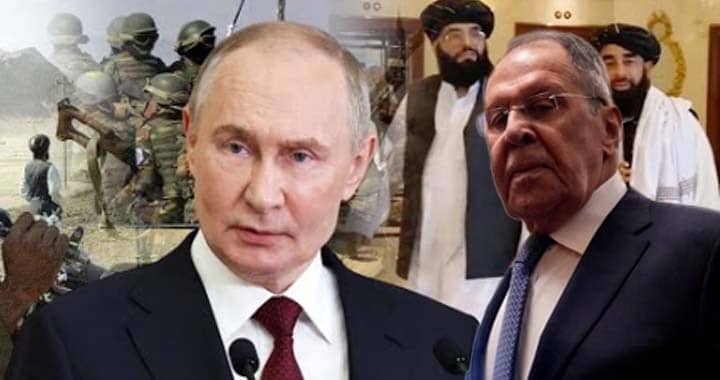
Russian Foreign Minister Sergey Lavrov has underscored growing instability in Afghanistan, warning that the situation could directly impact the security of Central Asia and the broader CSTO region, a stance that appears to diverge from the far more confident assessment earlier offered by President Vladimir Putin.
Speaking at a session of the Collective Security Treaty Organization Parliamentary Assembly on April 19, Lavrov pointed to ongoing threats emanating from Afghanistan, stating that the fight against terrorism and drug trafficking continues and requires sustained international attention. His remarks painted a picture of a volatile landscape, far from settled or securely governed.
Lavrov linked Afghanistan’s instability with broader regional tensions, including the crisis in the Persian Gulf and escalating conflict across the Middle East. He warned that these overlapping fault lines could trigger far-reaching consequences, particularly as tensions intensify in Lebanon and military pressure expands on Syria. He also highlighted the continued deterioration in Palestinian territories, noting that prospects for a viable state have diminished amid ongoing conflict, with conditions worsening in Gaza and the West Bank.
Yet, it is Lavrov’s framing of Afghanistan that raises the most pressing questions. His warning of persistent instability stands in contrast to Putin’s remarks from December 2025, delivered during his visit to India, where the Russian president described Taliban rule as firmly in control despite acknowledging unspecified “problems.” At the time, Putin had characterized Afghanistan’s past as a “horrible situation” but insisted that governance structures under the Taliban were functioning.
The gap between these two positions is difficult to reconcile. Lavrov’s emphasis on ongoing terrorist threats aligns more closely with Russia’s own intelligence assessments, which have repeatedly identified Afghanistan as a growing hub for transnational terrorist networks. A Russian report had earlier revealed the presence of over 23,000 terrorists belonging to more than twenty organizations, including Al-Qaeda, Islamic State Khorasan Province, the East Turkestan Islamic Movement, as well as the banned Tehreek-e-Taliban Pakistan and Balochistan Liberation Army.
These findings were not isolated. Moscow has, on multiple occasions, warned that Afghanistan poses a serious threat to regional and global peace and stability. Even the outcomes of a Moscow-hosted summit on Afghanistan reflected similar concerns, emphasizing risks rather than stability, a tone that sharply contrasts with Putin’s public assurances.
Lavrov’s latest remarks, therefore, do more than highlight regional insecurity, they expose an apparent inconsistency within Russia’s own narrative. On one hand, Moscow acknowledges Afghanistan as a breeding ground for terrorism with far-reaching implications. On the other, its top leadership has projected confidence in Taliban control, without clarifying how such control coexists with the scale of threats identified by its own institutions.
Russia remains the only country to have formally recognized the Taliban government, a decision that further complicates its position. While Moscow continues to engage with the Taliban diplomatically, its repeated warnings about instability, terrorism, and external interference suggest a far more cautious internal assessment than its public messaging sometimes conveys.
As Lavrov calls for greater attention to Afghanistan’s evolving security challenges, the contradiction becomes harder to ignore, if the situation is stable enough to be described as “under control,” why does Russia itself continue to sound the alarm?



