
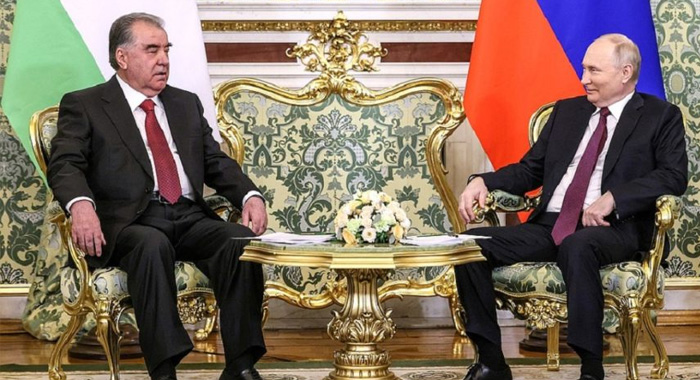
Russian President Vladimir Putin and Tajikistan’s President Emomali Rahmon held a telephone conversation to review bilateral cooperation, regional developments, and growing security challenges linked to Afghanistan, the Kremlin announced.
During the call, the two leaders underscored their shared commitment to strengthening the Russia–Tajikistan strategic partnership and enhancing regional coordination amid rising cross-border risks. While specific details of their discussion on Afghanistan were not disclosed, both sides emphasized the importance of close collaboration to preserve border stability and counter emerging security threats.
Tajikistan has recently reported an uptick in cross-border insecurity along its frontier with Afghanistan. On 25 December, Tajikistan’s National Security Committee confirmed an armed clash involving militants who crossed from Afghan territory, resulting in casualties among both insurgents and Tajik border guards. Earlier incidents in December, also linked to incursions from across the border, prompted heightened concern and a comprehensive review of border protection measures.
Sharing a long and porous border with Afghanistan, Tajikistan faces persistent risks from armed groups operating in the region. These challenges have intensified fears of instability spilling over into Central Asia, placing border security at the forefront of national and regional agendas.
Russia and Tajikistan maintain longstanding security cooperation, including joint military exercises, intelligence sharing, and coordination through regional security mechanisms. These efforts are aimed at containing threats posed by extremist and militant groups and reinforcing stability across Central Asia.
In response to the evolving threat environment, President Rahmon has accelerated measures to strengthen Tajikistan’s defensive capabilities. Recent steps include the inauguration of a tank training field and the establishment of four new border outposts along the Afghan frontier, reinforcing surveillance, readiness, and rapid response capacity.
Analysts note that sustained investment in border infrastructure, combined with close coordination with Russia, will be critical for Tajikistan as it works to secure its borders and prevent cross-border insurgencies from undermining national and regional stability.



