
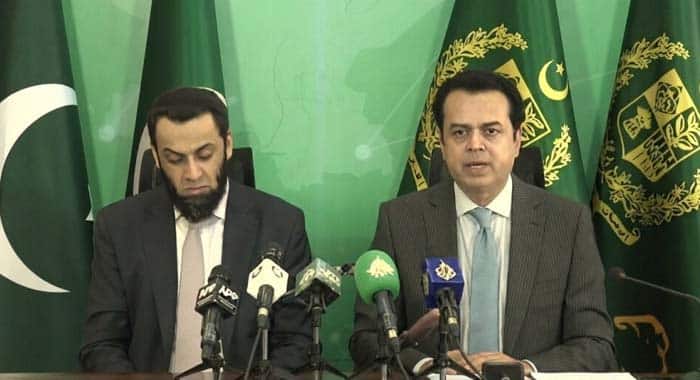
Federal Minister for Information and Broadcasting Attaullah Tarar and Minister of State for Interior Talal Chaudhry, addressing a joint press conference in Islamabad, expressed serious concern over the prevailing security situation in Khyber Pakhtunkhwa and underscored the federal government’s resolve to eliminate terrorism through coordinated national efforts and strengthened support for law-enforcement and security institutions.
The federal ministers said that terrorist formations were entering Pakistan from Afghanistan and carrying out attacks with the stated objective of destabilising the country. They said that, according to information available to the government, a significant proportion of the militants involved in such formations were residents of Afghanistan.
Minister of State for Interior Talal Chaudhry said that the recent terrorist attack at the Aman Mela Check Post in Dera Ismail Khan had resulted in the martyrdom of innocent civilians, including women and children, while rescue personnel were also deliberately targeted.
He said the incident demonstrated the continuing threat posed by terrorist networks and the need for an effective, coordinated and adequately resourced counterterrorism response.
Talal Chaudhry said that terrorist organisations frequently release photographs and footage of their operatives on social media following attacks. In the aftermath of the D.I. Khan incident, the photograph of one of the attackers was immediately entered into the relevant system and checked against NADRA and other available records.
According to the Minister of State, the individual could not be identified through the available domestic records. He said that information obtained through open-source intelligence subsequently indicated that the suspected terrorist was a resident of Kabul, Afghanistan.
Talal Chaudhry said that, according to the government’s assessment, terrorist formations were entering Pakistan from Afghanistan and that approximately 70 percent of the terrorists involved in such formations were Afghan residents.
He said Pakistan had exhausted multiple channels in its efforts to address the issue, including diplomatic engagement, dossiers, negotiations and other means of communication with the Afghan authorities.
“Pakistan has repeatedly engaged the Afghan authorities through every available channel, but our neighbour has so far not changed its approach,” he said. The Minister of State for Interior further alleged that terrorist operatives were being paid in dollars to carry out attacks and maintained that the broader objective of such activities was to create instability in Pakistan. He described Afghanistan as playing what he termed a “super-proxy” role in this context.
Talal Chaudhry questioned why the perpetrators and the alleged external dimension of terrorist attacks were not being openly discussed by all political stakeholders. Referring to the recent visit of the Chief Minister of Khyber Pakhtunkhwa to Dera Ismail Khan, he said that the provincial chief executive eventually visited the affected area and addressed the media, but questioned why Afghanistan and the terrorist threat emanating from its territory were not explicitly mentioned.
He said representatives of the federal government had visited the families of those martyred in the attack and maintained that national solidarity should extend beyond political differences whenever terrorism claims innocent lives. The Minister of State said that while government representatives had visited the affected families and the chief minister had also travelled to Dera Ismail Khan, those who had been protesting against the government were not present at the site.
Talal Chaudhry also raised concerns regarding the capacity and resources available to security and law-enforcement agencies in Khyber Pakhtunkhwa. He said that, in the federal government’s assessment, the political leadership of Khyber Pakhtunkhwa had not stood behind the security forces in the manner required during the past 14 years and that the provincial government had not provided law-enforcement institutions with the resources necessary to confront terrorism effectively.
He said security forces across Khyber Pakhtunkhwa still lacked several facilities and capabilities required for sustained counterterrorism operations. “Neither the required leadership nor the necessary resources have been provided to the security forces,” he said, adding that a counterterrorism campaign could not be effectively conducted without a properly equipped Counter Terrorism Department (CTD), bulletproof vehicles and appropriate weapons.
The Minister of State further alleged that bulletproof vehicles previously made available to security forces had been returned for political reasons. He also expressed concern over proposed amendments to the Police Act, which, according to him, could reduce or alter existing police powers.
Talal Chaudhry said that representatives of the provincial government did not consistently participate in meetings concerning security matters, while provincial representatives appeared when financial resources under the National Finance Commission (NFC) were involved. He stressed that counterterrorism required institutional coordination and collective implementation of agreed national policies.
Referring to the National Action Plan, he said there was consensus on its 14 points and that implementation of these measures remained essential to the national fight against terrorism. He said the federal government had also sought an account of approximately Rs800 billion from Khyber Pakhtunkhwa and called for transparency and accountability in the use of public funds.
According to the Minister of State, shortcomings in provincial governance and security management had contributed to the deteriorating law-and-order situation in parts of Khyber Pakhtunkhwa. He maintained that if Pakistan was facing insecurity and instability, the performance and responsibilities of the provincial government also needed to be examined.
Federal Minister for Information and Broadcasting Attaullah Tarar said that the government remained firmly committed to defeating terrorism and providing all possible assistance to security institutions engaged in protecting the country and its citizens. He criticised what he described as the current provincial leadership’s approach towards the security situation and reiterated the federal government’s allegations concerning links between elements within the Pakistan Tehreek-e-Insaf (PTI) leadership and the banned Tehreek-e-Taliban Pakistan (TTP).
The Information Minister said political differences should not prevent political parties from taking an unequivocal position against terrorism. He noted that political leaders and workers belonging to the Awami National Party (ANP), Pakistan Muslim League-Nawaz (PML-N) and Jamiat Ulema-e-Islam (JUI) had made significant sacrifices in the fight against terrorism.
Tarar questioned why, in his view, the PTI was not facing the same level of hostility from terrorists and alleged that elements within the party had been involved in providing financial support to terrorists.
The Information Minister also raised the issue of non-custom-paid (NCP) vehicles operating in Khyber Pakhtunkhwa. He questioned why such vehicles continued to operate without being brought within a comprehensive registration and regulatory framework, adding that, in some cases, motorcycles were also being operated without proper number plates.
Tarar alleged that the provincial government had deliberately failed to regularise NCP vehicles and claimed that such vehicles could be exploited for terrorist activities. He said proper registration of vehicles could generate billions of rupees in revenue for the province while also strengthening law-enforcement agencies’ ability to trace vehicles used in criminal or terrorist activities.
The Information Minister further alleged that the provincial government had failed to establish and adequately develop the Counter Terrorism Department and questioned whether there was sufficient political commitment to strengthening the institution.
Tarar said the Ministry of Interior had offered modern vehicles to the Khyber Pakhtunkhwa Police to enhance its operational capabilities, but alleged that the provincial government had declined to accept the vehicles. He criticised the provincial administration for what he described as inadequate support for the police and said that law-enforcement personnel should not be left without the equipment and institutional backing required to confront heavily armed terrorist groups.
The federal government, he said, would continue to provide all possible assistance to security and law-enforcement agencies within the framework of national counterterrorism policy.
The federal ministers emphasised that terrorism was not a challenge that could be addressed through political confrontation or partisan considerations alone. They called for stronger coordination among federal and provincial institutions, improved intelligence-sharing, adequate resources for security agencies and implementation of agreed national counterterrorism measures.
Attaullah Tarar said the federal government was determined to ensure that security institutions received the support necessary to protect citizens and confront terrorist organisations. He said the government’s resolve to eliminate terrorism remained firm and that every possible measure would be taken to strengthen the country’s security architecture.
The federal government reiterated that the protection of the lives and property of citizens remained its foremost responsibility and that the sacrifices of civilians, security personnel, police officers and rescue workers in the fight against terrorism would not be forgotten.
The ministers stressed that political differences should not undermine the collective national effort against terrorism and called for all relevant institutions and political stakeholders to play their respective roles in safeguarding Pakistan’s security, stability and sovereignty.



