
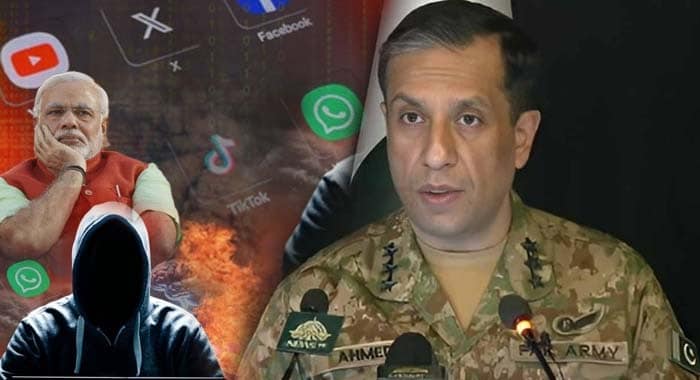
Pakistan’s army has sharply challenged India’s credibility over its terrorism-related claims, describing the country as having increasingly become “Fakistan” and “Encounteristan” amid what it termed a pattern of fabricated narratives and alleged fake encounters.
The remarks came during a press briefing following India’s claim that a former Pakistani SSG soldier had been killed as a Lashkar-e-Taiba terrorist.
Pakistan subsequently presented the retired soldier alive before the media, directly contradicting the Indian claim and prompting the military to question the credibility of the narrative.
The military spokesperson said the episode was not an isolated incident but reflected what Pakistan views as a recurring Indian practice of constructing terrorism narratives and attributing attacks or alleged terrorist activity to Pakistan without producing credible evidence.
He used the terms “Fakistan” and “Encounteristan” to describe what he portrayed as an environment in which allegations, staged narratives and encounter claims have become tools for advancing a particular security narrative.
The military spokesperson challenged India to provide evidence for its allegations against Pakistan rather than making accusations immediately after incidents.
Pakistan has repeatedly called for evidence in cases where India has alleged Pakistani involvement in terrorist attacks, including the Pahalgam incident, and has said such evidence could be presented to a third party for examination.
The latest dispute emerged after Indian military and media reports claimed that a former Pakistani soldier, identified as Muhammad Asif alias Musa, had been killed while allegedly operating as a Lashkar-e-Taiba terrorist.
Indian reports subsequently attributed various attacks to the alleged terrorist and described him as a former member of Pakistan’s Special Service Group.
Pakistan rejected the claim by presenting the retired soldier before the media.
The episode has since become part of a wider Pakistani argument that India’s terrorism narratives deserve scrutiny, particularly when claims change or are contradicted by available evidence.
The military spokesperson also connected the issue to Pakistan’s allegations that India has supported, funded and facilitated terrorist organizations operating against Pakistan, including the banned Tehreek-e-Taliban Pakistan (TTP) and Balochistan Liberation Army.
He argued that India’s repeated accusations against Pakistan could also serve to divert attention from allegations concerning its own role in regional terrorism.
The remarks placed the latest encounter claim within a much broader confrontation over terrorism narratives between the two nuclear-armed neighbors.
For Pakistan, the central question is no longer simply whether an individual was killed in an Indian operation, but how such claims are generated, verified and subsequently amplified through official and media channels.
The military’s presentation of a supposedly dead Pakistani soldier alive before cameras has therefore become the immediate basis for its latest challenge to India’s account.
The broader message from Islamabad was equally direct: if India has evidence linking Pakistan to terrorism, it should present that evidence rather than relying on allegations and encounter narratives.



