
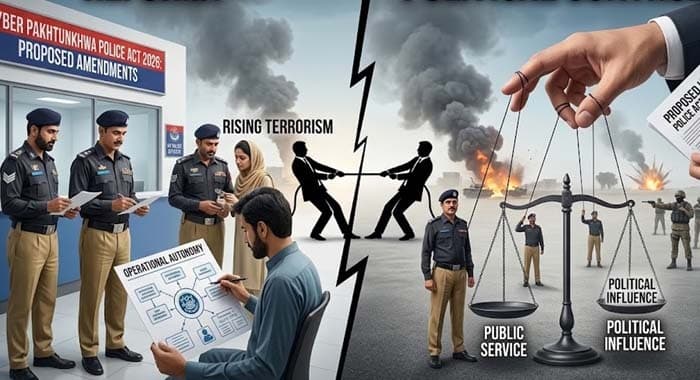
The proposed Khyber Pakhtunkhwa Police Act 2026 envisages fundamental changes to the province’s existing police structure, including police administration, policy-making, oversight, accountability, recruitment and the appointment and posting of senior police officers.
The proposed legislation has triggered an important institutional debate over whether the new framework would strengthen the effectiveness and accountability of the police or significantly increase the role of the provincial political administration in police affairs. The question carries particular importance for Khyber Pakhtunkhwa, a province facing persistent terrorism, militancy and serious law-and-order challenges, where the police command structure and operational independence have direct implications for counterterrorism and public security.
Under the proposed framework, the role of the provincial government and the Chief Minister in police administration would become considerably more prominent. This has led to concerns that increased political involvement in police policy, appointments, postings and accountability could affect professional autonomy, command continuity and the operational effectiveness of the force.
One of the most significant proposed changes concerns the appointment of the Inspector General of Police (IGP). Under the proposed bill, the federal government would forward the names of three officers for consideration for the position of IGP to the provincial government, after which the provincial government would select one of those officers.
The proposed mechanism would reverse the sequence under the existing arrangement, under which the provincial government forwards three names to the federal government. This proposed reversal has become a key point of discussion because it would give the provincial government a direct selection role in appointing the province’s police chief. It also raises the broader question of whether a comparable mechanism for appointing an IGP exists in any other province of Pakistan or whether the proposed KP model would represent a new institutional arrangement. Critics of the proposal have argued that such a mechanism would represent a significant departure from the appointment framework that has historically been followed in the provinces.
The proposed legislation would also significantly alter the structure of police policy-making. Under the proposed framework, the Chief Minister of Khyber Pakhtunkhwa would head the Police Policy Board, placing the provincial political executive at the centre of the body responsible for determining broader police policy.
The proposed Police Policy Board would also approve the annual provincial police plan, meaning that the strategic planning and annual priorities of the provincial police would be subject to approval by a board headed by the Chief Minister. The draft further proposes that police authorities would be required to promptly implement government directions concerning law and order.
This arrangement has raised questions about the boundary between political policy direction and professional police administration. If the provincial police chief is held responsible for maintaining law and order while administrative, financial and operational powers remain substantially subject to government policy and directions, concerns arise over whether responsibility and authority would remain adequately aligned.
In practical terms, the debate centres on whether a police chief can be held fully responsible for the province’s security situation if significant decisions affecting the force remain subject to political approval.
The proposed law also seeks to expand the Chief Minister’s role in the posting of senior police officers. Under the proposed framework, the Chief Minister would have direct authority in the postings of police officers in Grade 18 and above. This would include senior officers occupying important command and field positions.
The proposed requirement for Chief Minister approval in the appointment of district and regional police leadership would introduce an additional level of political approval into the field-command structure.
This consequently raises a fundamental question concerning the chain of command: if a District Police Officer’s appointment, posting or tenure requires approval from the Chief Minister, would the officer primarily remain institutionally accountable to the IGP or would the political administration acquire a direct role in the officer’s command relationship?
Concerns have been raised that greater political involvement in senior police postings could affect merit, administrative continuity, internal command, professional independence and the stability of field-level policing.
The issue is particularly significant given the province’s security environment, where frequent changes or politically influenced appointments could have implications for institutional continuity and counterterrorism operations.
Another major proposed change concerns recruitment at the Deputy Superintendent of Police (DSP) level. The proposed legislation envisages 25 percent direct recruitment at the DSP level, representing a significant change to the existing police service structure. Direct recruitment at this level could affect the relationship between officers entering the service through competitive recruitment and those progressing through the existing departmental promotion system.
The proposal therefore raises questions about career progression, promotion opportunities, service structure and morale within the police force. A further concern is the mechanism through which such direct recruitment would be conducted. If the process is not governed by clear, transparent and strictly merit-based procedures, questions could arise regarding political influence, recruitment standards and institutional credibility.
There are also concerns about the long-term consequences of such recruitment. Officers entering the force at the DSP level could eventually progress to senior positions such as SP and SSP, meaning that the recruitment mechanism introduced today could shape the leadership structure of the provincial police for years to come.
The central question is therefore how the proposed direct recruitment system would ensure merit, transparency and institutional safeguards while maintaining confidence among serving police personnel. The proposed legislation also contains changes to the existing Dispute Resolution Councils (DRCs). The DRC system has been functioning since 2015 as a mechanism for resolving disputes at the local level, particularly matters that can potentially be settled without lengthy conventional court proceedings.
The existing system has been credited with resolving approximately 85,000 cases and disputes, according to figures cited in the discussion surrounding the DRC mechanism. DRCs have played a role in resolving relatively minor disputes outside the formal judicial process, reducing pressure on courts and helping address local conflicts through community-based mechanisms.
The proposed legislation would alter the existing DRC structure and increase the role of the government in the appointment of its members. This has raised concerns regarding the independence and neutrality of DRC decisions. If members are appointed by the government or political officeholders and their tenure is also dependent upon government decisions, questions could arise over whether they would be able to make decisions independently, particularly in disputes involving politically influential individuals.
The concern is therefore not simply about changing the DRC structure, but about whether the proposed system would preserve the credibility and impartiality that make alternative dispute-resolution mechanisms effective. Without an effective alternative structure, critics argue that placing the existing DRC mechanism under greater political influence could weaken a system that has helped resolve local disputes and reduce the burden on courts.
The proposed law would also introduce changes to the Public Safety Commission and other police oversight institutions. Under the proposed framework, the provincial government and political officeholders would have a more prominent role in the composition of oversight bodies. The proposed Provincial Public Safety Commission would include seven independent members nominated by the government.
This provision raises a central question concerning the meaning of institutional independence. If members are designated as independent but their appointment, tenure or removal remains dependent on the government, the effectiveness of their independent oversight could become a subject of scrutiny. The same concern applies to other police monitoring and accountability bodies. If their members are appointed and removed through government-controlled mechanisms, questions could arise regarding their ability to independently examine police performance, investigate complaints and hold police officials accountable.
The composition of the Public Safety Commission is therefore particularly important because its credibility would depend not only on the designation of its members as independent, but also on the practical safeguards protecting them from political pressure.
The proposed legislation has consequently generated debate because the provincial government’s role would extend across four major areas of police administration: policy, postings, oversight and accountability. At the policy level, the Chief Minister would head the proposed Police Policy Board and play a central role in approving the annual provincial police plan.
At the postings level, the proposed law would give the Chief Minister a direct role in appointments and postings involving senior police officers, including officers in Grade 18 and above and key district and regional positions. At the oversight level, the government would have a significant role in constituting bodies such as the Public Safety Commission and other monitoring mechanisms.
At the accountability level, the proposed changes could also affect the mechanisms through which police officers and institutions are scrutinised. The central debate therefore extends beyond any individual clause. It concerns the overall institutional structure of the police, the chain of command and the degree of professional autonomy available to the police leadership.
The proposed changes come at a particularly sensitive time for Khyber Pakhtunkhwa. The province continues to confront terrorism, militancy, violent crime and serious law-and-order challenges. In such an environment, any major change to police administration or command structure can have implications for the wider security architecture.
A professional police force requires a clear chain of command, defined responsibilities, merit-based appointments, operational continuity and effective accountability. The concerns surrounding the proposed law therefore focus on whether these principles would remain sufficiently protected if political authorities acquire greater control over appointments, postings, policy-making, oversight and other administrative decisions.
The proposed framework raises a series of fundamental institutional questions. If the police chief is responsible for maintaining law and order, will the IGP also have sufficient professional and administrative authority to make the decisions necessary to fulfil that responsibility? If the appointment of a district police chief requires approval from the Chief Minister, will the officer ultimately be answerable through the professional police command to the IGP or directly to the Chief Minister and political administration?
If police policy-making, senior postings, oversight and accountability are all significantly influenced by the provincial government, what mechanisms will ensure the continued professional independence of the police?
If members of the Public Safety Commission, DRCs and complaint-related authorities are appointed by the government and their tenure remains subject to government decisions, what safeguards will guarantee independent and impartial oversight? If 25 percent of DSP positions are filled through direct recruitment, how will the system ensure merit, transparency, equal career opportunities, professional standards and the morale of officers already serving within the force?
And at the broadest level, does the proposed framework primarily seek to make the police more accountable to the public and elected institutions, or does it also substantially expand the political administration’s direct control over the police?
The debate surrounding the proposed KP Police Act 2026 is therefore fundamentally about the balance between democratic oversight and professional policing. An elected provincial government has a legitimate interest in setting broad policy priorities, ensuring accountability and overseeing public resources. At the same time, the police require a clearly defined professional command structure to make operational decisions, particularly during counterterrorism and emergency situations.
The distinction between policy oversight and operational control is consequently central to the discussion. The proposed law will ultimately need to establish clearly who is responsible for policy, who controls administration, who makes operational decisions, who appoints and transfers officers, and who exercises independent oversight.
The proposed legislation remains subject to the legislative process, and its provisions may be amended following consultations and scrutiny. Given the security challenges confronting Khyber Pakhtunkhwa, the debate over the proposed law extends beyond administrative reform. It concerns the future structure of one of the province’s most important security institutions and its ability to operate with professional continuity, clear authority and effective accountability.
Any final framework will therefore have significant implications for police morale, merit, recruitment, promotions, postings, command, oversight, counterterrorism capability and public confidence.
The central challenge is to establish a system in which the police remain accountable to elected institutions and the law, while retaining a clear professional chain of command and sufficient operational autonomy to respond effectively to the security challenges facing Khyber Pakhtunkhwa.



