
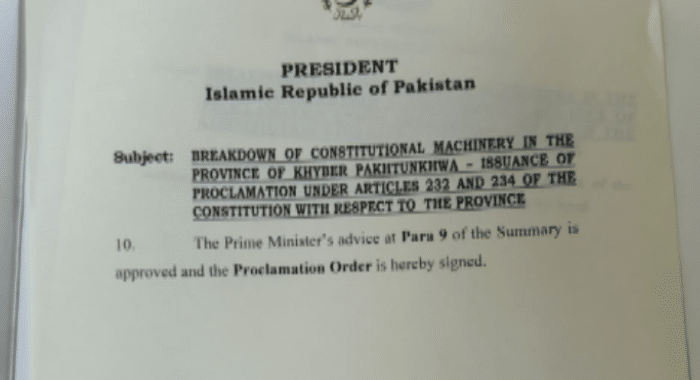
President of Pakistan Asif Ali Zardari has reportedly announced the imposition of an emergency in Khyber Pakhtunkhwa in response to the escalating threat of terrorism, the deteriorating law and order situation, and growing concerns over the protection of citizens’ lives and property. According to the information provided, the decision invokes constitutional provisions, including Articles 232(1) and 234(1) of the Constitution of Pakistan, with the stated objective of addressing the province’s deteriorating security environment and strengthening the state’s response to the prevailing challenges.
The reported decision represents a significant constitutional and administrative development at a time when Khyber Pakhtunkhwa continues to face serious security challenges, including terrorist attacks, assaults on security personnel, and threats to public infrastructure and essential state institutions.
Escalating Security Threats Prompt Constitutional Intervention
According to the reported presidential proclamation, the deteriorating security situation in Khyber Pakhtunkhwa has created serious risks for public safety, government installations, critical infrastructure, and law enforcement agencies. The reported increase in terrorist incidents has raised concerns about the state’s capacity to maintain public order and ensure the uninterrupted functioning of essential services.
The proclamation reportedly identifies the growing frequency of attacks and the inability to contain terrorism effectively as major factors necessitating immediate constitutional intervention. It also refers to concerns raised in a report by the Governor of Khyber Pakhtunkhwa regarding the functioning of the provincial constitutional and administrative system and the provincial government’s ability to discharge its responsibilities in accordance with the Constitution.
The reported intervention is intended to strengthen coordination between federal and provincial institutions, reinforce administrative capacity, and establish a more effective framework for responding to security threats.
Proposed Administrative and Constitutional Arrangements
Under the reported framework, the federal government would be empowered to direct the Governor of Khyber Pakhtunkhwa to assume responsibility for some or all provincial governmental functions, subject to the applicable constitutional provisions and legal requirements.
The Governor would perform the responsibilities assigned by the federal government, while the exercise of relevant provincial administrative powers would be governed by the directions issued under the proposed emergency arrangements.
The information provided further states that the exercise of the powers of the Khyber Pakhtunkhwa Assembly would be transferred to Parliament or exercised under its authority, as applicable under the relevant constitutional framework. It also indicates that the Chief Minister, provincial ministers, advisers, special assistants, and Advocate General would cease to hold their respective offices under the proposed arrangements.
These reported measures would constitute a major change in the province’s administrative structure. Their implementation, scope, and legal consequences would depend on the final terms of the official proclamation and the constitutional provisions applicable to the situation.
Possible Security Measures and Deployment of Armed Forces
The reported decision also refers to the possible use of Article 245 of the Constitution of Pakistan in connection with the deployment of the armed forces to support efforts to restore peace and maintain security.
Any such deployment would be subject to the relevant constitutional and legal requirements, the terms of the government’s decision, and the operational arrangements determined by the competent authorities.
The objective of enhanced security measures would be to strengthen the state’s capacity to respond to terrorist threats, protect vulnerable areas, secure critical installations, and support law enforcement agencies in maintaining public order.
Effective implementation would require close coordination among civilian authorities, law enforcement agencies, intelligence organisations, and security institutions. Clear responsibilities, timely information-sharing, and coordinated operational planning would be essential to ensure that security measures produce measurable improvements in public safety.
Khyber Pakhtunkhwa’s Continuing Struggle Against Terrorism
Khyber Pakhtunkhwa has endured years of insecurity, with terrorist violence affecting communities, public institutions, economic activity, and the daily lives of ordinary citizens.
Attacks in different parts of the province have resulted in the loss of civilian lives and the deaths of military personnel and other members of the security forces. Repeated incidents have also disrupted transportation, commercial activity, education, and access to essential services, particularly in areas exposed to persistent security threats.
The consequences extend beyond the immediate casualties of individual attacks. Prolonged insecurity places additional pressure on local administrations, discourages investment, disrupts livelihoods, and creates uncertainty for families, students, traders, and businesses.
For residents of affected districts, the restoration of peace is not simply a matter of security policy. It is a fundamental requirement for normal social and economic life, access to education and healthcare, and confidence in public institutions.
The reported emergency measures must therefore be assessed not only in terms of administrative changes or security operations, but also in terms of their ability to reduce violence, protect communities, and restore the conditions necessary for long-term stability.
Federal–Provincial Coordination and Political Responsibility
The deteriorating security situation has also intensified scrutiny of the provincial government’s approach to counterterrorism and the maintenance of law and order. The provincial government led by Pakistan Tehreek-e-Insaf has faced criticism over its security policies and its response to the continuing threat of militancy.
At the same time, addressing terrorism requires a coordinated national response that brings together federal and provincial governments, security institutions, law enforcement agencies, political parties, and local communities.
The reported federal intervention underscores the importance of institutional coordination and a clear division of responsibilities. Any administrative restructuring must be accompanied by effective policy implementation, operational accountability, and sustained efforts to address the underlying conditions that allow terrorist networks to operate.
Consultation among political stakeholders is particularly important during a period of significant constitutional change. Broad political engagement can help reduce institutional friction, strengthen public confidence, and establish a more unified national approach to counterterrorism.
According to the information provided, the reported decision followed consultation with relevant stakeholders and approval by the federal cabinet. The precise terms and legal basis of the decision should be established through the relevant official notifications.
Protection of Civilian Rights and Continuity of Essential Services
While restoring security remains an immediate priority, emergency arrangements must also account for the rights, welfare, and legitimate expectations of the people of Khyber Pakhtunkhwa.
Security operations should be conducted in accordance with the Constitution and applicable law, with appropriate safeguards for civilians and mechanisms for addressing complaints and protecting fundamental rights.
The continuity of education, healthcare, transportation, commercial activity, and other essential public services should remain a central consideration. In areas affected by violence or security operations, particular attention should be given to vulnerable communities, displaced families, and people whose livelihoods have been disrupted.
Transparent communication by the relevant authorities will also be essential. Citizens need timely and reliable information about security arrangements, administrative changes, public services, and any restrictions that may affect their daily lives.
Public confidence is strengthened when state institutions demonstrate not only the capacity to respond to security threats, but also a clear commitment to lawful governance, accountability, and the protection of citizens.
A Comprehensive Strategy for Lasting Peace
The restoration of sustainable peace in Khyber Pakhtunkhwa will require more than emergency administrative measures. Although enhanced security arrangements may be necessary to address immediate threats, long-term stability depends on a comprehensive strategy that combines effective counterterrorism operations with capable civilian administration, intelligence coordination, and community engagement.
Priority areas should include the protection of vulnerable districts, the disruption of terrorist networks and their support structures, improved coordination among security agencies, and the strengthening of law enforcement capabilities.
Equally important are the restoration of economic activity in affected areas, the protection of educational institutions, improved access to public services, and support for communities that have suffered repeated losses because of insecurity.
Sustainable peace also requires public trust. Local communities must be able to report threats safely, cooperate with lawful security efforts, and access responsive government institutions. The concerns of residents in affected districts should therefore inform both security planning and decisions about recovery and rehabilitation.
A successful response would be reflected in a measurable decline in terrorist incidents, fewer civilian casualties, improved security for public infrastructure, uninterrupted access to essential services, and the gradual restoration of normal economic and social activity.
Public Expectations and the Road Ahead
The people of Khyber Pakhtunkhwa have long sought an end to violence and a return to normal life. Their immediate expectations include greater protection from terrorist attacks, safer educational environments, secure business and transport routes, and the confidence that public institutions can respond effectively to threats.
The reported emergency measures have therefore placed renewed attention on the responsibilities of the federal government and all relevant institutions to deliver tangible improvements in security and governance.
The effectiveness of the reported decision will ultimately depend on the clarity of its legal foundation, the quality of its implementation, the coordination of the institutions involved, and its practical impact on the lives of ordinary citizens.
As the situation develops, sustained political engagement, institutional cooperation, respect for constitutional requirements, and transparent public communication will remain essential. The restoration of peace must be pursued alongside the protection of fundamental rights and the continuity of democratic and civilian institutions in accordance with the Constitution.
Conclusion
The reported announcement of emergency measures in Khyber Pakhtunkhwa marks a potentially significant development in the state’s response to escalating terrorism and persistent law and order challenges. It highlights the urgency of protecting citizens, strengthening institutional coordination, and developing an effective response to the security threats confronting the province.



