
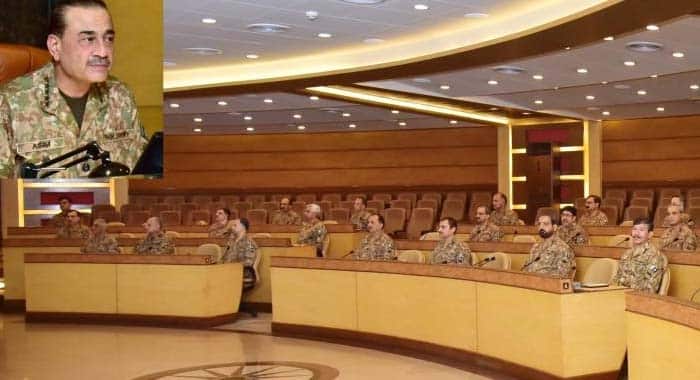
A high-level 276th Corps Commanders Conference chaired by Field Marshal Syed Asim Munir, NI (M), Hilal-e-Jurat, Chief of Army Staff and Chief of Defence Forces, reviewed the prevailing national security environment with a particular focus on cross-border terrorism, regional stability, and evolving hybrid threats.
The forum paid tribute to the sacrifices of Pakistan’s martyrs, stating that their unparalleled contributions continue to form the foundation of the country’s security, unity, and resilience. Fateha was also offered for the martyrs during the meeting.
A key focus of the meeting was the expression of serious concerns regarding the continued use of areas under the control of the Afghan Taliban administration for planning and facilitating attacks against Pakistan by India-backed terrorist groups. The forum noted that such activities pose a direct threat to regional peace and stability.
The participants emphasized that sustainable peace in the region is contingent upon preventing the use of Afghan soil by Indian proxies for terrorist activities against Pakistan. The responsibility, the forum noted, lies with the leadership of the Afghan Taliban to ensure that territories under their control are not exploited for cross-border terrorism.
The conference reaffirmed that Pakistan reserves the right to defend its citizens and territory against terrorism in accordance with its national security requirements. It was stated that Pakistan’s armed forces will continue intelligence-based operations targeting terrorist elements operating from across the border under ongoing operational frameworks.
The forum also underscored the need for improved governance structures in terrorism-affected regions, emphasizing that effective administrative systems must focus not only on public welfare but also on dismantling the nexus between terrorism and criminal networks.
It was further observed that, following setbacks in recent conflicts, hostile elements are increasingly relying on hybrid warfare tactics and disinformation campaigns to destabilize the security environment. The conference noted that such efforts, particularly those involving external facilitation, will be firmly countered.
The participants also highlighted Pakistan’s constructive role in promoting regional stability and reducing tensions, reiterating its commitment to peace while maintaining vigilance against security threats.
On water security, the forum took note of recent statements regarding the Indus Waters framework and reiterated that decisions taken by the National Security Committee on April 24, 2025, provide clear guidance on the matter. It was emphasized that Pakistan’s armed forces will take all necessary measures, in line with government directives and public expectations, to safeguard the country’s legitimate water rights.
The meeting also reiterated that Kashmir remains the core unresolved dispute in the region. It was emphasized that lasting peace in South Asia depends on ensuring the Kashmiri people’s right to self-determination in accordance with United Nations Security Council resolutions.
The conference directed all commanders to accelerate implementation of a multi-domain transformation plan in line with the evolving nature of warfare. It reaffirmed that safeguarding Pakistan’s sovereignty and national interests remains the foremost priority under all circumstances.
The meeting concluded with a renewed commitment to ensuring that Pakistan’s territorial integrity and national security are protected at all costs, while continuing efforts to counter terrorism and maintain regional stability.



