
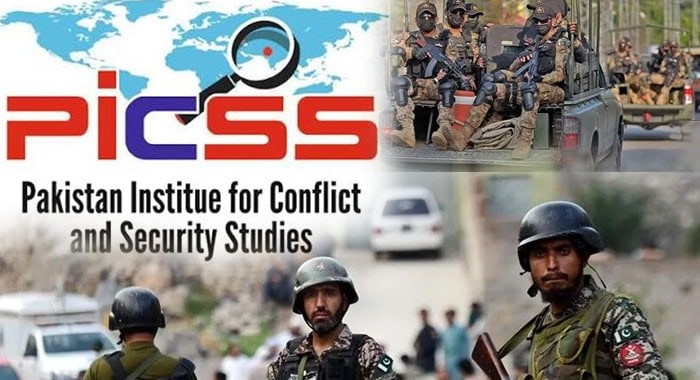
Pakistan witnessed a decline in overall anti-state violence and security-related incidents during June 2026 despite the occurrence of several high-profile attacks, according to a monthly security assessment released by the Pakistan Institute for Conflict and Security Studies (PICSS), an Islamabad-based independent think tank that monitors militancy, violence, and security trends across the country.
According to the PICSS report, a total of 262 fatalities were recorded during June 2026, while 134 individuals were injured in various incidents of violence across the country. The report indicates that the majority of fatalities were militants, with 184 militants killed in operations conducted by Pakistani security forces.
The report further states that, in addition to militant losses, 52 civilians and 26 personnel of security forces also lost their lives during the month. Among the injured, 63 civilians, 50 security forces personnel, 18 members of pro-government peace committees, and 3 militants sustained injuries in different incidents.
Despite the continued security challenges, PICSS highlighted a notable improvement in key indicators of violence when compared to May 2026. Fatalities among security forces decreased by 62 percent, while civilian deaths declined by 27 percent. Militant fatalities also registered a 32 percent reduction during the same period.
The report also recorded significant reductions in injuries across all categories. Injuries among security forces dropped by 43 percent, civilian injuries decreased by 57 percent, and militant injuries declined by 67 percent, reflecting a broader reduction in the intensity of violence during the month.
In addition, PICSS reported a 50 percent decline in kidnappings, with 27 cases recorded in June compared to 54 in May 2026. Pakistani security forces also intensified counterterrorism efforts during the month, resulting in the arrest of at least 27 suspected militants.
Operationally, the number of militant attacks across the country also showed a downward trend, falling from 128 attacks in May to 108 in June, marking a decrease of approximately 16 percent. However, the report noted that Pakistan continued to face high-impact incidents, including at least four suicide attacks, three of which were vehicle-borne, including a notable attack targeting Sindh Rangers in Karachi.
Regionally, the report observed mixed trends. Balochistan recorded a significant decline in violence, with 49 attacks in June compared to 71 in May, reflecting a 31 percent reduction. Similarly, the former tribal districts of Khyber Pakhtunkhwa witnessed a decline from 22 attacks in May to 17 in June, a decrease of 23 percent.
However, other areas of Khyber Pakhtunkhwa experienced a slight increase in violence, with 37 attacks in June compared to 32 in May, marking a 16 percent rise. Sindh also recorded an increase in militant activity, with four attacks reported in June compared to one in May 2026. Punjab reported a single attack during the month, while no militant incidents were recorded in Islamabad, Azad Jammu and Kashmir, or Gilgit-Baltistan.
The PICSS report further highlights that during the first six months of 2026, Pakistan experienced a total of 2,166 fatalities, including 1,442 militants, 404 civilians, 307 security forces personnel, and 13 members of pro-government peace committees.
Despite persistent security threats and the presence of high-impact attacks, the overall data suggests a measurable decline in violence indicators during June 2026, reflecting continued counterterrorism operations and evolving security dynamics across the country.



