
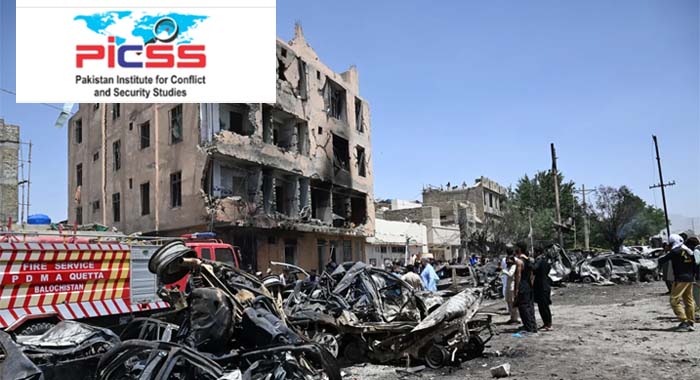
Pakistan witnessed a marked deterioration in its security environment during May 2026, as terrorist violence surged across key conflict-affected regions following two consecutive months of relative improvement, according to the latest monthly security assessment released by the Pakistan Institute for Conflict and Security Studies (PICSS).
The report highlights a significant reversal in the recent downward trend of violence, indicating that terrorist groups regained operational momentum during May, particularly in Khyber Pakhtunkhwa (KP) and Balochistan. The sharp increase in attacks, casualties, suicide bombings, and kidnappings underscores the continued and evolving threat posed by terrorist networks despite ongoing counterterrorism operations by state institutions.
According to PICSS data, Pakistan recorded 128 terrorist attacks during May, compared to 101 attacks in April, reflecting a 27 percent increase. This surge effectively reversed the improvement observed over the previous two months and reaffirmed the persistent security challenges facing conflict-affected regions.
The escalation in terrorist activity resulted in a significant rise in human casualties. During May, 71 civilians, 68 security forces personnel, and six members of peace committees were killed, while 147 civilians, 35 security forces personnel, and three peace committee members were injured.
Compared with April, civilian fatalities increased from 37 to 71, marking a 92 percent rise, while security forces fatalities surged from 28 to 68, representing a 143 percent increase.
One of the most alarming developments highlighted in the report was the sharp increase in suicide terrorism. Pakistan experienced six suicide attacks during May, including four vehicle-borne suicide attacks. These incidents alone resulted in the deaths of 34 security forces personnel and nine civilians.
In comparison, both March and April recorded only one suicide attack each, indicating a significant escalation in the use of suicide bombings by terrorist groups.
Balochistan emerged as the most affected province during the reporting period. The province recorded 71 terrorist attacks compared with 34 in April, reflecting a dramatic 109 percent increase.
The worsening security situation was further reflected in a surge in kidnappings. Of the 54 abductions reported nationwide during May, 52 occurred in Balochistan alone, highlighting the expanding operational reach and growing confidence of terrorist groups in the province.
Security analysts note that the rise in kidnappings, alongside conventional terrorist attacks, suggests an evolving threat landscape in which terrorist organizations are diversifying tactics to exert pressure, generate resources, and destabilize vulnerable regions.
Despite the escalation in violence, security forces intensified counterterrorism operations across the country. According to PICSS records, security forces killed 270 terrorists and arrested 15 others during targeted intelligence-based operations conducted throughout the month.
Of those killed, 128 were eliminated in the erstwhile Federally Administered Tribal Areas (FATA), 62 in mainland Khyber Pakhtunkhwa, 71 in Balochistan, and one in Punjab.
These figures reflect sustained operational pressure on terrorist networks; however, analysts caution that such groups continue to demonstrate the ability to carry out coordinated attacks, including high-casualty suicide operations, across multiple regions.
The broader security outlook for 2026 remains concerning. According to PICSS, the first five months of the year witnessed a total of 1,904 fatalities across Pakistan, including 1,258 terrorists, 352 civilians, and 281 security forces personnel.
During the same period, 1,003 individuals were injured, comprising 629 civilians, 231 security personnel, 133 terrorists, and 10 members of peace committees.
Security experts emphasize that while tactical gains against terrorist groups remain significant, the latest trends underscore the continued volatility of the security environment and the ability of terrorist organizations to adapt and reconstitute operational capabilities.
The findings highlight the need for sustained intelligence-driven operations, strengthened interagency coordination, and long-term counterterrorism strategies aimed at dismantling terrorist infrastructure and preventing the re-emergence of organized violence.
As Pakistan continues to confront evolving security challenges, analysts stress that durable stability will depend not only on kinetic operations but also on addressing underlying structural vulnerabilities that enable terrorist networks to persist and expand.
The PICSS report serves as a reminder that despite ongoing counterterrorism efforts, the threat of terrorism remains dynamic, persistent, and capable of rapid escalation.



