
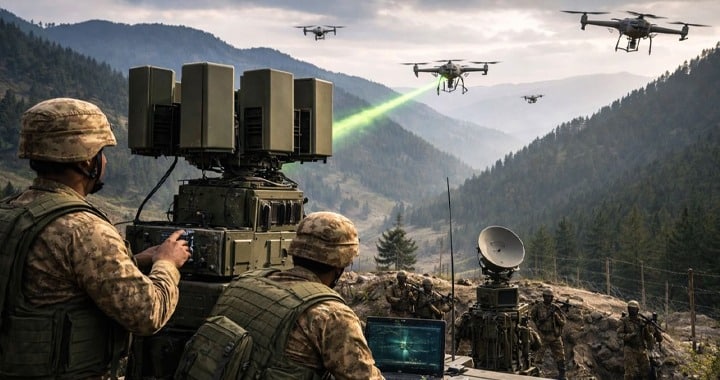
Terrorists are taking their fight to the skies, increasingly using drones to conduct surveillance, test security positions and explore new ways of striking Pakistan, and its citizens, civilians who are innocent, but at the same time, very soft targets as well. But the emerging aerial battlefield is producing a different result from what terrorist networks appear to have anticipated: Pakistan is detecting, tracking and neutralizing the threat before it can translate into operational advantage.
The challenge is not limited to drones operated by terrorists inside Pakistan. Recent drone incursions from Afghan territory have added a cross-border dimension to the threat, with Pakistan’s air-defence systems detecting and neutralizing hostile platforms before they could achieve their intended objectives. The downing of a drone near Shinko in Khyber in June, followed days later by the neutralization of four drones launched from Afghanistan into Balochistan, underscored the growing importance of the aerial domain in Pakistan’s counterterrorism and national-security response.
For years, terrorist attacks in Khyber Pakhtunkhwa and Balochistan were primarily associated with ambushes, improvised explosive devices, direct assaults and suicide attacks. That battlefield has changed.
Small commercial quadcopters have now emerged as another tool in the terrorist arsenal.
Their attraction to terrorist networks is obvious. They are relatively inexpensive, difficult to detect at a distance and capable of providing an aerial view of locations that would otherwise require terrorists to physically approach. A drone can observe a police position, track movement, identify routes and potentially deliver a small explosive payload while keeping its operator away from the immediate danger zone.
But the introduction of such technology has not given terrorists an uncontested advantage.
It has instead created another battlefield on which Pakistan’s security institutions are developing increasingly sophisticated methods of detection, disruption and neutralization.
The New Aerial Dimension
The significance of drones lies not merely in their ability to carry explosives.
Their greater strategic value to terrorist networks can be their eyes.
A terrorist group operating in a difficult mountainous district can use an aerial platform to observe roads, security posts and movement patterns. Information collected through such surveillance can then be combined with local knowledge and intelligence to plan an attack.
That makes the drone a force multiplier.
It also makes counter-drone capability an increasingly important component of modern counterterrorism.
A security post can be fortified against a ground assault, yet the same position can remain vulnerable if terrorists are able to observe it from above. A convoy can change its route, but surveillance can expose its movements. A hideout can remain concealed from ground patrols while becoming detectable through the broader intelligence picture created by aerial observation.
Pakistan’s response therefore cannot be limited to physically intercepting individual drones.
The wider objective is to deny terrorist networks the intelligence advantage that drone technology is designed to provide.
This is where the combination of intelligence and technology becomes decisive.
Bannu at the Centre of the New Battlefield
Bannu provides one of the clearest examples of why this transformation matters.
The district has remained under sustained terrorist pressure, with attacks and attempted attacks involving different methods. Terrorists have attempted direct assaults, used explosives and suicide vehicles, and increasingly experimented with aerial technology.
Yet the same environment has also witnessed increasingly proactive counterterrorism operations.
Suspicious explosive material near an educational institution was detected and safely neutralized before it could produce casualties. Intelligence-based operations have repeatedly located terrorist networks before they could consolidate their positions. Coordinated police and security operations have eliminated high-value terrorists and disrupted preparations for further attacks.
This is the essence of the new counterterrorism model.
The state does not have to wait for a drone attack to occur before responding to the drone threat.
It can identify terrorist movement, locate their support infrastructure, disrupt their preparations and eliminate the operators and facilitators responsible for developing these capabilities.
A drone in the sky is only one component of a terrorist operation.
Behind it are people, financing, logistics, communications, safe locations and intelligence networks.
Destroying that ecosystem is far more consequential than merely bringing down an aircraft.
Technology Cannot Replace Intelligence
The emergence of drone warfare also reinforces an old counterterrorism lesson: technology is most powerful when intelligence makes it meaningful.
A surveillance platform can detect movement. Intelligence can explain it.
An aerial system can identify a location. Human intelligence can establish who is operating there.
A counter-drone system can neutralize an airborne threat. Investigators can trace the network that acquired and deployed it.
This is why Pakistan’s intelligence-based operations remain central to the fight.
The terrorist threat is becoming technologically more sophisticated, but terrorist networks remain dependent on human beings.
Someone must obtain the equipment.
Someone must transport it.
Someone must operate it.
Someone must provide the location.
Someone must finance the operation.
Someone must collect information for the attack.
Every one of these links creates an opportunity for the state’s intelligence and law-enforcement architecture.
The objective is therefore not merely to defeat the technology.
It is to dismantle the network using it.
The Battlefield Has Expanded, Not Pakistan’s Vulnerability
There is an important distinction in assessing the emergence of drone attacks.
The fact that terrorists have adopted new technology should not be interpreted as evidence that they have acquired strategic superiority.
Terrorist organizations routinely change tactics when existing methods become increasingly difficult to execute.
When checkpoints become harder to penetrate, they seek alternative approaches.
When conventional movement becomes dangerous, they turn to remote surveillance.
When direct assaults become costly, they experiment with improvised technologies.
This is adaptation under pressure.
Pakistan’s counterterrorism institutions must respond accordingly, and they are.
The result is an increasingly multidimensional security architecture in which ground operations, intelligence gathering, aerial surveillance, explosive detection, counter-drone capabilities and rapid-response units operate as interconnected components.
The battlefield may have acquired a new dimension.
The state’s response has acquired one as well.
From Detection to Disruption
The most important shift is from responding to attacks toward preventing them.
A terrorist drone that is intercepted before reaching a target is a counterterrorism success.
A terrorist hideout identified before an attack is a counterterrorism success.
An explosive device discovered before detonation is a counterterrorism success.
A facilitator arrested or a terrorist eliminated before an operational network can mature is a counterterrorism success.
This approach changes how security performance should be measured.
The absence of casualties does not mean nothing happened.
Sometimes it means the security system worked precisely because something was detected and stopped before the public ever knew how close the danger had been.
That principle is particularly important in districts such as Bannu, where the terrorist threat is persistent and the security environment remains complex.
The Next Contest Is Over Intelligence
The drone threat ultimately points toward a broader reality.
The future of counterterrorism will not be determined solely by who possesses better weapons.
It will increasingly be determined by who possesses better information.
Terrorists may obtain commercial drones, encrypted communications, improvised explosives and other technologies. But technology alone does not create an effective terrorist network.
Intelligence does.
Pakistan therefore needs to continue integrating local intelligence, technical surveillance, forensic investigation, aerial monitoring and inter-agency information sharing into one coherent counterterrorism system.
The same model must extend across district boundaries.
A terrorist network operating in Bannu cannot be viewed separately from networks in Lakki Marwat, Tank, Dera Ismail Khan or the adjoining tribal districts. Information about movement, financing, recruitment and logistics must travel faster than the terrorists themselves.
This is particularly important because terrorist organizations seek to exploit administrative boundaries.
The state’s intelligence architecture cannot afford to operate within those same limitations.
Another Battlefield Terrorists Cannot Own
The emergence of weaponized drones demonstrates that terrorist networks are determined to exploit every available technological opening.
But it also demonstrates something else.
Pakistan’s counterterrorism campaign is no longer confined to traditional ground warfare.
The state is confronting terrorist networks across multiple domains simultaneously, from intelligence and surveillance to physical operations and technological countermeasures.
The terrorists may have taken their tactics into the skies.
They have not taken control of the skies.
They have merely opened another battlefield, one in which their movements, equipment, operators and networks can themselves be detected and targeted.
That is the central strategic reality.
The drone is a new tool in the terrorists’ hands, not a new advantage that Pakistan cannot overcome.
Pakistan’s task now is to ensure that every technological innovation adopted by terrorists is met with faster detection, stronger intelligence, better countermeasures and decisive action.
The objective remains unchanged: deny terrorist networks the freedom to observe, organize, infiltrate and strike.
They may have added the sky to their battlefield. Pakistan has added it to the counterterrorism hunt.
The drone threat does not give terrorists strategic superiority; it creates another domain in which Pakistan can integrate intelligence, surveillance and counter-drone operations to dismantle the networks behind each attack before they can turn aerial access into operational freedom.



