
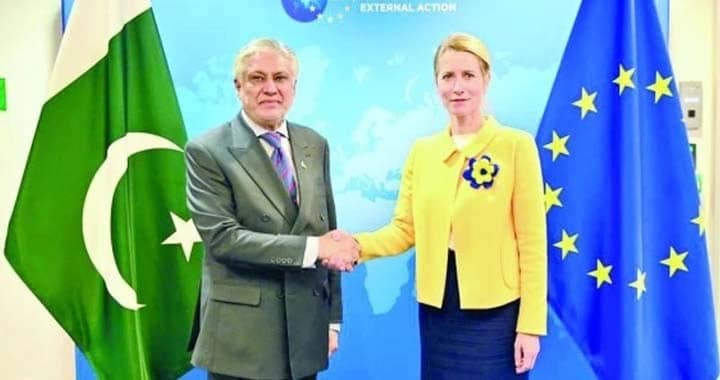
ISLAMABAD: The European Union’s top foreign policy official, Kaja Kallas, described Pakistan as a major regional power and a significant partner for the EU as both sides held the eighth EU-Pakistan Strategic Dialogue in Islamabad on Monday.
Kallas, who serves as Vice-President of the European Commission and EU High Representative for Foreign Affairs and Security Policy, visited Pakistan at the invitation of Deputy Prime Minister and Foreign Minister Ishaq Dar. The two leaders co-chaired the dialogue, the highest-level institutional platform between Pakistan and the European Union.
Addressing a joint press conference after the talks, Kallas said the dialogue reaffirmed the shared commitment of both sides to further strengthening bilateral relations at a time when regional and global dynamics were undergoing major changes.
Highlighting the economic dimension of the partnership, Kallas noted that the EU remained Pakistan’s largest export destination, exceeding the combined markets of the United States and China. She also pointed out that Pakistan continued to be the world’s largest beneficiary of the EU’s GSP+ trade scheme, which grants preferential market access to developing countries.
However, she emphasized that continued access to GSP+ benefits remains linked to progress in implementing international commitments related to governance, environmental standards, labour rights and human rights. The EU, she said, expected tangible progress from Pakistan in these areas.
Kallas noted that cooperation between Pakistan and the EU was expanding beyond trade into areas such as climate resilience, digital infrastructure, clean energy, migration management and educational exchanges. She praised Pakistan’s performance under the Erasmus Mundus scholarship programme, noting that Pakistani students had once again secured the highest number of scholarships globally for the fifth consecutive year.
The EU official also discussed major international developments during the dialogue, including the ongoing tensions between the United States and Iran. She acknowledged Pakistan’s diplomatic role in facilitating communication between the two sides and credited Islamabad’s efforts with helping avert wider escalation on multiple occasions.
According to Kallas, Europe values Pakistan’s mediation efforts and believes sustained diplomacy remains essential to preventing a broader regional conflict. While welcoming recent ceasefire initiatives and diplomatic openings, she stressed that long-term stability would require broader negotiations addressing Tehran’s nuclear programme and other outstanding issues.
She said the European Union was prepared to contribute to a lasting solution through diplomatic engagement, economic incentives and its longstanding relationships across the Gulf region.
On regional security, Kallas said instability linked to Afghanistan continued to pose challenges, warning that prolonged tensions risked aggravating humanitarian concerns and encouraging further radicalisation. At the same time, she reiterated that Pakistan had the right to defend itself and its citizens in accordance with international law.
Speaking alongside the visiting diplomat, Deputy Prime Minister Ishaq Dar described the visit as an important milestone in Pakistan-EU relations and evidence of growing momentum in bilateral engagement.
Dar noted that strategic contacts between Islamabad and Brussels had increased significantly over the past year, particularly during periods of regional crisis. He said both sides remained in close communication on developments ranging from South Asian security issues to the ongoing US-Iran tensions.
The foreign minister said discussions during the dialogue reviewed progress under the Strategic Engagement Plan covering trade, investment, development cooperation, human rights, migration, mobility, security and counterterrorism.
Describing the EU as one of Pakistan’s most important economic partners, Dar said bilateral trade had reached approximately €12 billion and termed cooperation under the GSP+ framework a mutually beneficial arrangement. He also welcomed efforts to deepen investment ties and praised the first Pakistan-EU Business Forum held earlier this year as a positive step toward expanding economic engagement.
Regional and international issues featured prominently in the discussions. Dar briefed the EU side on Pakistan’s position regarding the Jammu and Kashmir dispute, concerns over recent tensions with India, and developments related to the Indus Waters Treaty. He also highlighted Pakistan’s concerns regarding terrorist threats originating from Afghan territory, describing cross-border terrorism as a major security challenge.
Both sides reiterated support for multilateral diplomacy and the principles of the United Nations Charter, while expressing a shared desire to strengthen cooperation in addressing emerging global challenges.
Earlier, during opening remarks before the formal dialogue, Dar said Pakistan saw significant untapped potential in its relationship with the European Union and expressed hope that strategic consultations would continue on a more regular basis.
Kallas, for her part, stressed that the partnership between Pakistan and the EU was evolving beyond trade into a broader framework focused on stability, connectivity, sustainable development and regional cooperation.
The visit also included meetings with Pakistan’s senior civilian and military leadership as part of efforts to deepen political and strategic engagement between Islamabad and Brussels.
The European Union remains Pakistan’s second-largest trading partner and continues to provide preferential market access through the GSP+ scheme, which was extended until 2027. The programme grants developing countries reduced or zero tariffs on a large share of exports in return for compliance with international conventions related to human rights, labor standards, governance and environmental protection.
While European officials have acknowledged progress by Pakistan under the framework, they have also repeatedly stressed the need for further reforms and continued implementation of international commitments.



