
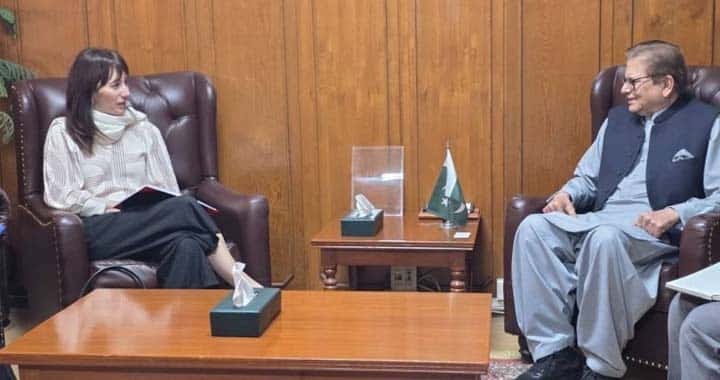
Senior officials Mohammad Sadiq and Gemma Huggins have held discussions on the presence of international militant groups in Afghanistan and the security risks these groups are reportedly posing to the region and the wider international community.
In a post shared on X on Tuesday, Mohammad Sadiq stated that both sides discussed reports regarding approximately 20 international militant groups allegedly operating inside Afghanistan. He noted that these groups are considered a significant security concern, with potential implications not only for neighboring countries but also for global peace and stability.
During the discussions, Sadiq also welcomed Australia’s recent decision to designate the Baloch Liberation Army as a terrorist organization, describing it as an important step in addressing transnational security threats.
The exchange comes amid heightened tensions between Pakistan and the Taliban authorities in Afghanistan, particularly over cross-border attacks and alleged militant activity. Pakistani officials have repeatedly expressed concerns that certain armed groups are using Afghan territory as a base to plan and execute attacks inside Pakistan.
Earlier this week, Pakistani political adviser Rana Sanaullah stated that more than 7,000 individuals identified as militants were allegedly being trained inside Afghanistan with external support, with the intent of carrying out attacks in Pakistan. He warned that Pakistan would continue actions targeting what it describes as militant hideouts across the border in response to ongoing security threats.
Pakistan’s Ministry of Foreign Affairs has also recently alleged that individuals involved in a deadly attack on a police facility in Bannu had links to networks operating from within Afghanistan. In response, Taliban spokesperson Zabihullah Mujahid rejected the allegations, stating that Afghan territory would not be allowed to be used against any country.
Meanwhile, the United Nations Security Council has, in multiple reports, raised concerns regarding the continued presence and operational capabilities of international militant organizations, including Al-Qaeda and the Islamic State Khorasan Province, in Afghanistan. UN experts have warned that Islamic State Khorasan Province continues recruitment activities across the region despite sustained counterterrorism pressure, raising concerns about potential cross-border attacks and broader regional instability.
The Taliban administration has consistently denied the presence of foreign militant groups operating from Afghan soil and maintains that it will not permit Afghan territory to be used for attacks against other countries.
The situation continues to underscore growing regional and international concerns regarding militant networks, cross-border security threats, and the need for coordinated counterterrorism efforts to ensure long-term stability in the region.



