
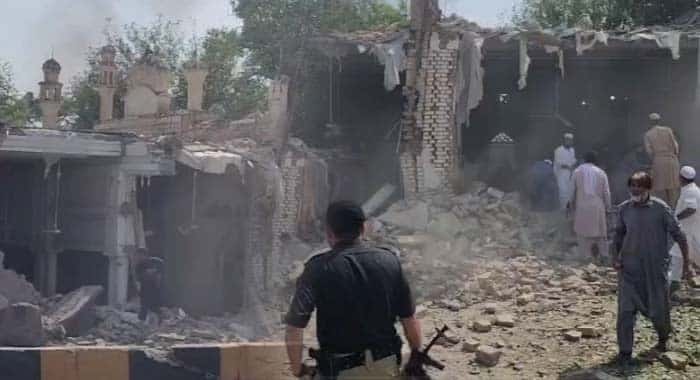
The terrorists who carried out the deadly attack on Kohat Police Lines remained in continuous contact with their handlers based in Afghanistan while they were holed up inside the police compound, according to security sources, adding another reported Afghan link to a major terrorist attack in Khyber Pakhtunkhwa.
The attackers first targeted a mosque inside the Police Lines with a suicide assault before entering the Special Branch building, where they engaged police and Counter Terrorism Department personnel in a prolonged gun battle. Security forces eventually cleared the compound and eliminated all the terrorists.
The reported contact between the attackers and their handlers in Afghanistan provides a significant indication of an external command-and-control dimension to the assault. It also raises renewed questions about the continued presence and operational freedom of Pakistan-focused terrorist networks on Afghan soil.
The development comes amid a series of recent incidents in which security forces have either intercepted terrorists attempting to cross from Afghanistan into Pakistan or identified Afghan nationals among terrorists operating inside the country.
In Kurram, security forces on Saturday foiled another attempted cross-border infiltration along the Pakistan-Afghanistan border, forcing the attackers to retreat toward Afghanistan. Security sources said the attempted infiltration was allegedly being facilitated from the Afghan side, with Afghan border positions reportedly assisting the infiltrators. Pakistani forces subsequently targeted those positions.
The Kurram incident followed several counterterrorism operations in the district. On September 8, security forces killed four terrorists and captured two others during an intelligence-based operation in Tatang village. One of those killed in a separate Kurram operation was subsequently identified as Afghan national Obaidullah Saad, a resident of Logar province, according to security reporting.
An even larger infiltration attempt was foiled earlier this month in North Waziristan. Security forces eliminated 27 terrorists attempting to cross into Pakistan through the Ghulam Khan border area from Afghanistan. Among those subsequently identified was Syed Ahmed Haroon, a resident of Afghanistan’s Paktia province, while other reporting has identified five of the 27 terrorists as Afghan nationals.
The North Waziristan episode followed another infiltration attempt in the same border sector in which security forces killed 15 terrorists attempting to enter Pakistan from Afghanistan. The military said the movement was detected along the border and the infiltrators were engaged in an operation lasting 36 hours.
Taken together, the attempted infiltrations, the identification of Afghan nationals among terrorists and now the reported communication between Kohat attackers and Afghanistan-based handlers form a recurring pattern that Pakistan has repeatedly raised with Kabul.
The issue also brings earlier Taliban commitments under renewed scrutiny. Under the February 2020 Doha Agreement, the Taliban committed to prevent individuals and groups from using Afghan soil to threaten the security of the United States and its allies, and to prevent terrorist groups from recruiting, training and fundraising there.
Pakistan has subsequently sought assurances specifically concerning attacks emanating from Afghan territory. Its Foreign Office said in October 2025 that talks in Doha and Istanbul were focused on stopping terrorist attacks from Afghan soil and establishing a verifiable mechanism to determine whether Kabul was taking concrete action against them.
There is also a particularly notable contradiction between the Taliban’s stated religious position and the continuing reports of attacks against Pakistan. In 2023, Taliban Defence Minister Mohammad Yaqoob Mujahid said Supreme Leader Hibatullah Akhundzada had warned that fighting outside Afghanistan was not religiously sanctioned jihad but “war,” which the emir had prohibited. In May 2025, Taliban commander Saeedullah Saeed similarly said fighting in Pakistan was impermissible and that permission for jihad rested with the emir.
Against that backdrop, the reported presence of Afghanistan-based handlers on communications with attackers during the Kohat assault raises a straightforward question: if the Taliban leadership has repeatedly declared cross-border fighting against Pakistan impermissible, how are Afghanistan-based handlers continuing to direct or communicate with terrorists attacking Pakistan?
The question extends beyond individual attackers to the effectiveness of the Taliban authorities’ control over terrorist networks operating from Afghan territory. It also puts renewed focus on whether previous assurances and commitments are translating into verifiable action on the ground.
Afghan authorities have repeatedly rejected Pakistani accusations that they permit their territory to be used for attacks against Pakistan. The competing claims make independent verification and concrete evidence particularly important in assessing the reported links.
The Kohat attack therefore adds another layer to an already contentious security relationship: terrorists operating inside Pakistan, reported handlers communicating from Afghanistan, repeated attempted infiltrations across the border and Afghan nationals identified among those involved in terrorist activity.



